This article is written by Shylet Nyamupinga, MVN University. This article examines the evolving landscape of AI regulation in India, focusing on legal accountability, privacy concerns, innovation opportunities, and relevant judicial developments.
Artificial Intelligence (AI) is no longer a futuristic concept confined to science fiction. It has become an integral part of everyday life, influencing sectors such as healthcare, education, finance, governance, transportation, and law enforcement. From virtual assistants and recommendation algorithms to generative AI tools like ChatGPT and autonomous systems, AI is transforming how individuals, businesses, and governments operate.
India, one of the fastest-growing digital economies in the world, has embraced AI as a key driver of innovation and economic growth. Government initiatives, startup ecosystems, and private sector investments have accelerated the adoption of AI technologies. According to various industry reports, AI is expected to contribute significantly to India’s GDP over the coming years, creating new opportunities for economic development and technological advancement.
However, the rapid deployment of AI also raises critical legal and ethical concerns. Questions surrounding accountability, privacy, transparency, algorithmic bias, misinformation, intellectual property rights, and consumer protection have become increasingly important. As AI systems become more sophisticated and autonomous, determining liability for AI-generated decisions and actions becomes a complex legal challenge.
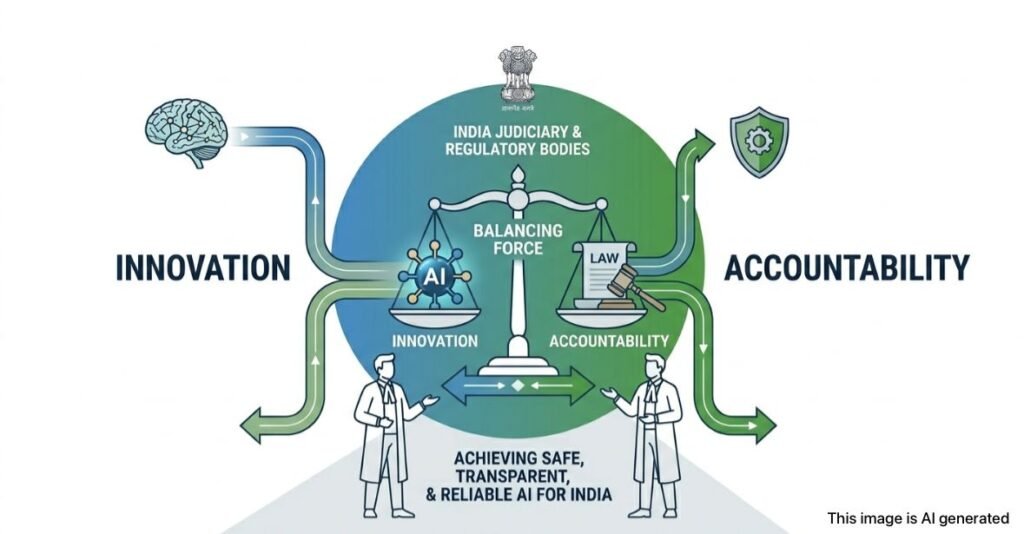
India currently does not have a dedicated AI legislation. Instead, AI governance is addressed through a combination of existing laws, policy frameworks, and emerging regulatory initiatives. The challenge lies in striking a balance between fostering innovation and ensuring adequate safeguards to protect fundamental rights and public interests.
The Current Regulatory Landscape of AI in India
Unlike some jurisdictions that are moving toward comprehensive AI-specific regulations, India has adopted a relatively flexible and innovation-friendly approach. The government has emphasized the importance of responsible AI while avoiding overly restrictive regulations that may hinder technological growth.
One of the most significant developments is the enactment of the Digital Personal Data Protection Act, 2023 (DPDP Act). While the legislation is not specifically designed for AI, it directly impacts AI systems that process personal data. The Act establishes obligations for data fiduciaries, introduces consent requirements, and grants individuals greater control over their personal information.
Additionally, the Ministry of Electronics and Information Technology (MeitY) has released various policy papers and guidelines emphasizing ethical AI principles, including transparency, fairness, accountability, and privacy protection.
India’s AI governance framework currently relies on:
- The Digital Personal Data Protection Act, 2023
- The Information Technology Act, 2000
- Consumer protection laws
- Intellectual property laws
- Sector-specific regulations
- Emerging government guidelines on responsible AI
This approach reflects India’s attempt to encourage innovation while gradually developing a comprehensive regulatory framework.
India has also witnessed evolving regulatory guidance through advisories issued by the Ministry of Electronics and Information Technology (MeitY), particularly concerning generative AI platforms, intermediary due diligence, and responsible deployment of emerging technologies. These developments indicate a gradual shift towards more structured AI governance without introducing a standalone AI statute.
Legal Accountability in AI Systems
One of the most challenging aspects of AI regulation concerns legal accountability. Traditional legal systems are built around human decision-makers. AI systems, however, can operate autonomously, making decisions without direct human intervention.
Consider a situation where an AI-powered healthcare system misdiagnoses a patient, or an autonomous vehicle causes an accident. Determining responsibility becomes difficult. Should liability fall on the developer, the manufacturer, the operator, the organization deploying the AI system, or another party?
Under current Indian law, AI itself cannot be held legally responsible because it lacks legal personality. Consequently, liability generally falls upon the individuals or entities involved in developing, deploying, or managing the technology.
Another emerging concern relates to intellectual property rights. Questions have arisen regarding the ownership of AI-generated content, the use of copyrighted material for training AI models, and potential infringement claims arising from AI-generated outputs. Indian law has not yet developed a comprehensive framework to address these issues.
Several accountability challenges arise:
Algorithmic Bias
AI systems learn from data. If the training data contains biases, the resulting decisions may discriminate against certain groups. This could lead to unfair hiring practices, biased lending decisions, or discriminatory public service delivery.
Lack of Transparency
Many AI systems function as “black boxes,” making it difficult to understand how decisions are reached. This lack of explainability creates challenges for courts, regulators, and affected individuals seeking remedies.
Product Liability Concerns
Manufacturers and developers may face liability when AI systems malfunction or produce harmful outcomes. Existing consumer protection and tort law principles may apply, but specific AI-related standards remain underdeveloped.
Corporate Responsibility
Organizations deploying AI systems must ensure adequate oversight, risk assessments, and compliance mechanisms. Failure to implement reasonable safeguards may expose businesses to legal consequences.
Privacy Challenges in the AI Era
Privacy has emerged as one of the most significant legal concerns associated with AI technologies. AI systems rely heavily on data collection, analysis, and processing. The larger the dataset, the more effective the AI system often becomes.
However, extensive data collection can threaten individual privacy rights.
AI technologies can process:
- Personal information
- Biometric data
- Behavioral patterns
- Financial records
- Location data
- Online activities
The widespread use of facial recognition systems, predictive analytics, and surveillance technologies has intensified debates surrounding privacy protection.
The DPDP Act seeks to address some of these concerns by introducing requirements related to consent, purpose limitation, and data security. Nevertheless, challenges remain regarding the practical implementation of these protections in AI-driven environments.
Privacy concerns become particularly serious when AI systems:
- Collect data without informed consent.
- Retain information longer than necessary.
- Generate detailed behavioral profiles.
- Facilitate mass surveillance.
- Enable unauthorized data sharing.
Balancing technological advancement with privacy protection remains one of the defining regulatory challenges of the digital age.
Innovation and Economic Growth
While regulatory concerns are important, excessive regulation may stifle innovation. AI has the potential to revolutionize multiple sectors and significantly contribute to India’s economic development.
Healthcare
AI can improve diagnostics, disease prediction, medical imaging, and patient care management.
Agriculture
Farmers can use AI-powered tools for crop monitoring, weather forecasting, and resource optimization.
Education
Personalized learning platforms can enhance educational outcomes and improve accessibility.
Financial Services
AI supports fraud detection, risk assessment, customer service automation, and financial inclusion initiatives.
Governance
Government agencies can leverage AI to improve service delivery, public administration, and policymaking.
India’s growing startup ecosystem has positioned the country as a significant player in AI innovation. Regulatory frameworks must therefore encourage responsible innovation rather than create barriers to technological development.
A balanced approach should include:
- Risk-based regulation
- Ethical AI standards
- Regulatory sandboxes
- Industry self-governance mechanisms
- Transparency requirements
- Strong privacy protections
Such measures can promote innovation while minimizing societal risks.
Case Laws
Justice K.S. Puttaswamy (Retd.) v. Union of India (2017)
This landmark judgment by the Supreme Court of India recognized the right to privacy as a fundamental right under Article 21 of the Constitution.
Although the case was not directly related to AI, it has profound implications for AI governance. The decision established constitutional protections against intrusive data collection and surveillance practices. Any AI system that processes personal data must operate in a manner consistent with the privacy principles recognized in this judgment.
Anuradha Bhasin v. Union of India (2020)
The Supreme Court emphasized the importance of balancing state interests with constitutional freedoms in the digital age. The judgment reinforced principles of proportionality and accountability in governmental decision-making.
These principles are increasingly relevant when AI technologies are deployed for surveillance, public administration, or law enforcement purposes.
Internet and Mobile Association of India v. Reserve Bank of India (2020)
Although centered on cryptocurrency regulation, this case demonstrated the judiciary’s willingness to scrutinize technology-related restrictions using proportionality standards.
The judgment highlights the importance of evidence-based regulation and serves as a useful reference point for future AI-related regulatory measures.
Deepfakes and Emerging Litigation
IThe rise of AI-generated deepfakes presents one of the most significant regulatory challenges facing India. Deepfakes can be used to create fabricated videos, audio recordings, and images that closely resemble real individuals, creating risks of misinformation, identity theft, reputational harm, election manipulation, and cyber harassment. While existing provisions under the Information Technology Act, Bharatiya Nyaya Sanhita, and intermediary regulations may provide partial remedies, India currently lacks a dedicated statutory framework specifically addressing AI-generated synthetic media. Future judicial and legislative developments in this area are likely to play a crucial role in shaping AI governance.
Conclusion
Artificial Intelligence is reshaping the social, economic, and legal landscape of India. Its transformative potential offers unprecedented opportunities for innovation, efficiency, and economic growth. However, these benefits are accompanied by complex challenges involving privacy, accountability, transparency, and ethical governance.
India’s current regulatory approach seeks to strike a delicate balance between encouraging innovation and protecting individual rights. The Digital Personal Data Protection Act, judicial precedents, and emerging policy frameworks provide an important foundation, but dedicated AI governance mechanisms may become necessary as technology continues to evolve.
The challenge is no longer whether AI should be regulated, but how regulation can remain flexible enough to accommodate rapid technological change while ensuring accountability and protection of fundamental rights.
The future of AI regulation in India should focus on responsible innovation, robust privacy safeguards, transparent decision-making, and clear accountability structures. By adopting a balanced and forward-looking regulatory framework, India can harness the benefits of AI while ensuring that technological progress remains aligned with constitutional values and public interest.
Frequently Asked Questions
1. Does India currently have a dedicated AI law?
No. India does not yet have a comprehensive AI-specific legislation. AI is presently regulated through existing laws, policy frameworks, and sector-specific regulations.
2. Why is legal accountability important in AI systems?
AI systems can make autonomous decisions that impact individuals and organisations. Legal accountability ensures that responsibility can be assigned when harm occurs.
3. How does the Digital Personal Data Protection Act affect AI?
The DPDP Act regulates the collection and processing of personal data, requiring organizations using AI to comply with consent and privacy obligations.
4. What is algorithmic bias?
Algorithmic bias occurs when AI systems produce unfair or discriminatory outcomes due to biased training data or flawed design.
5. What are the biggest AI regulatory challenges in India?
Major challenges include privacy protection, transparency, accountability, deepfake regulation, algorithmic fairness, and balancing innovation with public safety.