
This article is written by Rudrapratapsingh Ratola of ILC, Faculty of Law, University of Delhi. This article examines how the increasing, though still limited, representation of women in India’s legal and legislative institutions has influenced the development of the new criminal codes, highlighting both the progress achieved and the areas where significant gaps remain.
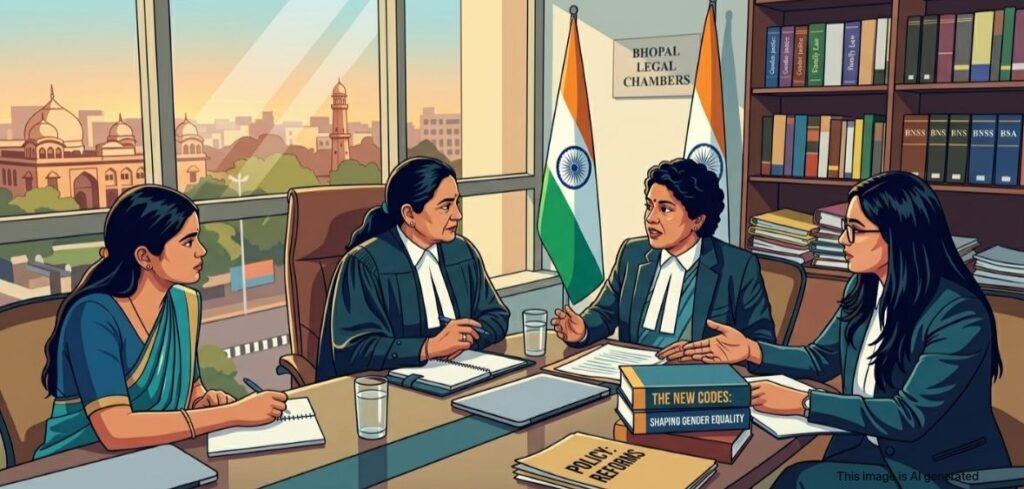
On 1st July, 2024, three new criminal laws were enacted to replace colonial-era laws that had been in force for more than a century. This Bharatiya Nyaya Sanhita, 2023, superseded the Indian Penal Code, 1860. The Code of Criminal Procedure, 1973 (CrPC) was replaced by the Bharatiya Nagarik Suraksha Sanhita, 2023. The Indian Evidence Act, 1872, was replaced by the Bharatiya Sakshya Adhiniyam, 2023. These changes were made by the government under the guise of ‘decolonisation of Indian law.’ But critics were posing a tougher challenge: Did the new codes account for the gender gap that their predecessors failed to address? The answer to that question can only be obtained by asking, “How many women were in the rooms where these laws were written?
Women account for about half of the total population, but in every institution that formulates the law in India, women are in the minority. This underrepresentation is not something to take lightly. The law does not speak without bias, but it reflects the values and priorities of those who create it. Where women are not involved in the drafting process, their experiences of violence, discrimination and injustice often are regarded as the exception rather than the norm.
Keywords: Women’s Representation, Bharatiya Nyaya Sanhita, Gender Justice, New Criminal Codes, Legal Reform
Women In Indian Legal Institutions: A Brief Overview
Historically, India’s legal institutions have been overwhelmingly male-dominated. Regina Guha’s attempt to enroll as a legal practitioner in 1916 became one of the earliest challenges to the exclusion of women from the legal profession, and the Legal Practitioners (Women) Act, 1923, eventually removed formal barriers preventing women from entering legal practice. Despite significant progress since then, women remain underrepresented across legal institutions. Women are estimated to constitute only a small proportion of advocates enrolled with Bar Councils in India and around 14 per cent of judges across the judiciary. Representation remains limited even at the highest levels of the legal system, including the Supreme Court of India. In Parliament, women constitute approximately 14 per cent of the Lok Sabha, highlighting the continuing gender gap in legislative decision-making and law reform.
Women did serve on the Parliamentary Standing Committee on Home Affairs that reviewed the Bills which subsequently became the three new codes. They played a role in raising the profile of gender-sensitive provisions on the legislative agenda during the public consultation stage, as did advocacy by women’s rights organisations. The process was flawed, but there were voices of women in the finished texts, albeit small, that made their mark.
Gender-Sensitive Provisions in the New Codes
The Bharatiya Nyaya Sanhita, 2023, includes some provisions in its favour which are more gender-sensitive than the IPC it replaced. Section 63 continues and reinforces the rape offence, while the new definition of sexual assault has been read in conjunction with the demands of advocacy, which have mostly come from the women’s movement and women lawyers in the years following the Nirbhaya case in 2012. One of the key new provisions is the introduction of Section 69 of the Act, which makes it illegal to be a man who has sexual intercourse with a woman after falsely promising her marriage, employment, or promotion, or concealing his identity. The addition reflects a long-standing issue of women’s rights activists and women judges that it had been observed that women’s rights were not covered by the existing law.
It is important to note that Section 69 has also generated significant legal debate. Supporters argue that the provision protects women from exploitation through deliberate deception, particularly in situations where consent is obtained through false promises. However, critics contend that the provision may blur the distinction between a failed relationship and criminal conduct. The interpretation of what constitutes a “false promise” is likely to be shaped by future judicial decisions, making this one of the most closely watched provisions of the new criminal code.
Section 85 and 86 of the Bharatiya Nyaya Sanhita provide for the offence of cruelty by the husband or his relatives, continuing and extending the protection provided earlier under Indian Penal Code Section 498A. Women advocates had been consistently saying that the existing provision was being used in a weaponised manner with the counter-allegations brought against the complainants and the new code tries to balance it more carefully.
While the core offence remains largely similar to the former Section 498A of the IPC, the continued inclusion of these provisions demonstrates Parliament’s recognition that domestic violence and cruelty within marriage remain serious social concerns. The retention of these protections reflects sustained advocacy by women’s rights groups, which have consistently emphasised the need for legal safeguards against physical, emotional, and economic abuse within the household.
The Bharatiya Nagarik Suraksha Sanhita, 2023, introduces several procedural safeguards aimed at protecting women during the criminal justice process, many of which have long been demanded by women’s rights activists and legal reform advocates. The BNSS strengthens protections for victims of sexual offences by requiring statements and examinations to be conducted in a manner that promotes dignity, privacy, and convenience. Section 43 also continues the principle that women should ordinarily not be arrested after sunset and before sunrise except in exceptional circumstances and in accordance with the prescribed procedure. These are not merely technical safeguards; they reflect a long-standing concern raised by women in the legal profession that the process of investigation itself should not become a source of further trauma or re-victimisation.
The Bharatiya Sakshya Adhiniyam, 2023 introduces impactful amendments to the realm of electronic evidence, with significant implications for matters involving cybercrimes against women, such as online harassment and the sharing of non-consensual images. These are crimes against women and for which the prosecution was hindered by the ambiguity of the old Indian Evidence Act.
The Limits of Representation: What The New Codes Still Miss
While these codes have a great deal to be commended, the new codes also reflect what limited representation can do. In spite of decades of women’s rights groups, women lawyers and women judges seeking to have marital rape criminalised, the offence is not yet part of the law in India. The Law Commission of India, along with several High Courts, has taken up the issue and Parliament has yet to respond. The drafting of the new codes was an opportunity to fill this gap. It was not taken.
Similarly, the new codes largely replicate the framework for addressing sexual harassment in public spaces without meaningful expansion. Provisions relating to trafficking of women, while present, do not go as far as advocates had hoped in addressing the structural conditions, including poverty and caste discrimination, that make women vulnerable. The absence of these provisions is not accidental; it reflects the fact that the women who are most affected by these gaps are also the women least represented in Parliament and in legal drafting bodies.
There is also a structural problem that no individual provision can solve. Representation matters not only at the drafting stage but at the implementation stage. A law that protects women on paper but is enforced by a police force that is nearly 90% male and interpreted by a judiciary that is 86% male will not deliver the justice it promises. Women’s representation in law must mean representation in enforcement and adjudication as well as in drafting.
Case Laws
Vishaka v. State of Rajasthan (1997)
A landmark development in gender justice was the decision in Vishaka v. State of Rajasthan (1997), where the Supreme Court laid down the Vishaka Guidelines to prevent sexual harassment at the workplace. The judgment highlighted the importance of incorporating women’s experiences into legal frameworks and remains a significant example of how legal institutions can respond to gender-specific concerns.
Mukesh & Anr. v. State (NCT of Delhi) (2017) – Nirbhaya Case
The impact of women’s advocacy on criminal law reform became particularly visible after the Nirbhaya case (Mukesh & Anr. v. State (NCT of Delhi), 2017), which led to widespread demands for stronger protections against sexual violence. The subsequent Justice Verma Committee Report influenced several gender-sensitive reforms that continue to shape India’s criminal justice framework.
Conclusion
The new criminal codes of India are, in certain respects, more gender-sensitive than the laws they replaced. That is a genuine achievement, and it is not unrelated to the growing presence of women in Parliament, in the legal profession, and in advocacy organisations that engage with the legislative process. But genuine achievement is not the same as adequacy. The absence of provisions on marital rape, the slow pace of progress on trafficking, and the persistent underrepresentation of women in enforcement and adjudication institutions mean that the transformative potential of the new codes remains substantially unrealised.
The relationship between women’s representation in law and the quality of legal protection for women is not a simple one-to-one correspondence. Laws are shaped by politics, by ideology, and by the relative power of competing interests. But representation matters. The provisions that have been included in the new codes reflect, at least in part, the arguments made by women in the institutions that shaped them. The provisions that are missing reflect, at least in part, the arguments that were not heard loudly enough. Increasing women’s representation in every institution that makes, interprets, and enforces the law is not a matter of symbolic fairness alone. It is a condition for a legal system that works for everyone it is meant to serve.
References
Bar Council of India – Statistics on Women Advocates: https://www.barcouncilofindia.org
Report of Parliamentary Standing Committee on Home Affairs on the Three New Criminal Bills, 2023: https://sansad.in/ls/committees/standing-committees/home-affairs
National Crime Records Bureau – Crime in India Report 2022: https://ncrb.gov.in/sites/default/files/crime_in_india_table_additional_table_2022.pdf
Supreme Court of India – Composition of Judiciary: https://www.supremecourtofindia.nic.in
Justice J.S. Verma Committee Report, 2013 – Amendments to Criminal Law: https://www.prsindia.org/uploads/media/Justice%20verma%20committee/js%20verma%20committe%20report.pdf
Inter-Parliamentary Union – Women in Parliament: Global and Regional Averages: https://www.ipu.org/women-in-parliament
Ministry of Women and Child Development – Status of Women in India: https://wcd.nic.in