This article is written by Ayushman Anand, Vivekananda Institute of Professional Studies- Technical Campus (VIPS-TC). This article traces that judicial journey, examines the key decisions shaping how social media evidence is treated today, and flags the questions that remain unresolved.
Keywords: Social Media Evidence, Digital Evidence, Indian Evidence Act, Cyber Jurisprudence, Electronic Records
Think about how often people document their lives online. Every argument, every outing, every opinion posted, shared, screenshotted, stored on servers that never forget. What was once a private moment now has a digital trail, and increasingly, that trail leads into courtrooms.
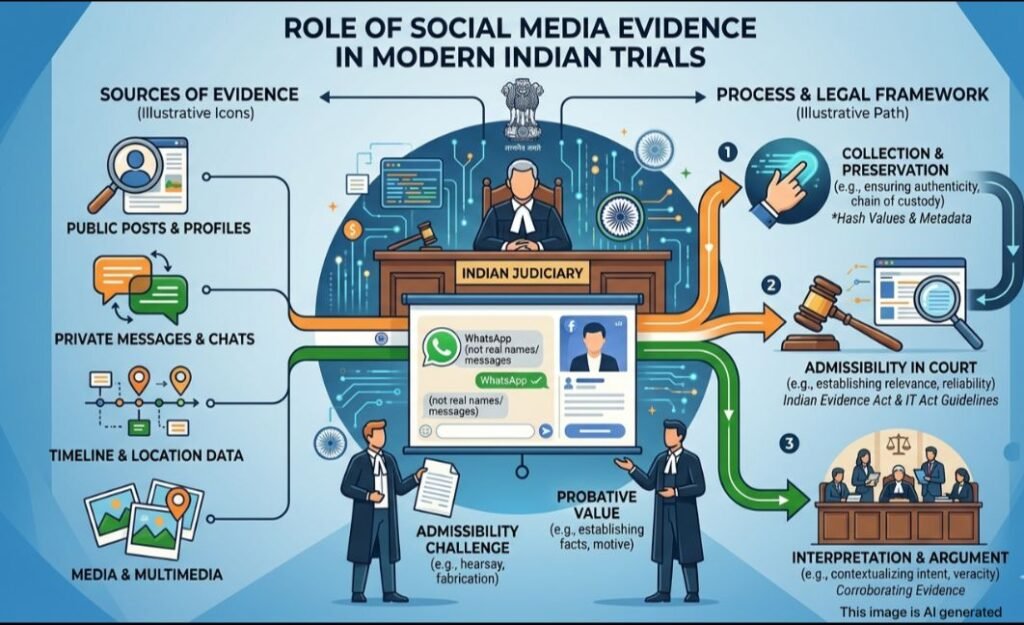
Social media platforms like Facebook, WhatsApp, Instagram and X have become unexpected reservoirs of evidence in Indian litigation. Murder cases are cracked open through location check-ins. Defamation suits turn entirely on deleted tweets that someone screenshotted just in time. Matrimonial disputes rely on WhatsApp conversations printed and placed before family court judges. The volume of such evidence entering Indian trials has grown sharply, and courts are still working out exactly how to handle it.
Historically, the Indian Evidence Act, 1872, read with the Information Technology Act, 2000, provided the framework governing electronic evidence. Since 1 July 2024, the Bharatiya Sakshya Adhiniyam, 2023 has replaced the Evidence Act while largely retaining the principles governing electronic records. But the framework is imperfect, and the courts have had to do considerable work through case law to fill the gaps.
The Legal Position On Electronic Evidence
Under Section 2(1)(t) of the Information Technology Act, 2000, social media content posts, messages, metadata, activity logs qualifies as an “electronic record.” That classification matters because it determines which Evidence Act provisions apply.
Sections 65A and 65B of the Indian Evidence Act govern electronic records produced as secondary evidence. Section 65B sets out specific technical conditions: the record must have come from a properly functioning computer, used in ordinary activity, with output that accurately reflects what was stored. Most critically, Section 65B(4) requires a certificate from a responsible person confirming these conditions. Without that certificate, the content is generally inadmissible regardless of how genuine it looks. The Bharatiya Sakshya Adhiniyam, 2023, which now replaces the Evidence Act, preserves this framework in substantially similar terms.
Under the Bharatiya Sakshya Adhiniyam, 2023, electronic and digital records continue to receive statutory recognition, ensuring that social media communications, digital messages, screenshots, and online activity logs remain admissible subject to authenticity and certification requirements.
Case Laws
Anvar P.V. v. P.K. Basheer, (2014) 10 SCC 473
This is the foundational case. It arose from a Kerala election dispute where the losing candidate relied on CDs as evidence of corrupt practices without a Section 65B certificate. A three-judge bench of the Supreme Court, comprising Chief Justice R.M. Lodha, Justice Kurian Joseph and Justice Rohinton Fali Nariman, held that electronic records produced as secondary evidence are inadmissible without the certificate. The court overruled State (NCT of Delhi) v. Navjot Sandhu, which had previously allowed oral evidence to fill the gap. After Anvar, there is no shortcut: no certificate, no admissibility.
Arjun Panditrao Khotkar v. Kailash Kushanrao Gorantyal, (2020) 7 SCC 1
After Anvar, a two-judge bench in Shafhi Mohammad (below) suggested the certificate could be dispensed with in certain situations. This created confusion in lower courts. A three-judge bench comprising Justice R.F. Nariman, Justice S. Ravindra Bhat, and Justice V. Ramasubramanian had to step in and settle the question in 2020. The bench confirmed the Section 65B(4) certificate is mandatory and not a procedural formality that courts can overlook. Shafhi Mohammad was declared per incuriam and overruled. One relief granted: if a party cannot obtain the certificate because the opposing party is obstructing access, the court may order that it be furnished at a later stage.
Dharambir v. Central Bureau of Investigation, 148 (2008) DLT 289
A Delhi High Court decision that established important groundwork. The CBI had stored intercepted telephone conversations on hard disks, and the accused sought copies before trial. Justice S. Muralidhar first resolved a threshold question: what is a hard disk, legally? The court held it is an “electronic record” under the IT Act and therefore a “document” under Section 3 of the Evidence Act. Further, where a proper Section 65B certificate has been issued by a competent authority as the Andhra Pradesh Forensic Science Laboratory had done here the certified output is admissible without producing the original device. The case clarified how digital storage media fit within existing evidentiary categories.
Shafhi Mohammad v. State of Himachal Pradesh, (2018) 2 SCC 801
A two-judge bench held that the Section 65B certificate requirement is procedural and can be relaxed when a party is unable to obtain it because the device is not in their possession. The decision was controversial and caused courts across India to take inconsistent positions for roughly two years. It was eventually declared per incuriam by the bench in Arjun Panditrao Khotkar and overruled. Its main legacy today is as an example of how ambiguity in a developing area of law can spread quickly once a higher court signals it.
Sonu @ Amar v. State of Haryana, (2017) 8 SCC 570
Often cited but frequently misread. In a murder trial, Call Detail Records were produced as evidence without a Section 65B certificate, and the defence said nothing at trial. On appeal, counsel tried to argue the CDRs should never have been admitted. A bench of Justice S.A. Bobde and Justice L. Nageswara Rao refused. An objection about the mode or method of proving electronic evidence as opposed to challenging its admissibility as a category cannot be raised for the first time on appeal. Silence at trial is a waiver. The case is therefore about procedural discipline as much as anything else: if you don’t challenge electronic evidence when tendered, you may lose the right to do so entirely.
K.S. Puttaswamy v. Union of India, (2017) 10 SCC 1
A nine-judge bench of the Supreme Court unanimously held that privacy is a fundamental right under Articles 14, 19 and 21 of the Constitution. Its immediate context was the Aadhaar scheme, but the ruling has a direct bearing on social media evidence. Evidence gathered by hacking into someone’s account, accessing private messages without consent, or conducting digital surveillance without lawful authority potentially infringes a constitutional right. Indian courts have yet to develop a consistent doctrine on whether such evidence should be excluded but the question is live, and Puttaswamy gives plaintiffs and accused persons a constitutional hook on which to hang the argument.
Social media evidence presents unique evidentiary concerns because content can be edited, deleted, reposted, impersonated, or generated through fake accounts. Courts must therefore evaluate not only the content itself but also surrounding metadata, account ownership, timestamps, and the circumstances in which the evidence was collected.
Conclusion
Social media evidence has become routine in Indian courts and the legal system is still catching up with that reality. The decisions discussed here represent the Supreme Court’s serious effort to bring order to a chaotic landscape: mandatory certification, strict waiver rules, and constitutional guardrails around the manner in which evidence is obtained.
The gaps, though, are real. Screenshots are easy to fabricate. Metadata disappears. Platforms sit in foreign jurisdictions. And the constitutional question raised by Puttaswamy what courts should do with evidence that is authentic in content but tainted in origin has no clear answer yet. Emerging challenges such as deepfakes, AI-generated images and videos, anonymous accounts, and cross-border data storage are likely to become central evidentiary issues in future litigation involving social media platforms. As digital life deepens and more disputes play out online, courts will need not just a framework but the technical understanding to apply it meaningfully. That is the challenge ahead.
Frequently Asked Questions
1. Is a WhatsApp screenshot enough to prove something in court?
No, by itself it is not. A screenshot is secondary electronic evidence and must be accompanied by a certificate under Section 65B(4) of the Indian Evidence Act to be admissible. The certificate confirms the technical conditions required by law. Without it, the court cannot rely on the screenshot regardless of how credible it appears.
2. Who issues the Section 65B certificate, and what does it say?
It is issued by a person in a responsible position in relation to the relevant computer system, typically an IT officer or authorised nodal officer. The certificate confirms that the device was functioning properly, that it was used in the ordinary course of activity, and that the output accurately reflects what was stored.
3. Can evidence from a private social media account be used against someone?
It can, but its admissibility may be challenged if it was obtained without authorisation. Following K.S. Puttaswamy v. Union of India (2017), privacy is a fundamental right. Evidence gathered by hacking, covert surveillance, or accessing private accounts without consent may face a constitutional challenge that courts are increasingly being asked to address.
4. What happens if the accused doesn’t object to uncertified electronic evidence at trial?
As held in Sonu @ Amar v. State of Haryana (2017), the objection is waived. Failure to raise a Section 65B objection when evidence is tendered at trial means you cannot raise it for the first time on appeal. This is why early scrutiny of electronic evidence by defence counsel is critical.
5. Has the Bharatiya Sakshya Adhiniyam, 2023 changed the position significantly?
Not in substance. The new statute retains the authentication framework for electronic records and continues to require certification. Courts will apply broadly the same standards developed under the Indian Evidence Act when evaluating social media and other digital content.