This article is written by Ahona Das from Sister Nivedita University. This article examines the legal and ethical duties of advocates and refers to precedents established by the courts. It covers issues related to the use of fake or AI-generated citations, AI’s potential in legal practice, the responsibilities of the Bar Council of India, new judicial trends, and the ongoing significance of professional ethics in the digital age.
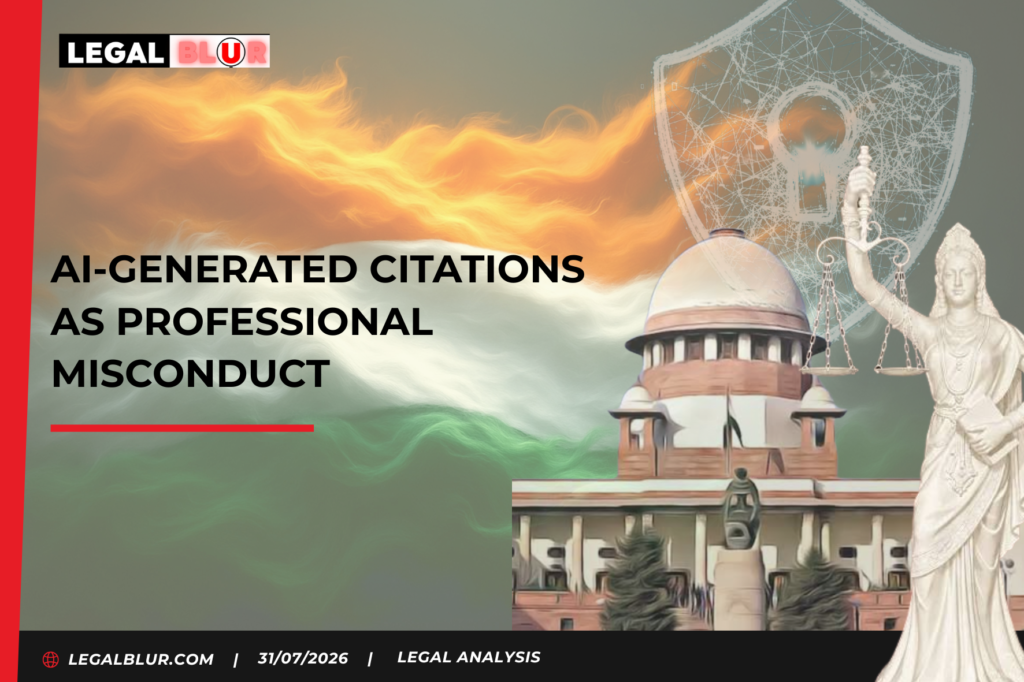
The legal profession is one of the noblest professions as it relies on accuracy, transparency, honesty and public trust. The duty of every advocate is legal and ethical to help the court with accurate facts, valid law and genuine judicial precedents.
The application of Artificial Intelligence (AI) in legal research and legal drafting has been growing rapidly over the past few years. AI-powered legal tools aid legal professionals in finding statutes, judgments, and legal resources, saving them time.AI-powered legal tools streamline the process for lawyers, enabling them to quickly access statutes, judgments, and legal resources. However, in some cases, these technologies might produce false or non-existent case citations, a phenomenon known as “AI hallucination. Without verification such citations can lead to a misconception by the Court and result in delay of the administration of justice.
Professional misconduct is defined as engaging in conduct inconsistent with ethical or professional standards as set forth in the law. The Advocates Act, 1961 and Rules of the Bar Council of India, have placed on the duty of every advocate to be honest, fair, dignified and responsible towards the court, client and the profession. Every advocate must also avoid any act or conduct which may amount to professional misconduct.
Keywords: Artificial Intelligence; AI Hallucinations; Fake Case Citations; Professional Misconduct; Professional Ethics; Duty to the Court; Legal Research; Advocates Act, 1961.
Professional Misconduct and Responsibilities of Advocates
An advocate’s role is not just to represent the interests of a client, but also to help the Court to effectively carry out justice. This duty demands having a reasonable attitude, providing accurate information and only using proper legal sources. Knowingly misleading the Court with false information and/or wrong judicial citations should never be the duty of any lawyer.
There is no specific definition of ‘professional misconduct’ but Section 35 of the Advocates Act, 1961 covers disciplinary proceedings against advocates for professional or other ‘misconduct’. The State Bar Council is entitled to refer to its Disciplinary Committee any question arising out of its inquiry relating to the conduct of an advocate in compliance with Section 35 of the Advocates Act, 1961, in its opinion that such advocate has been guilty of professional misconduct or otherwise. Where the allegation is substantiated the advocate will be warned, suspended from practice for a specified period and in severe cases, may have his or her name removed from the State Roll of Advocates.
The Bar Council of India Rules Part VI Chapter II provides for the standards of professional conduct and etiquette of advocates. These rules provide for advocates being respectful towards the Court, acting with integrity, avoiding misleading the Court and maintaining the dignity of the legal profession. Professional responsibility goes beyond winning a case. It also covers the maintenance of the fairness and credibility of the judicial system.
Fake Case Citations and Their Impact on Justice
A fake case citation is a reference to a judgment that does not exist or is wrongly quoted before a court. Sometimes this happens because of poor legal research. In recent years, it has also happened due to the use of AI tools which generate incorrect or imaginary judgments. This phenomenon is commonly known as AI hallucination. If such citations are used without verification, they may seriously affect the outcome of a case.
Courts rely on previous judgments while interpreting the law and deciding disputes. If a lawyer cites a non-existent judgment, the Court may be misled. This can result in unnecessary delays, incorrect legal reasoning and loss of valuable judicial time. It also reduces public trust in the justice delivery system.
For this reason, fake case citations are treated as a serious ethical issue. The responsibility for checking the correctness of every case citation always lies with the advocate. A lawyer cannot avoid responsibility by saying that the mistake was made by an AI tool or computer software. AI may assist legal research but cannot replace professional judgment or legal responsibility.
Why Fake Case Citations Amount to Professional Misconduct
Fake case citations are treated as professional misconduct because they violate an advocate’s duty of honesty towards the Court. Every advocate is expected to verify the authenticity of legal authorities before citing them. Failure to do so may mislead the Court, create unnecessary litigation and weaken public confidence in the judicial process.
The excuse of relying on AI cannot protect a legal practitioner from responsibility. Technology is only a supporting tool. Professional judgment and legal responsibility cannot be dependent on AI or technology. So, any person appearing before a court must carefully verify every judgment, statute, and legal authority before using it in legal proceedings.
The duty to present accurate legal authorities flows from an advocate’s obligation to act with candour, fairness, and honesty towards the Court. Misleading the Court by relying on fabricated or non-existent precedents undermines the administration of justice and violates the professional standards expected under the Advocates Act, 1961 and the Bar Council of India Rules.
Judicial Decisions
The misuse of fake case citations has become a serious concern in recent years following the widespread use of AI-assisted legal research tools. AI can make research faster but may generate non-existent judgments or wrongly attribute legal principles to genuine cases sometimes.
A major judicial development took place in Pooja Ramesh Singh v. Jammu & Kashmir Bank Ltd. (2026 INSC 668). In this case, the Supreme Court found that the NCLT had relied on several fake AI-generated judicial precedents at the time of deciding the dispute. Some citations referred to judgments that never existed while others quoted paragraphs that were not part of the original decisions. The Supreme Court set aside the orders of both the NCLT and the NCLAT. It held that a decision based on hallucinated precedents cannot be treated as a valid judicial decision because it weakens the rule of law and affects the fairness of adjudication.
The Court also made an important observation regarding professional responsibility. It stated that technology may assist legal research but it cannot replace human judgment. Every person appearing before a court has a duty to verify the correctness of every judgment, statutory provision, and legal authority before relying upon it. The Court clearly stated that the responsibility always remains with the person who files or relies upon the document and cannot be shifted to an AI platform or software.
Role of Bar Council of India
While deciding the above case, the Supreme Court also recognised that the increasing use of AI has created new ethical challenges for the legal profession. Therefore, it requested the BCI to examine the issue and consider framing appropriate guidelines for the responsible use of AI in legal practice. The Court suggested that the BCI should study the risks associated with AI-generated legal content and recommend suitable safeguards for advocates and courts.
At present, the BCI has not issued any separate binding rules specifically regulating the use of Artificial Intelligence. However, advocates continue to be governed by the existing Bar Council of India Rules, Part VI, Chapter II. So, every legal practitioner must independently verify every authority before citing it.
Responsible Use of AI
Artificial Intelligence should be treated only as a research assistant. It can help locate judgments, summarise legal documents, and improve efficiency. It should never become the final source of legal advice or authority. Every citation must be checked from reliable sources such as the SCC Online, Manupatra, Indian Kanoon (where appropriate), or other recognised legal databases.
The Supreme Court has also recognised that AI is becoming an important part of the legal profession. The Court further observed that AI may assist legal research, but every citation and legal authority must be verified by the person using it before it is presented before a court. In simple words, technology may support legal research, but the final decision, verification, and professional responsibility must always remain with a human legal professional.
Strengthening Professional Ethics in Digital Era
The legal profession is changing with technological development but its basic values remain unchanged. Honesty, accuracy, and integrity continue to be the foundation of legal practice. Every advocate should carefully verify facts, judgments, and legal provisions before presenting them before a court. This practice protects both the interests of clients and the credibility of the justice delivery system. The recent Supreme Court judgment is an important reminder that professional ethics cannot be compromised for convenience or speed. Responsible use of technology, careful legal research, and respect for professional standards will help maintain public confidence in the judiciary. As digital tools become more common, the legal profession must ensure that innovation always works together with accountability, transparency, and the rule of law.
Conclusion
As AI becomes more widespread, it is altering how legal research is done, as well as its ethical and professional implications. With the recent Supreme Court approach it is evident that automated case citations, whether AI-generated or due to negligent research, cannot be used in judicial proceedings. It is the responsibility of each legal practitioner to check facts, judgments and law to present them in front of a court. While technology can make things more efficient, it cannot make things more honest or make things more skillful or more of a lawyer’s judgment. The conduct of advocates in the digital era is still governed by the provisions of the Advocates Act, 1961 and the Bar Council of India Rules. In conclusion, the ethical and responsible application of AI, coupled with adequate verification and professional integrity, is vital to safeguard the trust in the legal profession and the integrity of justice.
Frequently Asked Questions
1. What is Fake Case Citation?
A fake case citation is a reference to a judgment that does not exist or is incorrectly cited before a court.
2. Why is using a fake case citation considered professional misconduct?
It misleads the Court which violates professional ethics and may affect the administration of justice.
3. Can advocates rely completely on AI for legal research?
No. AI may assist research but every citation must be verified before it is used in court.
4. Which provision deals with professional misconduct by advocates?
Section 35 of the Advocates Act, 1961 provides for disciplinary proceedings against advocates guilty of professional or other misconduct.
5. What is the Supreme Court’s view on AI-generated fake citations?
The Supreme Court has held that every AI-generated citation must be verified, and the responsibility always remains with the legal professional using it.
References
1. https://indiankanoon.org/doc/113338666/