This article is written by Divya Gupta, Vivekananda Institute of Professional Studies (VIPS-TC), GGSIPU.
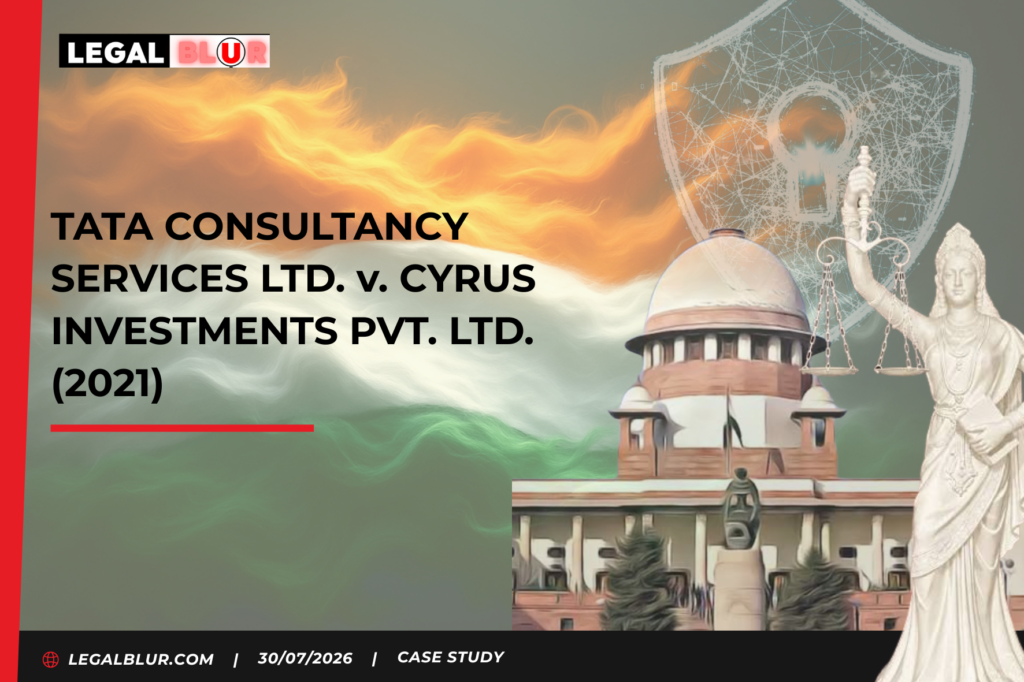
When Trust Isn’t Enough: Reassessing the Quasi-Partnership Doctrine in Tata Consultancy Services Ltd. v. Cyrus Investments Pvt. Ltd. (2021)
Every law student is bound to come across the term “just and equitable” when they study corporate law. They take it to mean whatever is fair, just at that particular point in time. The Supreme Court of India’s ruling in Tata Consultancy Services Ltd. v. Cyrus Investments Pvt. Ltd. (2021), provides a useful corrective to that approach. Deep within what has been described as the most publicized corporate governance dispute in India is an interesting and well-reasoned answer to a more focused problem, and that is, under what circumstances a company may be considered more than a company.
The answer is significant because if a company is found to have the characteristics of a quasi-partnership, courts may apply equitable partnership principles while deciding disputes relating to oppression and mismanagement. The judgment therefore clarifies that personal trust alone is insufficient; the surrounding legal and factual circumstances must justify such an approach.
The Backdrop
Tata Sons is the main holding company for the Tata Group. Around two-thirds (66%) of its shares belong to two charity trusts. The SP Group, run by the Mistry family, had around 18%, which it took in 1965, 48 years after Tata Sons’ incorporation in 1917. In 2012, Cyrus Mistry, who was a member of the Mistry family, became Executive Chairman as Ratan Tata picked him as his successor.
In October 2016, he was removed from his position due to a lack of trust by the board members. This was followed by a series of further developments: leaking of an e-mail to press, which was meant for the board, confidential files sent to the revenue department, and eventually, removal of Cyrus Mistry from the boards of many Tata corporations.
Companies belonging to the SP Group approached the National Company Law Tribunal (NCLT) citing oppression and mismanagement under Sections 241 and 242 of the Companies Act, 2013. The argument on which their case rested was that the conduct of Tata Sons itself justified the dissolution of the company on the “just and equitable” grounds, but it would be prejudicial to the minority shareholders also, so they asked for a lesser remedy instead. In 2018, NCLT dismissed the petition by considering each claim separately. However, in December 2019, the National Company Law Appellate Tribunal (NCLAT) set aside the ruling of the lower tribunal and directed the reinstatement of Mr. Cyrus Mistry. In March 2021, the Supreme Court overruled the NCLAT and upheld the ruling of the NCLT.
While most discussions surrounding the case have revolved around the drama associated with the boardroom coup, the corporate governance issue, and the reinstatement, an important aspect of the case was overlooked – the judicial reasoning behind the decision of the Court on the ‘just and equitable’ ground for winding up, particularly, the characterization of Tata Sons as a quasi-partnership.
Before examining the “just and equitable” ground, it is useful to understand the statutory framework. Sections 241 and 242 of the Companies Act, 2013 provide relief against oppression and mismanagement. A member who alleges that the affairs of the company are being conducted in a prejudicial or oppressive manner may approach the Tribunal under Section 241. While exercising its powers under Section 242, the Tribunal must also consider whether the facts would otherwise justify winding up the company on the “just and equitable” ground, but whether such winding up would unfairly prejudice the members. Thus, the remedy is intended to preserve the company while addressing serious instances of unfair conduct.
What does the “Just and Equitable” clause actually require?
Section 241 and Section 242 provide minority shareholders with an avenue to relief without resorting to a winding up of the company if the affairs of the company are being conducted in an oppressive or prejudicial manner to certain members. However, the original petition filed initially by the SP Group went beyond this point. It claimed that there were just and equitable reasons for winding up the company, Tata Sons. But even this would amount to prejudicing the minority shareholders unfairly. This was not just a peripheral claim but a basis of the whole case on which it was pleaded.
This doctrine was traced back by the Supreme Court through well over a hundred years of legislative history in England and India – all the way from the English Companies Act, 1862, where the notion of “just and equitable” ground for winding up a company was enshrined for the first time, to Section 242 of the Companies Act, 2013. What has remained unchanged throughout each of these iterations of the remedy, in both jurisdictions, was the mandate on the court to act ‘with a view of bringing the matters complained of, to an end’ – not to punish, not to tell which person should have the control but only to resolve the specific matters.
Following the English precedent, specifically the House of Lords’ case of Ebrahimi v. Westbourne Galleries Ltd (1972) and Lau v Chu (2020), it was stated by the court that there are two cases in which the “just and equitable” doctrine can be applied:
- Functional deadlock – when the members simply cannot work together, and the business cannot continue to operate effectively either as a board or with shareholders. For example, there are two 50-50 shareholders. Both disagree. No resolution ever passes. The company stops functioning. That is deadlock.
- Quasi-partnership – it is where a company operated on the principle of trust among its members rather than formal ownership through shareholding, regardless of its official formal legal structure. In most cases, the above situation could mean any of the following: that the company emerged from a real partnership among the participants or an agreement on the participation of certain members in the management of the company or limited options for disposing of their shares and walking out of the company.
Neither of these grounds was fulfilled here.
Why Tata Sons was not a Quasi – Partnership?
It has been argued that the relationship of over four decades between these families, the level of dependence on each other, the position on the board held by one Mistry in the past and the chairmanship held by another, meant that there existed sufficient grounds to treat the company as a “two group company”, which, in essence, a quasi-partnership dressed in corporate form.
However, it has been pointed out by the Court that these arguments overlook what the doctrine actually requires at its origin. According to this precedent (Ebrahimi), usually require at least one of the following three elements:
- The establishment of an association on the basis of personal trust (for example, when conversion from partnership to company took place);
- The existence of the understanding that certain individuals will be participants in the management;
- Contractual provision limiting the ability of the participant to sell his stake.
Nothing here suits the situation of Tata Sons. The company was founded in 1917. While Shapoorji Pallonji Mistry had acquired an indirect economic interest in Tata Sons in 1936 through the purchase of F.E. Dinshaw & Co. (which itself held a 12.5% stake), the SP Group became direct, registered shareholders in their own name only in 1965 through the purchase of 40 ordinary shares from Mrs. Rodabeh Sawhney and did not gain board representation until 1980. Even then, it happened without any rights conferred under the contract or statute. In the words of the Court, it was an act of goodwill from the majority, not a right SP Group had bargained for at incorporation. There was no prior partnership which was changed into a corporation; SP Group was just another shareholder of the already established corporation, bound by the Articles of Association (AoA), accepted by the SP Group, which it later amended with its own consent.
This issue is of greater significance than meets the eye at the outset. The recognition of a quasi-partnership relationship would, on a liberal interpretation, enable any shareholder, who has had a long-standing cordial relationship with the majority controlling shareholders, to demand equitable considerations which are in excess of what their shareholding or contractual terms provide for. The Court’s requirement of proving the existence of the relationship at the time of the incorporation of the company ensures that this possibility is excluded. Longevity of a close relationship, itself, is not evidence of a quasi – partnership; the relationship between two parties must have shaped the foundational structure of the company.
As far as functional deadlock is concerned, the second prong, even less help came from the Court, to support the SP Group. In a situation of deadlock, the corporation is incapable of functioning, making it impossible for decisions to be made. In this case, however, there was no question that the board could and did vote, and the majority won, as is the right of a majority in a corporation. A mere disagreement, even a sharp one, does not constitute a functional deadlock.
The Wider Point: Corporate Democracy is not a Grievance
The common thread that runs throughout the decision in this regard is the fact that the submissions made by SP Group have attempted on multiple occasions to turn their dissatisfaction with the end result into a right to demand structural changes. Losing an internal vote does not amount to oppression. Being deprived of office where one cannot claim to be entitled by contract does not amount to oppression, unless there is more to it than that. The Court made it abundantly clear that Section 241 is aimed at prejudicial actions – proven, specific, and based upon the conduct of the company itself – and not simply a feeling of being outmanoeuvred.
And it’s worth reflecting upon, as it runs contrary to one’s intuition regarding oppression law, which is the belief that there should be some recognition of the longstanding, trusting relationship regardless of the fact that there may not be any existing underlying legal rights regarding that. The Supreme Court’s response is that there can be, but only if the trusting relationship has been hard-wired into the corporate system from the very beginning.
A Point Worth Questioning
Nonetheless, there is some tension here that is noteworthy. The Court places great emphasis on the notion of the SP Group accepting the Articles of Association (AoA) with “eyes wide open”, including the Articles that gave the Trusts’ nominee directors an affirmative vote over board decisions. However, acceptance of the Articles in one instance does not equate to accepting all the ways in which the Articles may later be applied. The oppression ground exists because of situations wherein a minority shareholder is unable, upon making their initial investment, to anticipate how the majority shareholders may exercise their power in the future years ahead. By rooting the quasi-partnership test in the context of incorporation, the Court arguably makes it very difficult for any minority investor to invoke this ground upon joining an already incorporated company, regardless of whether or not they gain significant weight and influence in the process later. This raises the question as to whether this is an appropriate balance for Indian corporate law.
Conclusion
The lasting legacy of Tata Consultancy Services Ltd. v. Cyrus Investments Pvt. Ltd. (2021) is less likely to be the corporate saga of Ratan Tata, Cyrus Mistry, their dramatic falling out, and the resulting controversy. Rather, its enduring legacy lies in its doctrinal reaffirmation of what constitutes just and equitable grounds for a winding-up petition, and the unequivocal assertion that an enduring commercial relationship, standing on its own, cannot be deemed to constitute quasi-partnership rights. To a minority shareholder, it sends a clear message: business relationship and goodwill matter, but it cannot take the place of a contract that the articles of association of the company never promised you.
Frequently Asked Questions
1. What is the meaning of ‘just and equitable’ under the Companies Act, 2013?
It refers to the equitable ground under company law that allows the Tribunal to consider whether the facts would otherwise justify winding up the company, while granting alternative relief under Section 242 where winding up would unfairly prejudice the members.
2. What is a quasi-partnership company?
It is a company with an apparent formal corporate framework but operating on relationships of trust among each other, similar to a partnership company – usually due to its emergence from an actual partnership, there was an agreement that some members would manage it, or they were forbidden to sell shares without others’ consent.
3. Why did the Supreme Court conclude that Tata Sons was not a quasi-partnership?
The trust-based elements cited by the SP Group (board representation and long associations) happened years after incorporation and were never put into the contract. Thus, for the Court, the quasi-partnership should be traceable in the foundation of the corporation rather than developed during its life.
4. What is the takeaway from the case for minority shareholders?
A long and friendly business relationship with the majority shareholders will not give them any equity rights since minority shareholders can claim the quasi-partnership doctrine only if the trust-based relationship existed at the moment of incorporation.
References
- Tata Consultancy Services Ltd. v. Cyrus Investments Pvt. Ltd., (2021): https://api.sci.gov.in/supremecourt/2020/212/212_2020_31_1503_27229_Judgement_26-Mar-2021.pdf
- Ebrahimi v. Westbourne Galleries Ltd., [1972]: https://go-legal.co.uk/wp-content/uploads/2024/05/Ebrahimi-v-Westbourne-Galleries-Ltd.pdf
- Lau v. Chu, [2020]: https://jcpc.uk/cases/jcpc-2020-0021