This article is written by Priyam Pratik, Faculty of Law, University of Allahabad.
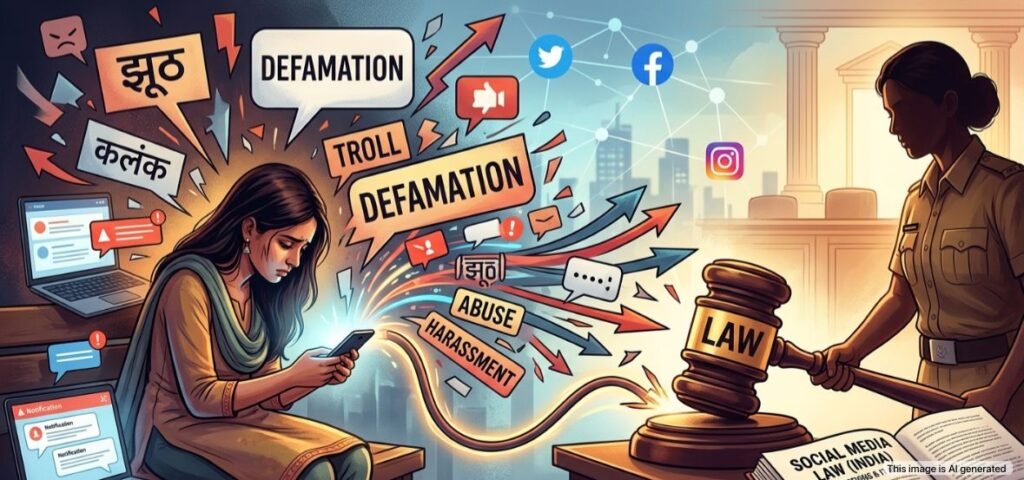
In June 2026, a televised debate about the rise of online coaching in India rapidly escalated into one of the year’s most closely watched defamation disputes. Aaj Tak anchor Anjana Om Kashyap and TV Today Network filed a civil defamation suit before the Delhi High Court against educator Faisal Khan, popularly known as Khan Sir, along with several other educators, social media accounts, and 4PM News Network, claiming damages of Rs 2 crore.
The controversy began on 29 May 2026, when Kashyap hosted a discussion on star teachers in online education, reportedly labelling certain instructors as fraudsters. Khan Sir and others responded publicly, allegedly using terms such as bikau patrakar (journalist who works for money), dalali (brokerage), and chatukar (sycophant), statements amplified widely across YouTube, X, and Meta. The suit further alleges that Khan Sir disclosed the school attended by Kashyap’s child, an act characterised as reckless and exposing the family to harassment and security concerns.3
The Delhi High Court, before Justice Neena Bansal Krishna, issued notice to all defendants but declined to grant an interim injunction, listing the matter for further hearing on 17 June 2026. The case raises foundational questions about how Indian law balances free speech, the right to reputation, and the accountability of digital platforms in an era of viral pile-ons.
THE LEGAL FRAMEWORK
Defamation is defined in India under two heads, as a civil tort with damages and injunctions as remedies and as a criminal offence under Sections 356-357 of the Bharatiya Nyaya Sanhita, 2023 (BNS), which came into effect on 1 July 2024, replacing the earlier Section 499-500 of the Indian Penal Code (IPC). Defamation has been interpreted to cover anything that is spoken, written, signed or visible, and has also been held to apply to social media posts and digital broadcasts.
The list of exceptions in the law represents the constitutional limits that have to be observed in the scope of the right to freedom of speech, as guaranteed by Article 19(1)(a) of the Constitution, vis-à-vis the reasonable restrictions to be observed in the scope of the right to freedom of speech under Article 19(2) of the Constitution. A further dimension is added by the Information Technology Act, 2000, which grants a ‘safe harbour’ to online intermediaries from liability for third-party content, but this protection is withdrawn if a court order is issued to remove offending content and the platform is not comply.
Case Laws
A. Subramanian Swamy v. Union of India (2016) 7 SCC 221
This is the basic constitutional decision concerning criminal defamation. The decision reiterates that any statement made in public to cause harm to another person’s reputation can be sued both civilly and criminally and that the right to freedom of speech in Article 19(1)(a) must be balanced with the right to dignity in Article 21, with particular emphasis on the importance of statements that are true in matters of public interest.
B. SMC Pneumatics (India) Pvt. Ltd. v. Jogesh Kwatra (Delhi High Court, 2014)
A landmark decision by the Delhi High Court that granted an ex-parte ad interim injunction against an employee of the plaintiff company who had been sending derogatory and defamatory e-mails to the management of the plaintiff company and its international subsidiaries, set the precedent that the electronic medium itself does not make a communication immune from defamation law, that is the channel of communication is not the determining factor of the legal nature of the imputation. This logic is directly applicable to the social media posts that are being appealed in the Kashyap case.
C. Shreya Singhal vs the Union of India AIR 2015 SC 1523
Supreme Court deems Section 66A of IT Act to be unconstitutional restriction on freedom of speech and also read down Section 79 on intermediary liability. But platforms are not required to take down content on private complaints; they are required to do so only after a court or government order, the Court said in the Kashyap case when it had granted an interim injunction as its first relief.
D. Google India Pvt. Ltd. v. M/s Visaka Industries and Another (2019)
A court found Google India responsible for defamation because it failed to remove the defamatory material even after the complainant had informed the company about it.12 This is the outer limits of the Section 79 safe harbour: a platform which knowsingly continues to allow the dissemination of harmful material is not covered by immunity. The named social media handles and 4PM News Network, in the Kashyap case, is a clear attempt to invoke the principle.
Conclusion
The Kashyap-Khan Sir dispute is more than a clash between two prominent public figures. It is a test case for how Indian law navigates three genuinely competing constitutional values: press freedom, the right to reputation, and the right to respond to criticism.
The existing framework, anchored in Section 356 BNS and shaped by Subramanian Swamy, SMC Pneumatics, and Shreya Singhal, provides a workable foundation. It protects both expression and reputation, holds intermediaries accountable once put on notice, and ensures that robust public debate does not automatically become actionable defamation. The exceptions to the defamation provisions do substantial work here: a statement made in good faith on a matter of public concern, even if critical, remains protected.
What the case also reveals, however, is the structural mismatch between the speed of online harm and the deliberate pace of litigation. The court’s refusal to grant an interim injunction at this stage reflects sound procedural caution, but it also means the allegedly defamatory content continues to circulate while the dispute is heard. Going forward, dedicated mechanisms for expedited content takedowns in cases of clear and demonstrable reputational harm may be a necessary addition to India’s digital speech architecture.
Frequently Asked Questions
1. What is the difference between civil and criminal defamation in India?
Civil defamation is a tort actionable in a civil court for damages, injunctions, and content removal. Criminal defamation under Section 356 BNS is a non-cognisable, bailable offence carrying up to two years’ simple imprisonment, a fine, or community service. Both proceedings may run concurrently.
2. Are public figures afforded less protection in defamation cases?
Indian law does not formally adopt the American actual malice standard, but the statutory exceptions provide wider latitude for good-faith criticism of public figures on matters of public concern. False and malicious imputations remain fully actionable regardless of the target’s public status.
3. When can social media platforms be held liable for defamatory content?
Under Section 79 of the IT Act, platforms enjoy a safe harbour for third-party content. They lose this protection once directed by a court or government authority to remove the material and they fail to comply, as established in Google India v. Visaka Industries (2019).
4. What reliefs are available to a defamation plaintiff?
A civil plaintiff may seek a permanent or interim injunction, compensatory and punitive damages, and orders directing platforms to remove offending content. Criminal proceedings may result in imprisonment, a fine, or community service.
5. Can disclosing a journalist’s child’s school amount to a legal wrong?
It may not constitute defamation in the technical sense unless it involves a false imputation, but it can amount to an invasion of privacy under the constitutional right recognised in K.S. Puttaswamy v. Union of India (2017), and may attract liability for harassment depending on the intent and effect of the disclosure.
Disclaimer: The dispute discussed in this article is currently the subject of ongoing legal proceedings. References to statements, allegations, and claims are based on publicly reported court filings and media reports, and should not be construed as findings of fact or determinations of liability. This article is intended solely for academic and informational purposes.
References
1. Anjana Om Kashyap and Another v Faisal Khan and Others, Delhi High Court, suit filed June 2026 (Justice Neena Bansal Krishna); Bar and Bench (8 June 2026) <https://www.barandbench.com>.
2. India Legal Live, “NEET Star Teacher Controversy: Anjana Om Kashyap moves Delhi High Court against Khan Sir” (8 June 2026) <https://indialegallive.com>.
3. India Legal Live, “Delhi High Court issues notice on Anjana Om Kashyap plea against Khan Sir” (9 June 2026) <https://indialegallive.com>.