This article is written by Vedant Raj Chopra, Vivekananda Institute of Professional Studies.
Introduction
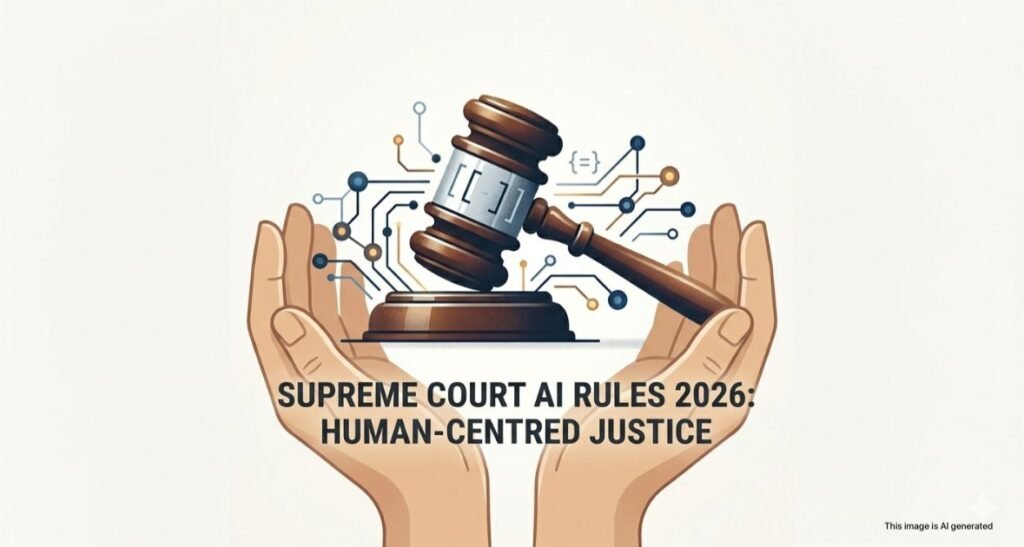
The Supreme Court of India’s Draft Regulations for Use of Artificial Intelligence (AI) in Courts, 2026 are an important legal development because they attempt to regulate a technology that is already entering legal workflows but has not yet been institutionally stabilised. Published through a notice dated 3 June 2026, the draft does not reject AI outright. Instead, it draws a constitutional boundary: AI may support court administration and access to justice, but it must not replace judicial reasoning or compromise accountability. In that sense, the draft is less about technology procurement and more about preserving the character of adjudication in a constitutional democracy.
The draft is grounded in human primacy, transparency, accountability, fairness, auditability, data protection, proportionality, inclusivity, and judicial independence. These principles matter because court processes affect enforceable rights, not just administrative convenience. The framework therefore rejects opacity, unchecked bias, and blind reliance on machine-generated outputs.
The draft also responds to practical realities. Reporting by The Hindu and The Indian Express notes that the proposed regulations prohibit AI from determining judicial outcomes, bar AI-assisted sentencing without mandatory human oversight, prohibit risk-scoring in relation to bail or recidivism, and disallow undisclosed, opaque, or unexplainable AI in court processes affecting rights or personal liberty. At the same time, the draft permits AI for case management, hearing scheduling, transcription, translation, legal research, administrative support, chatbot assistance, accessibility services, and anonymisation. This structure reflects a careful legal judgment: efficiency-enhancing uses can be accepted, but decision-shaping uses require the highest restraint.
The draft also strengthens professional responsibility by requiring disclosure of AI-assisted material and retaining liability with the submitting party or lawyer. Its invitation for public comments until 20 June 2026 shows that judicial AI governance is being treated as an evolving institutional process.
Case Laws
This case illustrates the immediate institutional risk that likely shaped the draft regulations. As reported by LawBeat, the Supreme Court found serious cause for concern when a trial court relied on AI-generated, fake, or non-existent judgments while dealing with objections relating to an Advocate Commissioner’s report. The Bench of Justices P.S. Narasimha and Alok Aradhe observed that a decision based on such fake judgments was not merely an error in decision-making, but could amount to misconduct with legal consequences. The Court therefore framed the matter as one affecting the integrity of the adjudicatory process itself. This is directly relevant to the 2026 draft because the regulations are premised on human primacy, explainability, and accountability. If courts begin to rely on synthetic authorities, the legitimacy of adjudication is threatened at its foundation
2. Jaswinder Singh @ Jassi v. State of Punjab and another (Punjab and Haryana High Court, 2023)
The Punjab and Haryana High Court’s use of ChatGPT in a bail matter offered an earlier warning sign about the judicial fascination with generative AI. According to the IndiaAI report, Justice Anoop Chitkara referred to ChatGPT only to obtain a broader picture of bail jurisprudence where cruelty was a factor and expressly clarified that the chatbot response was not an opinion on the merits of the case. Even with that caution, the episode became widely debated because it showed how easily AI can move from background assistance to visible judicial reasoning. The significance of this case is that it exposed the lack of a clear line between supplementary reference and improper dependence. The 2026 draft regulations now attempt to draw that line.
3. Mata v. Avianca, Inc. (United States District Court, S.D.N.Y.)
Though not an Indian case, Mata v. Avianca is highly relevant to the legal profession’s use of generative AI. The Justia-hosted sanctions order records that lawyers filed submissions citing six non-existent cases produced by ChatGPT and continued to rely on them even after the court questioned their authenticity. The court imposed a 5,000 US dollar sanction and emphasised that while AI may be used as an assistive tool, lawyers remain responsible for verifying the accuracy of their filings. This reasoning closely aligns with the Indian draft regulations, which require disclosure of AI-assisted material and retain responsibility with the legal representative or party filing it. The broader lesson is universal: AI may speed up drafting, but it cannot transfer professional ethics or procedural accountability from human actors to software.
These cases collectively explain why the draft regulations adopt a layered model. Low-risk uses such as transcription, translation, scheduling, filing assistance, research support, and anonymisation are permitted. High-risk uses that touch liberty, credibility, or adjudicative discretion are either prohibited or subjected to strict human oversight. In particular, the draft bars AI risk-scoring for flight risk, recidivism, bail eligibility, or witness credibility and treats AI outputs on adjudicative questions as merely advisory. This makes legal sense because constitutional adjudication requires reasons that are transparent, challengeable, and attributable to a human decision-maker.
Conclusion
The Supreme Court’s Draft Regulations for Use of Artificial Intelligence in Courts, 2026 offer a carefully balanced approach to judicial modernisation. They acknowledge that AI can make courts more accessible and efficient through administrative assistance, translation, transcription, and legal research, but they refuse to permit algorithmic substitution where legal rights, liberty, and judicial discretion are at stake. By centring human oversight, disclosure, fairness, privacy, and explainability, the draft protects both institutional legitimacy and public confidence.
The deeper constitutional message is that justice cannot be automated without risking the erosion of accountability. A court may use technology, but it cannot surrender judgment to it. If implemented with meaningful training, impact assessment, and oversight, these regulations could become an important Indian model for ensuring that innovation remains subordinate to the rule of law rather than the other way around.
Frequently Asked Questions
1. What is the core purpose of the 2026 draft regulations?
The draft seeks to govern the responsible use of AI in courts while ensuring human judicial control, transparency, accountability, and data protection.
2. Can AI decide judicial outcomes or bail eligibility?
No. The draft prohibits AI from autonomously determining judicial outcomes and also bars risk-scoring tools for bail eligibility, recidivism, flight risk, or witness credibility.
3. Where is AI permitted under the draft?
Permissible areas include case management, cause lists, hearing scheduling, transcription, translation, legal research, administrative support, accessibility services, litigant chatbots, and anonymisation of records.
4. Must lawyers disclose AI use in filings?
Yes. The draft requires disclosure when AI-assisted material is submitted, and liability for false or misleading content remains with the party or legal representative filing it.
5. Why is this draft legally significant?
It is significant because it responds to real instances of fabricated citations, opacity, and the risk of delegating judicial reasoning to AI, while still allowing beneficial technological assistance in low-risk functions.
References
1. Supreme Court of India, Notice dated 03.06.2026 with Draft Regulations for Use of Artificial Intelligence (AI) in Courts, 2026: https://cdnbbsr.s3waas.gov.in/s3ec0490f1f4972d133619a60c30f3559e/uploads/2026/06/2026060342.pdf
2. The Hindu, ‘Draft SC rules prohibit AI use for judicial outcomes, assessing bail eligibility’: https://www.thehindu.com/news/national/draft-sc-rules-prohibit-use-of-ai-for-judicial-outcomes-assessing-bail-eligibility/article71060335.ece
3. The Indian Express, ‘Supreme Court AI draft rules: No AI in verdicts, bail eligibility’: https://indianexpress.com/article/legal-news/supreme-court-ai-regulations-2026-draft-rules-courts-ban-ai-decisions-10723503/
4. LawBeat, ‘Trial Court Uses AI-Made Judgments; Supreme Court Says Misconduct, Legal Consequence Shall Follow’: https://lawbeat.in/top-stories/trial-court-uses-ai-made-judgments-supreme-court-says-misconduct-legal-consequence-shall-follow-1569224
5. IndiaAI, ‘For the first time, HC in Punjab and Haryana uses ChatGPT to decide bail for an assault’: https://indiaai.gov.in/news/for-the-first-time-hc-in-punjab-and-haryana-uses-chatgpt-to-decide-bail-for-an-assault
6. Bar and Bench PDF link for Jaswinder Singh @ Jassi v. State of Punjab: https://images.assettype.com/barandbench/2023-03/afc97b0f-40cb-4c2b-b1ff-968287df356c/Jaswinder_Singh___Jassi_v_State_of_Punjab.pdf
7. Justia Law, Mata v. Avianca, Inc. sanctions order: https://law.justia.com/cases/federal/district-courts/new-york/nysdce/1:2022cv01461/575368/54/