This article is written by Unnati Dixit, a 4th-semester BA.LL.B. (Hons.) from Arya Kanya Degree College (aff. University of Allahabad)
Introduction
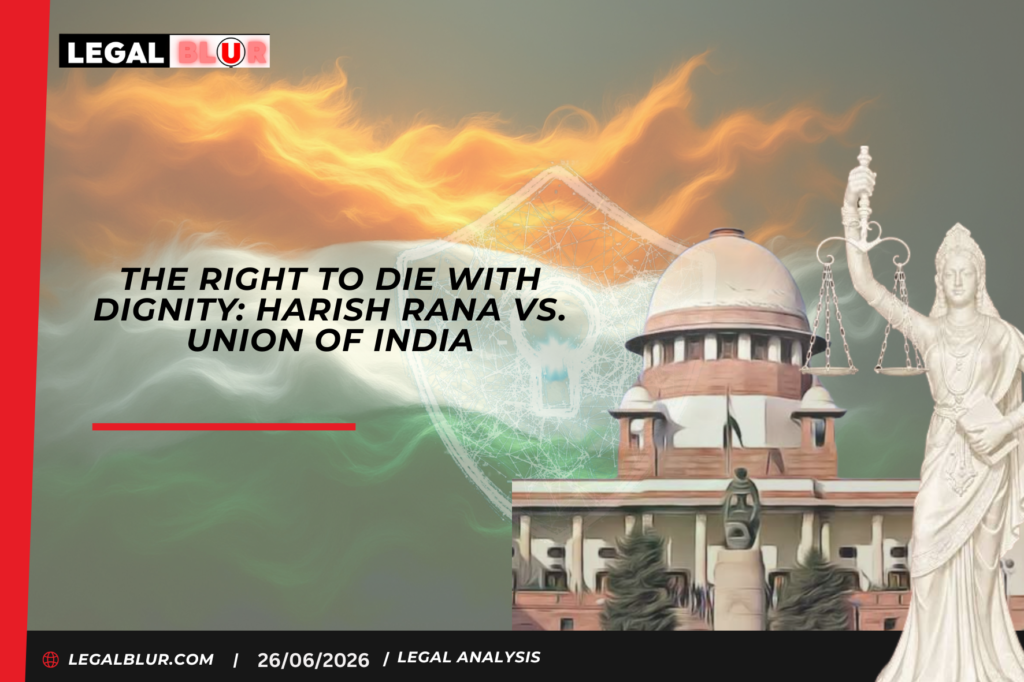
Imagine being kept alive for thirteen years, with no awareness, consciousness and no chance of ever waking up, with your body being sustained with only a feeding tube. This was the reality for Harish Rana, a young engineering student from Chandigarh, after a catastrophic fall left him in this kind of vegetative state in 2013. His case eventually reached the Supreme Court of India, and on 11th March, 2026, in the case Harish Rana vs. Union of India, the court did something that had never happened before. It allowed a patient’s life support to be withdrawn under the passive euthanasia framework that it had only sketched out on paper years earlier.
For most of India’s constitutional history, courts spoke about “death with dignity” as just an abstract under a right that existed “in principle”. Harish Rana’s case changed that as it took the guidelines laid down in the landmark 2018 Common Cause judgement and applied them for the first time to a real person, a real hospital with a real family waiting for an answer. This article traces how Article 21 of the Constitution came to protect this right, what the courts actually decided and explains why this judgement matters far beyond just one family’s tragedy.
Case Laws
Constitutional Aspect: Article 21 and the Right to Die with Dignity
Article 21 of the Constitution simply states that no person shall be deprived of their life or personal liberty except according to the procedure established by law. For decades, courts read this in a narrow sense as protection against unlawful imprisonment and nothing more. This changed with the landmark case ruling of Maneka Gandhi v. Union of India (1978), where the hon’ble Supreme Court held that “life” under Article 21 means more than mere existence, but rather includes the right to live with human dignity. The lone decision changed the interpretation of Article 21 from one of privacy to clean surroundings and finally to a dignified death as well. The element of dignity became more focused through the case of Francis Coralie Mullin v. Union Territory of Delhi (1981). In that case, the Court stated that the right to life includes a life with human dignity. Together, these cases raised a question to ask whether living with dignity is a fundamental right and whether the manner of one’s death can be entirely outside this scope.
This question is what Gian Kaur, Aruna Shanbaug, Common Cause and now Harish Rana have built on. None of these cases recognized a general right of “right to die” where suicide remained outside the scope of Article 21’s protection and active euthanasia remain a criminal offence. The recognized concept is way narrower that says for a patient who is terminally ill or in a permanent vegetative state, prolonging biological existence through artificial means and no meaningful life left to preserve can itself become an assault on one’s dignity. The right protected is not a right to die, but a right not to be kept alive artificially once dignity itself has become impossible to sustain.
Background
However, it took decades of constitutional reasoning for such a settled principle to emerge. In Maruti Shripati v. State of Maharashtra (1987), the Bombay High Court read a right to die into Article 21 in a brief confirmation while the Supreme Court declared Section 309 IPC unconstitutional, which made attempts to commit suicide a punishable act. However, the right to die was reversed in Gian Kaur v. State of Punjab (1996), which held that the right to life cannot have a right to die within its ambit, excepting a right to die with dignity for the terminally ill with no prospect of recovery.
The right to die with dignity was made operational in Aruna Shanbaug v. Union of India (2011), wherein the court allowed passive euthanasia with a proper set of conditions for a nurse who had been kept alive in a vegetative state for decades after being assaulted. However, it was the landmark decision of the case Common Cause v. Union of India (2018) wherein the constitutional bench upheld the right to die with dignity within the purview of Article 21 and allowed the use of living wills through a two-step medical board procedure.
The Facts of Harish Rana Case
Harish Rana was a nineteen-year-old, studying in Chandigarh, who in August 2013 fell from the fourth floor of his paying guest accommodation. The fell caused him several brain injuries, leaving him in a permanent vegetative state with complete paralysis of all four limbs. For next thirteen years, his parents cared for him without giving up, while his body was kept alive solely through Clinically Assisted Nutrition and Hydration delivered via surgically placed feeding tubes in his body. Doctors repeatedly confirmed there was no possibility of recovery.
His father eventually approached the court seeking permission to withdraw his life support. The Delhi High Court dismissed the plea in 2024, prompting the family to file the same in Supreme Court. After examining several medical evidences and hearing the opinion of medical boards, the Court finally granted permission for withdrawal of treatment.
What the Supreme Court Decided
The judgement is significant as it considered several reasons which were:
- The court held that Clinically Assisted Nutrition delivered through a feeding tube counts as “medical treatment” and not merely basic care. This distinction mattered enormously as basic care like cleaning or turning a patient cannot be withdrawn but a medical treatment can be, once the doctors agree that it no longer serves the patient’s best interest.
- The court waived the standard thirty-day reconsideration period that usually follows a medical board’s decision that allows the withdrawal process. This allowed withdrawal proceed further without delay considering the family’s long wait.
- The court clarified that withdrawing treatment did not amount to abandoning the patient. It further directed AIIMS Delhi to admit Harish Rana into its palliative care department and design a proper end-of-life care plan to keep the process humane and dignified rather than abrupt.
- The court issued directions to make the system work better nationwide instructing the High Courts to ensure Judicial Magistrate are ready to receive hospital intimations promptly and asking the Union Government to ensure district maintains a panel of doctors for Secondary Medical Boards.
- Finally, the court urged the Parliament to enact a comprehensive law on end-of-life care, stating that without clear legislation such decisions remain vulnerable to being influenced by several factors that has nothing to do with the patient’s best interest.
The Union of India did not oppose passive euthanasia rather its counsel argued that withdrawing treatment was a legal omission not an unlawful act. The court also acknowledged Harish Rana’s parents recognizing their thirteen years of unweaving care as an act of affection rather than neglect.
Conclusion
Harish Rana v. Union of India matters because it closes the gap between constitutional principle and the lived practice. For nearly a decade, the Common Cause guidelines existed mostly as an answer to a hypothetical question with no real practice. This judgement portrayed how the framework works with a family caught in an impossible situation can with medical and judicial decision secure a dignified end for a loved one. At the same time, the Court was careful not to treat this as a free pass rather by insisting on palliative care, warning against misuse and pushing for a proper legislation it tried to ensure that compassion does not come at the cost of safeguards for the vulnerable. The real law now lies with Parliament, until it has decided a legislation for end-to-life care, families will keep depending on courts to do so, case by case, what should really be stalled by a clear policy.
Frequently Asked Questions
1. What is the difference between active and passive euthanasia in India?
Active euthanasia means deliberately causing deaths and it remains a criminal offence under the Bhartiya Nyaya Sanhita, 2023. Passive euthanasia means withdrawing or withholding life-sustaining treatment, allowing natural death to occur and is legal under strict medical and judicial safeguards.
2. Why is Harish Rana case called a “first” when passive euthanasia was already legal?
Common Cause (2018) laid down the legal framework for passive euthanasia, but Harish Rana’s case was the first case where the Supreme Court first time applied theframework of passive euthanasia to permit the withdrawal of treatment in specific real-life case.
3. What is a “living will”? How does it relate to this case?
A living will is a written document giving advance instruction about medical treatment for if a person later becomes unable to communicate, including the authorization of withdrawal of life support. It was first validated in Common cause case and remains a key tool for the patient’s autonomy.
4. Does India have a specific law for euthanasia? If it doesn’t, how is it practise
No, India doesn’t have a specific law for euthanasia. It is currently governed by judicial guidelines from “Common Cause” and “Harish Rana” and not as a standalone statute. Though the Supreme Court has urged the Parliament to enact a legislation for this.