This article is written by Adv. Aditi Jain.
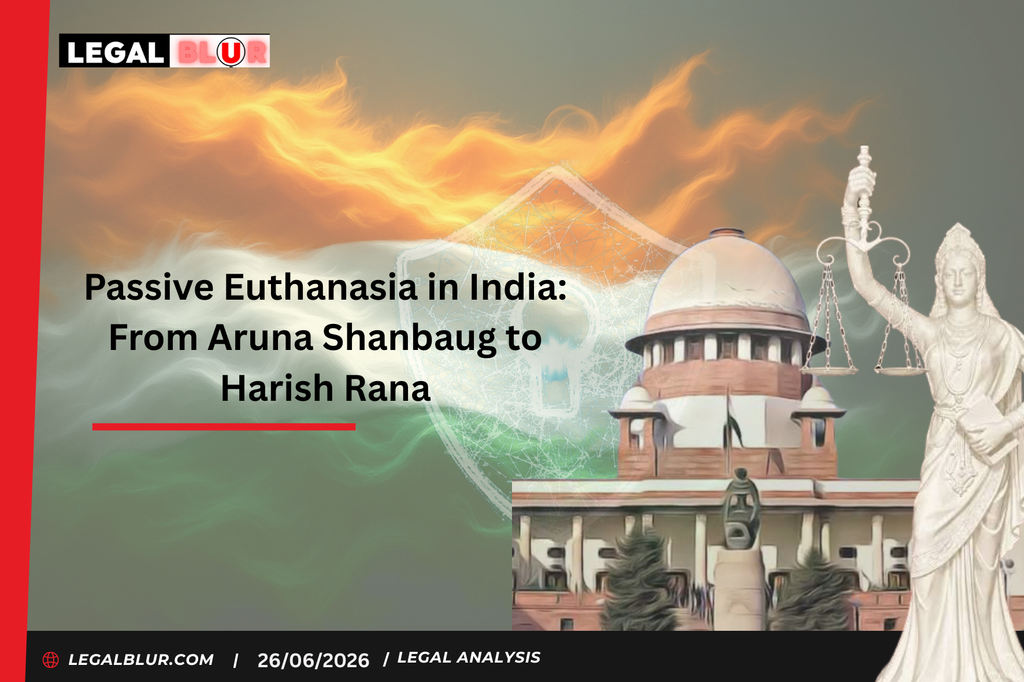
The right to die with dignity does not mean that one day a person wakes up and announces to sacrifice their life. Still, it means if a patient is in the last stage of terminal illness and his recovery is impossible, then he has the right to stop the ventilator and the medicines. Article 21 of the Constitution of India protects the right to life, stating, “No person shall be deprived of his life or personal liberty except according to procedure established by law.” This means that life is not just an “act of breathing” or “mere biological existence of breathing”, but to have it with a meaningful or dignified life.
Does the right to life include the right to die?
The demand to recognise the Right to Die as a part of Article 21 was first accepted by the apex court in the landmark case of P. Rathinam v. Union of India (1994). A two-judge bench of Justice R. M. Sahai and Justice B.L. Hansaria declared that if we have the right to speak, we logically have the right to be silent as well. Consequently, the Court declared Section 309 of the IPC (attempt to suicide) unconstitutional and a violation of Article 21.
However, this precedent lasted for barely two years. In Gian Kaur v. State of Punjab (1996), the judgment was overruled. The Court held that while the right to speak includes the right to be silent, the right to live cannot include the right to die because death is the ‘extinction’ of the right, not a part of it.
Though the Common Cause Case vs Union of India (2018) was the game-changer, when the five-judge bench of the Apex Court recognised and sanctioned passive euthanasia and living will directions.
Definition of Euthanasia:
The Greek word euthanasia translates to ‘good death’, making it ‘mercy killing,’ a simplified legal meaning of it, which is defined as ‘the act of putting a person or animal to death painlessly or allowing to die by withholding medical services, usually because of a painful and incurable disease’
When any person, especially a family member or close friend, is experiencing pain, mental degeneration, or other adverse condition, our instinct is to relieve the person in any way possible. Sometimes, this desire to alleviate pain can become so strong in the caregiver or patient that it overrides our deeper impulse to preserve life and survive.
What is a persistent vegetative state, or passive euthanasia?
Persistent vegetative state is a medical condition in which a person is awake but unaware of their surroundings. It may be described as ‘wakefulness without awareness’.
“Aruna Shanbaug v. UOI (2011) is the foundation of cases related to passive euthanasia in Indian legal history. While it was not the first time the issue of euthanasia had arisen before the judiciary, it was the landmark case where the Supreme Court of India formally recognized and laid down guidelines for passive euthanasia.”
In this case, the Hon’ble Court rejected the plea to withdraw life-sustaining treatment. Still, it declared the hospital’s nursing staff as Aruna’s true “next friend” instead of the petitioner, Pinki Virani.”
Judicial Recognition of Passive Euthanasia: Harish Rana precedent
Harish Rana, an engineering student, suffered a catastrophic brain injury after a tragic fall from the terrace of his hostel in Chandigarh. Trapped in a persistent vegetative state for 13 years, bedridden and unresponsive, finally won the legal battle when, in March 2026, a bench of J.B. Pardiwala and K.V. Viswanathan granted permission to keep the support system and clinical nutrition away from him.
In a final act of generosity, his family consented to donate his organs, and the hospital successfully retrieved the corneas and heart.
Conclusion
From Aruna Shanbaug to Harish Rana (2026), the judicial system has become more sensitive and compassionate. Now, the common man is facing the changes towards a living will, and it has become easier. Today’s judiciary concentrates on the point that if the person’s departure is decided, then there is no meaning to keep him on medical devices and punish but to give him a peaceful and dignified death, which is a commendable fact.