This article is written by Adv. Aditi Jain.
Introduction:
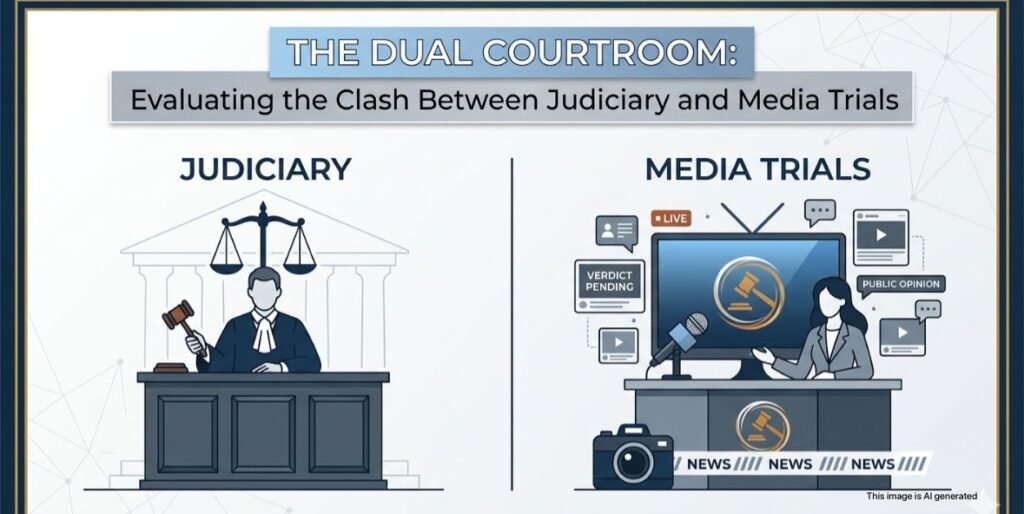
Traditionally, courtrooms are places where justice is based on evidence and legal rules. Today, television and social media often announce verdicts before official investigations are even finished. This raises an important question: Which system truly serves justice and upholds the rule of law?
As a first-generation lawyer and legal writer, I feel caught between two worlds. On one side is the Judiciary, built on laws and the Constitution. On the other is the world of media trials, driven by social media and sensational headlines that often stir public emotions.
While the press is known as the fourth pillar of democracy, the judiciary remains the core foundation of justice, without which an individual cannot survive, without either an independent press or an unpolluted judiciary. However, when newsrooms begin to deliver public judgments based on hypothetical situations and incomplete facts, it can be dangerous and toxic to the administration of justice.
What is a Media Trial?
The term ‘Media trial ’ is significantly explained as the term for the outside boundaries of judicial proceedings in the actual courts of law, in the media newsrooms, social media platforms, or by newspapers, leading to a public trial regarding the criminal matter or dispute even before the completion of a police investigation or a magistrate can evaluate the merits of the case.
- Constant interruption in the judicial matter with assumptions and creating public discourse towards a definite pronouncement of a verdict by media houses without even being aware of the facts.
- Sensationalizing the case by the media with assumptions and narratives, leading the public to believe an accused is guilty long before they ever entered the courtroom.
- Creating an opinion on the case and facts, without verification of evidence and leaking them as viral headlines for the sake of television rating points (TRP) and prime time.
In simpler terms, a media trial is an environment in which an individual is declared guilty by digital platforms and newsrooms long before a judge can hear the facts.
The Clash of Freedom of Speech and Fair Trial
The friction between media trial and judicial trial stems from constitutional rights, between the fundamental rights guaranteed under The Constitution of India, as a tug of war.
According to Article 19(1)(a) of the Constitution of India, freedom of speech and expression was granted to the press as a right to investigate, publish, report, and critique matters of public interest. Article 21 of the Constitution of India guarantees the Right to Life and Personal Liberty and includes within its scope the right to a fair trial, dignity, reputation, and due process.
The freedom of the press is indispensable, but strictly subject to ‘reasonable restrictions ’under Article 19(2), which explicitly includes ‘contempt of court’ and the ‘administration of justice’. The commercial right to the press cannot be permitted to violate a citizen’s constitutional right to a fair trial.
Judicial View on Media Trials
In Sahara India Real Estate Corporation Ltd. v. Securities and Exchange Board of India (2012), the Supreme Court recognised that excessive media reporting can prejudice ongoing judicial proceedings and held that courts may issue postponement orders in appropriate cases to protect the fairness of trials.
Similarly, in Manu Sharma v. State (NCT of Delhi) (2010), the Supreme Court observed that while a free press is essential to democracy, media reporting should not interfere with the administration of justice or create prejudice against the accused.
Burden of Proof vs. The Pursuit of TRP:
In the court of law, justice is strictly based on ‘burden of proof’. The judiciary is an evidentiary body controlled by evidence, and the prosecution must establish guilt beyond a reasonable doubt. The court cannot compromise justice under public pressure or media-sensationalised headlines.
Instead, the court of public opinion operates on a completely opposite maxim: “guilty until proven innocent”. The parallel narrative is entirely commercial pressure and the demand for high TRPs. Where hon’ble courts demand legally admissible evidence, testing the credibility of testimony through cross-examinations, and procedural safeguards. Whereas sensationalised media covers viral traction, distorting complex legal processes to maximise subscribers and viewers rather than confirming the facts or procedural accuracy.
Judicial Deliberations vs. The instant Digital verdict
Digital media is very impatient and strives for the immediate delivery of a verdict on its own, without even thinking for a while. Social media and the 24-hour running news channels regularly deliver a definite ‘verdict’ based on mere circumstances and facts in a few hours of the accident or the incident being leaked. The thirst to punish the accused or innocent can completely condemn a court.
The Burden of ‘Digital Scars’
Perhaps, the most tragic and irreversible consequences of the whole media trial are the permanent damage to an individual’s life, reputation and mental condition, even after getting the acquittal from court of law. A formal legal acquittal cannot even completely restore a person under the law, but it rarely erases the permanent scars that the media or digital media have given to him, “the digital scars”.
An innocent person may lose his entire reputation, mental health, career and whatnot, just for the sake of temporary media profitability; the viral cycle and sensationalised headlines can create a social stigma of an offence they never committed.
The Apex Court of India has increasingly recognized the ‘Right to Reputation’ as a part of Article 21 of the Constitution of India, which cannot be sacrificed at the altar of media entertainment.
The State of UP through CBI v/s Rajesh Talwar (2008), known as the famous Aarushi Talwar and Hemraj dual murder case, saw a massive media campaign, and news anchors openly speculated about the character, motives, and absolute guilt of the parents. This aggressive projection of the case resulted in the leaking of unverified investigation rumours and the irreversible reputational ruin of the parents after the High Court subsequently acquitted them. The Aarushi Talwar case demonstrated how extensive media speculation can influence public perception and potentially affect the fairness of criminal proceedings. Numerous unverified theories circulated through television debates and newspaper reports before the trial had concluded.
Same as in Rhea Chakraborty v/s State of Bihar (2020), famously known as the Sushant Singh Rajput suicide case, the media 24-hour channels and digital influencers conspired to spread the theory, but the selected individuals were guilty of abetment to suicide in the court of public opinion. It exposed how modern media trials can publicly assassinate without any legal accountability.
Conclusion
The media’s job is to shine a light on the news, not to bypass the investigation and declare someone guilty. In the early stages of the matter, the aggressive media trial almost caused inappropriate and disproportionate damage to the ‘Right of Fair Trial’.
Freedom of speech and expression must not be allowed to swallow up the independent administration of justice. The media’s role in any case is to highlight the facts, not to exaggerate them. For the survival of the rule of law, we must strictly guard the decorum of our courtrooms and respect the integrity of the formal. Ultimately, justice must always be delivered by a robe, not a remote control.