This article is written by Ayushman Anand, VIPS-TC, VSLLS.
Keywords: Algorithmic Bias, Article 14, Artificial Intelligence, Indirect Discrimination, Constitutional Law
Imagine being denied a loan, screened out of a job interview, or flagged for extra checks at an airport and never finding out a computer program made the call. This isn’t hypothetical. Government departments, banks, and private platforms increasingly hand decisions that once required human judgment to algorithms. The promise is efficiency and objectivity. The risk is that these systems quietly replicate, and sometimes amplify, the very bias the Constitution was written to dismantle.
Algorithms don’t discriminate out of malice, the way a prejudiced official might. They discriminate because they learn from data, and data carries the fingerprints of history. A credit-scoring model trained on decades of lending records from communities historically denied credit can learn those communities are “risky” without anyone telling it to look at caste, religion, or region at all.
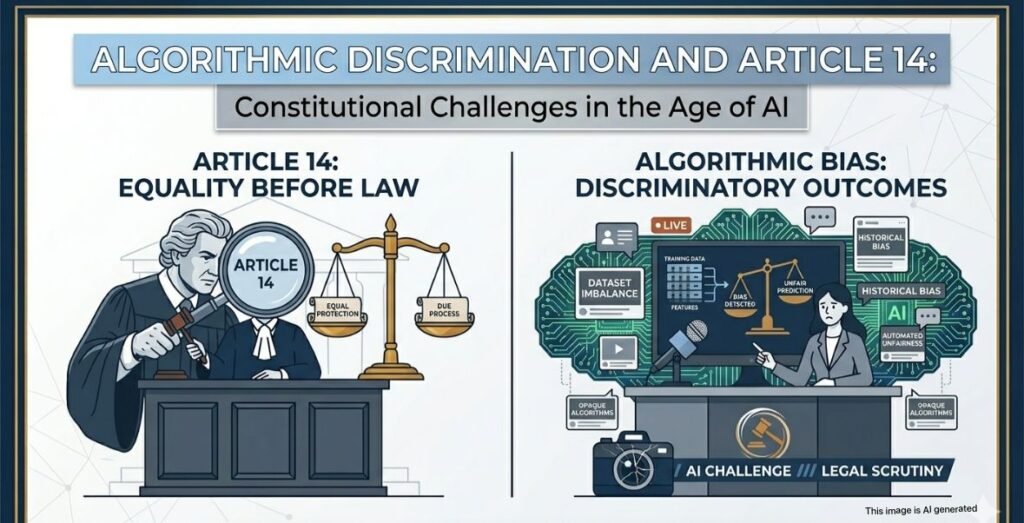
This raises a question Indian courts haven’t squarely faced: can Article 14 equality before the law reach a decision made by a code? This article argues it already can, since Article 14 jurisprudence has, over seven decades, quietly built the tools needed.
Before applying Article 14 to algorithmic decision-making, it is important to identify whether the entity deploying the system qualifies as “State” under Article 12 of the Constitution. While government departments and public authorities clearly fall within Article 12, the constitutional position becomes more complex when automated systems are developed or operated by private entities performing public functions. This emerging question is likely to play a central role in future constitutional litigation involving artificial intelligence.
How Algorithms End Up Discriminating
Three mechanisms matter most. Training data bias means a model inherits whatever exclusion existed in the outcomes it learned from. Proxy variables mean that even when caste, religion, or gender are excluded from a dataset, inputs like PIN code, surname, or employment gaps can act as near-perfect substitutes where such markers correlate with social identity. And feedback loops mean a policing tool sending more patrols to a “high crime score” area generates more arrests, confirming the score a self-fulfilling prophecy dressed up as data.
Case Laws
State of West Bengal v. Anwar Ali Sarkar, AIR 1952 SC 75
This is where Article 14 jurisprudence in India effectively begins. The Supreme Court struck down a provision of the West Bengal Special Courts Act, 1950 that let the government refer cases to a special court without laying down any criteria for doing so. Any classification by the State, it held, must rest on an “intelligible differentia” bearing a rational nexus to the law’s object. Apply that to an algorithm: if a government system sorts of people into categories for benefits or scrutiny, the data points used to build those categories must survive this test a variable with no rational connection to the scheme’s purpose fails the Anwar Ali Sarkar test.
E.P. Royappa v. State of Tamil Nadu, (1974) 4 SCC 3
Two decades later, the Court, in an opinion by Justice P.N. Bhagwati, added a second test to Article 14: arbitrariness. Equality and arbitrariness, it held, are “sworn enemies”; any arbitrary State action is unequal and unconstitutional, whether or not a formal classification is involved. Think about what that means once decisions are handed to code. A system denying a benefit based on a score that nobody, not even the officials running it, can explain looks like the action Royappa was written to prohibit.
Maneka Gandhi v. Union of India, (1978) 1 SCC 248
This case tied Article 14 to Articles 19 and 21, forming the “golden triangle” of Indian constitutional law. A seven-judge bench held that any procedure depriving a person of a right must be fair, just, and reasonable, with the right to be heard before an adverse decision built into Article 21 itself. Carry that into an automated system: if it flags someone for denial of a subsidy or license, due process under Maneka Gandhi suggests a right to know a decision was made, on what basis, and a chance to contest it, protections most Indian e-governance systems don’t offer.
Shayara Bano v. Union of India, (2017) 9 SCC 1
In striking down instant triple talaq, a five-judge bench extended arbitrariness from executive action to legislation, through what Justice R.F. Nariman termed “manifest arbitrariness” action that is capricious or lacks any determining principle. The same logic extends to algorithmic governance: a policy mandating a black-box system whose logic cannot be audited could itself be challenged as manifestly arbitrary, independent of any outcome it produces.
Navtej Singh Johar v. Union of India, (2018) 10 SCC 1
While primarily remembered for decriminalising consensual same-sex relations, Navtej Singh Johar further strengthened the constitutional understanding of dignity, substantive equality, and anti-discrimination. The Court emphasised that constitutional rights cannot be denied merely because a particular group constitutes a minority. This reasoning is relevant to algorithmic discrimination because automated systems may disproportionately affect vulnerable groups whose exclusion remains statistically invisible but constitutionally significant.
Lt. Col. Nitisha v. Union of India, 2021 SCC OnLine SC 261
This may be the most important case for algorithmic bias, despite having nothing to do with computers. The Supreme Court, through Justice D.Y. Chandrachud, examined the Army’s criteria for granting Permanent Commissions to women officers, making no mention of gender, facially neutral. But because of how medical categorisation and promotion timelines had worked historically, those criteria disproportionately disqualified women. The Court recognised, for the first time under Articles 14 and 15(1), the doctrine of indirect discrimination: a rule can be unconstitutional because of what it does, not what it says, precisely the structure of algorithmic bias, where a model never references caste or gender yet produces outcomes that track them through proxies in its data.
K.S. Puttaswamy (Aadhaar-5J.) v. Union of India, (2019) 1 SCC 1
This is the closest India has come to an algorithmic-exclusion case. A five-judge bench upheld the Aadhaar Act but confronted the problem of authentication failures, biometric matching failing for technical reasons, such as worn fingerprints from manual labour or iris-scan errors among the elderly, locking out genuine beneficiaries from rations, pensions, and wages. The Court read this into Article 14’s guarantee against arbitrary denial of welfare: a failed authentication could not be the sole ground for denying entitlements. Aadhaar’s authentication system is, at its core, an algorithm deciding who someone is, and the judgment recognises that when such a system errs, the resulting exclusion is a constitutional problem, not a technical glitch.
The Practical Problem With Holding Algorithms Accountable
Even with this toolkit, challenging an algorithmic decision in India runs into real difficulties. Article 14 binds the “State,” defined broadly under Article 12 but the line blurs when a private company’s model is licensed to a public bank, or a department quietly outsources decision-making to a private vendor. There is also the opacity problem: someone unfairly denied something has no way of knowing an algorithm was involved, let alone obtaining its logic. Unlike the EU, India has no statutory “right to an explanation” for automated decisions. The Digital Personal Data Protection Act, 2023 governs how personal data is processed, but stops short of addressing automated decision-making.
Comparative Developments
Other jurisdictions have already begun confronting the constitutional implications of algorithmic decision-making. The European Union’s AI Act adopts a risk-based regulatory framework and imposes obligations relating to transparency, accountability, and human oversight. Similarly, courts in the United States and Canada have increasingly examined whether automated decision-making systems can perpetuate discrimination through seemingly neutral criteria. These developments indicate that constitutional scrutiny of AI systems is likely to become a major area of legal debate worldwide.
Conclusion
India’s Article 14 jurisprudence has moved, over seven decades, from a narrow classification test to a broad guarantee against arbitrariness, and most recently to a recognition that neutral rules can still discriminate in effect. Together, these doctrines give courts most of what they would need to scrutinise algorithmic decision-making by the State they simply haven’t been asked to, at least not in those terms.
That is likely to change. As AI moves deeper into welfare delivery, policing, recruitment, and judicial processes, the gap between what the Constitution permits and what these systems do will become harder to ignore. The Aadhaar exclusion debate was an early signal. The next wave of constitutional litigation in India may turn less on what a law says and more on what a model decided and whether anyone can explain why.
Frequently Asked Questions
1. What exactly is “algorithmic bias” in the legal sense?
It refers to systematic, unfair outcomes from an automated system not because anyone programmed it to discriminate, but because the data it learned from reflects historical patterns of exclusion. The constitutional question is whether such outcomes amount to discrimination under Article 14, without discriminatory intent.
2. Does Article 14 apply to a decision made by a computer program?
Article 14 applies to State action, not software itself. If a government department, public bank, or statutory body uses an algorithm to deny a benefit or service, that decision remains State action, subject to the same constitutional scrutiny as a decision by a human official.
3. What is “indirect discrimination,” and why does it matter for AI?
Recognised by the Supreme Court in Lt. Col. Nitisha v. Union of India (2021), indirect discrimination occurs when a facially neutral rule produces a disproportionate impact on a particular group exactly how algorithmic bias works, since a model rarely targets a group explicitly but can reach the same outcome through proxies.
4. Can someone in India actually challenge a government AI system in court?
In principle, yes, through a writ petition under Article 32 or 226 alleging a violation of Article 14. In practice, the challenge is evidentiary: showing the system exists, how it works, and that its outcomes are disproportionate information rarely made public.
5. Does India have a law that specifically regulates AI and discrimination?
Not yet. The Digital Personal Data Protection Act, 2023, governs how personal data is collected and processed, but creates no obligations around automated decision-making, audits, or explainability. For now, Article 14 remains the primary, if largely untested, safeguard against algorithmic discrimination.