This article is written by Divyanshu Tyagi, Vivekananda Institute of Professional Studies. This article examines the factual matrix, procedural trajectory, and reasoning of the judgment, situates it within India’s evolving curative-jurisdiction doctrine, and assesses its implications for the law of confessions, circumstantial evidence, and capital sentencing.
Introduction
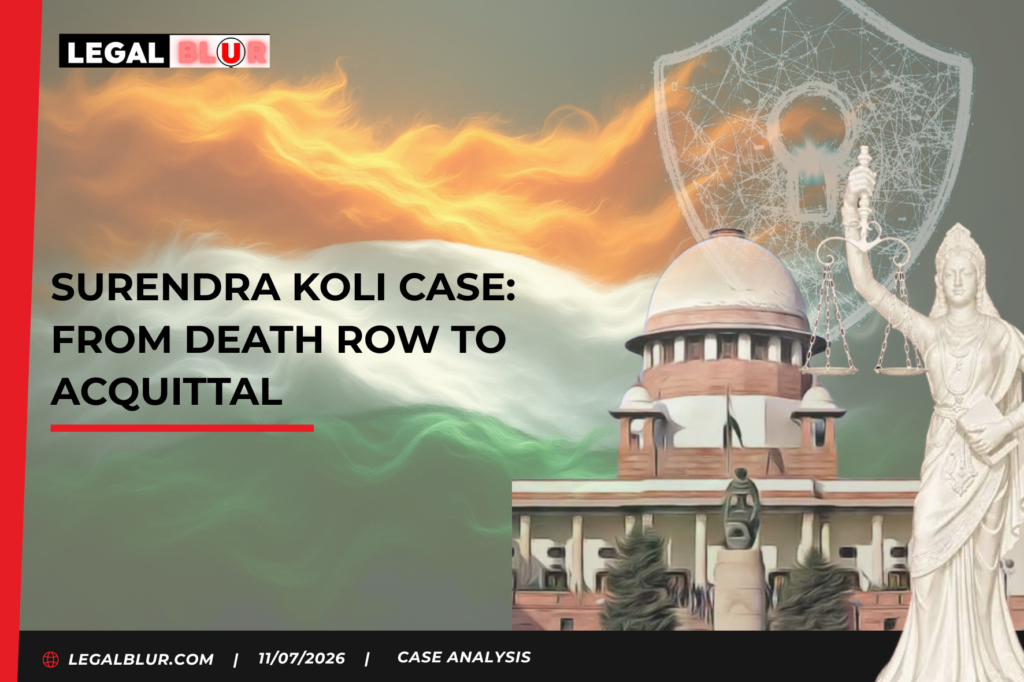
On 11 November 2025, a three-Judge Bench of the Supreme Court of India comprising Chief Justice B.R. Gavai and Justices Surya Kant and Vikram Nath allowed a curative petition. It acquitted Surendra Koli of murder, kidnapping, rape and destruction of evidence in the Rimpa Haldar case, the last surviving conviction arising from the Nithari killings of 2005–06. The judgment, reported as 2025 INSC 1308, closed a twenty-year ordeal that began with the discovery of skeletal remains behind a house in Noida’s Nithari locality and culminated in Koli’s release after nearly two decades, much of it spent on death row. What makes the verdict jurisprudentially significant is not merely the acquittal itself, but the route by which it was achieved: the Court invoked its rarest post-judgment remedy, the curative petition, to undo a final and twice-affirmed conviction, on the ground that an identical evidentiary foundation had already been declared unreliable by the same Court in twelve companion prosecutions.
Keywords: Curative petition; circumstantial evidence; Section 164 CrPC confession; Section 27 Evidence Act; death penalty jurisprudence.
Background of the Nithari Killings
In December 2006, police excavated a drain behind House No. D-5, Sector 31, Noida the residence of businessman Moninder Singh Pandher recovered skeletal remains, skulls, bones, clothing, and footwear linked to several missing children and young women from the adjoining Nithari village. Pandher’s domestic servant, Surendra Koli, a migrant labourer, was arrested on 29 December 2006. The Central Bureau of Investigation eventually registered separate FIRs for each victim, resulting in thirteen separate criminal trials, all resting on the same evidentiary core: an alleged confession recorded under Section 164 of the Code of Criminal Procedure, 1973, and recoveries of physical evidence said to have been made pursuant to Koli’s disclosure statements under Section 27 of the Indian Evidence Act, 1872.
Facts and Procedural History
The Rimpa Haldar matter concerning a minor girl who disappeared in 2005 proceeded fastest. The trial court convicted Koli in 2009 under Sections 302, 364, 376 and 201 of the Indian Penal Code and sentenced him to death; the Allahabad High Court confirmed this in September 2009, and the Supreme Court affirmed both conviction and sentence in February 2011 (Surendra Koli v. State of U.P., (2011) 4 SCC 80).
A review petition was dismissed in October 2014, and in January 2015 the High Court commuted the death sentence to life imprisonment owing to delay in disposing of Koli’s mercy petition. Meanwhile, the twelve companion prosecutions followed a markedly different trajectory: on 16 October 2023, the Allahabad High Court acquitted Koli in all of them, holding the confession involuntary and the recoveries legally untenable, and on 30 July 2025 the Supreme Court dismissed the State’s appeals against those acquittals.
This left an untenable position Koli stood convicted for life in one case and exonerated in twelve others on the very same confession and the very same recoveries. He thereafter filed a curative petition against the 2011 judgment, which the Court allowed on 11 November 2025, recalling its own earlier judgment and the 2014 review order, and acquitting him outright.
Issues, and the Parties’ Positions
The central question was narrow but profound: could two final orders of the same Court, resting on an identical evidentiary record, lawfully coexist where one affirms guilt and the other proclaims innocence? The State argued that curative jurisdiction is confined to breaches of natural justice or apprehended bias under Rupa Ashok Hurra v. Ashok Hurra, (2002) 4 SCC 388, and that re-appreciating settled findings on the confession and recoveries would convert the curative remedy into a fourth round of appeal. Koli’s counsel countered that the inconsistency itself was a structural defect striking at the integrity of the justice-delivery system, distinct from ordinary error correction, and that allowing the conviction to stand would perpetuate a violation of Articles 14 and 21 that the Court had itself already recognised in the companion cases.
Judgment and Judicial Reasoning
The Bench accepted Koli’s position. It held that where the Supreme Court’s own subsequent findings have discredited the very confession and recoveries that anchored an earlier, final conviction, permitting that conviction to survive would offend the guarantee of fair procedure under Article 21 and produce an arbitrary disparity in outcomes proscribed by Article 14. The Court found the Section 164 confession tainted: Koli had been held in continuous police custody for roughly sixty days before it was recorded, legal aid was illusory, and the Magistrate recorded no independent satisfaction of voluntariness. The Section 27 recoveries fared no better; the remains lay in a municipal drain and open gallery already accessible to the public and known to investigators, defeating the “exclusive knowledge” requirement, while contradictions between panchnamas and remand papers further undermined their evidentiary value. With both pillars removed, the Court held, “the circumstantial chain no longer holds,” and continuing incarceration on such a foundation could not be reconciled with the presumption of innocence.
Legal Analysis
Circumstantial Evidence and Burden of Proof
The judgment reaffirms the Sharad Birdhichand Sarda standard that circumstances must be fully established and exclude every reasonable hypothesis but guilt; a single discredited link collapses the entire chain, irrespective of the gravity of the underlying crime.
Presumption of Innocence and Benefit of Doubt
The Court treated the presumption as a continuing constitutional entitlement that survives even a final conviction where the evidentiary basis is subsequently shown to be illusory, extending the benefit-of-doubt doctrine into the post-finality stage through the curative mechanism.
Reliability of Evidence and Investigative Failure
Forensic searches of Pandher’s house yielded no corroborating bloodstains, and recovered weapons bore no forensic link to the injuries. Both the High Court and Supreme Court characterised the investigation as “botched,” noting that an organ-trafficking lead flagged by a government committee was never pursued a finding that converts individual evidentiary infirmity into a systemic critique of investigative practice.
Constitutional Dimensions
Articles 20(3) (protection against self-incrimination), 21 (fair procedure) and 14 (equality) were read together to hold that coerced testimony and arbitrary disparity in outcomes are constitutionally impermissible, regardless of finality.
Death Penalty Jurisprudence
The case exemplifies heightened appellate caution in capital matters: a person spent nearly two decades, much of it under sentence of death, for a crime the evidentiary foundation for which could not withstand scrutiny a sobering data point in the debate over irreversible punishment.
Precedents Strengthened, and Doctrinal Contribution
Koli does not overturn Rupa Ashok Hurra but extends it, recognising that exceptional circumstances involving conflicting final judgments on an identical evidentiary record may justify the exercise of curative jurisdiction. Beyond natural-justice violations and bias: the prevention of “discordant voices” within final orders of the same Court on an identical record. It reaffirms Sharad Birdhichand Sarda on circumstantial evidence and implicitly revives the spirit of Kali Ram v. State of Himachal Pradesh that the law tilts decisively in favour of liberty where doubt persists. It also signals that appellate review in criminal cases is not exhausted by the formal closure of review jurisdiction where the Court’s own subsequent record reveals a structural inconsistency.
Critical Evaluation and Contemporary Relevance
Supporters view the judgment as a vindication of constitutional fidelity over procedural finality, and a rare acknowledgment of two decades lost to flawed police work. Critics caution that expanding curative grounds risks diluting the doctrine’s deliberately narrow character and inviting repeated post-finality litigation in unrelated cases lacking Koli’s unusual procedural symmetry. The judgment also reflects the judiciary’s increasingly cautious approach towards confirming death sentences where evidentiary certainty is lacking, reflecting growing institutional unease with capital punishment absent airtight evidence, and it strengthens calls for mandatory legal aid at the confession stage, audio-video recording safeguards, and compensation frameworks for the wrongfully incarcerated.
Conclusion
Surendra Koli v. State of Uttar Pradesh is less a vindication of innocence than an admonition against allowing institutional inertia to entrench injustice once a court’s own findings have undercut the basis of a conviction. By using the curative jurisdiction to align an outlying judgment with the truth its sister benches had already found, the Supreme Court reaffirmed that consistency, fair procedure and the presumption of innocence are not casualties of finality. The judgment is likely to have a lasting impact on India’s jurisprudence relating to curative petitions, evidentiary standards and capital punishment.
References
- Surendra Koli v. State of Uttar Pradesh, 2025 INSC 1308 (curative petition, decided 11 Nov 2025)
https://indiankanoon.org/doc/85701969/ - Surendra Koli v. State of U.P., (2011) 4 SCC 80 (Criminal Appeal No. 2227/2010, decided 15 Feb 2011)
https://indiankanoon.org/doc/659859/ - Rupa Ashok Hurra v. Ashok Hurra, (2002) 4 SCC 388
https://indiankanoon.org/doc/123456797/ - Sharad Birdhichand Sarda v. State of Maharashtra, (1984) 4 SCC 116
https://indiankanoon.org/doc/1505859/ - Kali Ram v. State of Himachal Pradesh, (1973) 2 SCC 808
https://indiankanoon.org/doc/1072474/ - Indian Penal Code, 1860 (ss. 302, 364, 376, 201)
https://www.indiacode.nic.in/handle/123456789/2263 - Code of Criminal Procedure, 1973 (s. 164)
https://www.indiacode.nic.in/handle/123456789/1611 - Indian Evidence Act, 1872 (s. 27)
https://www.indiacode.nic.in/handle/123456789/15351 - SCC Online Blog, “Supreme Court Acquits Nithari Killings Accused Surendra Koli” (12 Nov. 2025), https://www.scconline.com/blog/post/2025/11/12/supreme-court-acquits-nithari-killings-accused-surendra-koli/
- The Leaflet, “Judgment Summary: Surendra Koli’s Acquittal in Nithari Killings,” https://theleaflet.in/supreme-court/judgment-summary-surendra-kolis-acquittal-in-nithari-killings-after-16-years-on-death-row-and-why-curative-jurisdiction-remains-crucial/
- LiveLaw, “The Ghosts of Nithari: When Suspicion Cannot Substitute Justice,” https://www.livelaw.in/articles/supreme-court-acquittal-surendra-koli-nithari-killings-analysis-309710
- LawBeat, “Nithari Killings: Supreme Court Sets Aside Conviction of Surendra Koli, Orders Immediate Release,” https://lawbeat.in/top-stories/nithari-killings-supreme-court-sets-aside-conviction-of-surendra-koli-orders-immediate-release-1538956
- Business Standard, “Nithari Killings: Supreme Court Acquits Surendra Koli in Last Case” (11 Nov. 2025), https://www.business-standard.com/india-news/nithari-killings-supreme-court-acquits-surendra-koli-moninder-pandher-125111100801_1.html
- Legal Services India, “SC Acquits Surendra Koli in Nithari Killings After 16 Years on Death Row,” https://www.legalservicesindia.com/law/article/40240/9/SC-Acquits-Surendra-Koli-In-Nithari-Killings-After-16-Years-On-Death-Row