This Article is written by Shalom Manamela from Noida International University.
Abstract
Sexual violence remains as one of the biggest human rights violations in today modern era, despite having reforms in the legislative, a vast number of public awareness and international advocacy for example the #METoo, cases of rape and sexual assault continue to rise that too at a very disturbing rate around the world. The Nirbhaya case, in India which took place in 2012 marked a very humongous moment as it led to vast legal reforms and renewed calls for gender justice. Despite all these efforts, the persistence of sexual violations still raises a very critical question on the effectiveness of the legal frameworks. Society attitude towards victims and the bigger role of law when it comes to preventing such crimes. This article examines the legal treatment of rape under the Bhartiya Nyaya Sanhita, 2023, it compares Indias approach to that of international legal systems while also analysing the debate which surrounds capital punishment for offenders of rape and l will also explore the social realities that still continue to be a hindrance to justice for survivors.
Introduction
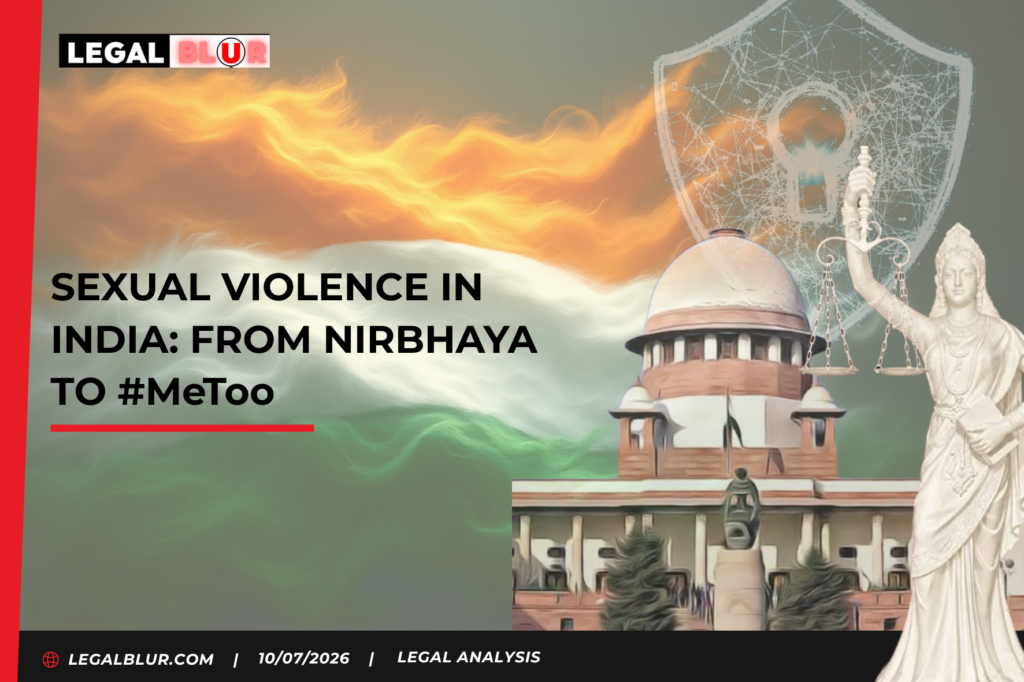
It has been more that a decade since the Nirbhaya case shook India and was able to grab the attention of the whole world. It was the brutal gang rape and murder of a young woman in Delhi and this case sparked nationwide protest, international condemnation and demands for stronger legal protections against sexual violence. This case rose to become a symbol of the struggle for women safety and dignity especially in India. Rape continues to dominate news headlines despite having stricter laws and harsher punishments. There is hardly a day which passes without a report of sexual assault, rape and violence against women in some parts of the country. Crimes that are similar continue to occur in different parts of the world making rape not unique to India and it also shows that sexual violence is not just a national problem but rather a global crisis which is affecting societies regardless of economic developments, culture and political systems
They are some difficult questions which arise due to the persistence of these crimes such as if legal reforms are sufficient or enough to deter offenders?, Why does survivors usually face social scrutiny while on the other hand perpetrators mostly receive sympathy?, the fact also that why are women inappropriately affected and male victims why are they underreported?. These questions form the basis and give the essence of my research and this analysis.
Cases that have shocked the conscience of Humanity in the world
There are certain crimes that can transcend national boundaries and they end up becoming symbols of humanity’s collective failure to be able to protect the vulnerable. The following cases are some of the examples:
The Nirbhaya case in India remains one of the most significant examples and its solely due to the brutality of the offence as it was able to enable widespread public outrage and it promoted a humongous number of reforms in criminal law. This case was able top transform public discourse about women safety and it was able to compel lawmakers to reconsider all existing legal protections.
This was a rape and murder case which was able to expose the vulnerability of children and it was able to highlight or show how social and political had the opportunity or chance to be able to obstruct justice
The Unnao rape case showcased how the use of power and influence is sometimes used to intimidate or scare victims and sometimes to also interfere with legal proceedings.
- Global Cases
Outside of India there Are plenty of cases that have gone beyond humanity and shocked the world for example the Junko Furuta Case (Japan, 1988–1989), which took place in Japan it was able to reveal the horrifying consequences of sexual violence and torture. The Steubenville sexual assault case which took place in the United States of America was able to showcase the influence of rape cultures and victim blaming attitudes. In a more recent case, which is the Gisèle Pelicot Case (France), it was able to reignite global discussions focused on consent, sexual violence and accountability.
These cases may differ in context however they are able to reveal l believe a common truth which is that sexual violence remains one of the profound violations of human dignity and fundamental human rights.
Understanding Rape under Indian Laws
Section 63 of the Bharatiya Nyaya Sanhita, 2023 defines the offence of rape. Sections 64 to 71 prescribe punishments for rape under different circumstances, including aggravated rape, also able to outline the circumstances where sexual intercourse is able to constitute to the offence especially in cases where consent is absent, coerced, obtained through deception and when a victim is unable or incapable of giving a valid consent. Consent is supposed to be free, informed and voluntary according to the law, it also further states that the absence of physical resistance also does not mean automatic consent.
Under the BNS there are also severe penalties which all depend on the circumstance and with punishment starting from rigorous imprisonment, life imprisonment and in aggravated cases it may lead to even a death penalty for example in cases which involve minors, repeated offenders and situations that may result in death, all these attract enhanced penalties.
Comparative Position: India and Other Jurisdictions
Every country has a different way in which it approaches sexual offences, which are also different from India; for example, under the Sexual Offences Act 2003 (UK), rape carries a maximum sentence of life imprisonment. The United Kingdom also puts emphasis on victim support services or systems, and it also makes use of specialised investigative procedures. In the United States of America, there are different approaches to sentencing that vary across states. Most states impose lengthy imprisonment, while a few jurisdictions permit capital punishment only where rape is accompanied by homicide or other capital offences.
In countries like Germany, France and Sweden, there is a humongous growth which pertains to legal definitions of consent, and it can place greater emphasis on whether there was genuine consent rather than the fact whether physical force was used. South Africa’s Criminal Law (Sexual Offences and Related Matters) Amendment Act, 2007 adopts a broad definition of sexual offences and provides specialised sexual offences courts.
Do Extreme Cases of Rape Warrant the Death Penalty?
This question has managed to generate a lot of debate when it comes to whether rapists should face execution, also known as the death penalty. Some of the supporters of capital punishment argue that heinous crimes, especially ones that go beyond humanity, especially in cases that involve children, extreme brutality, or murder as they believe this justify the ultimate penalty. They argue that society has a moral obligation to impose the harshest sentence or punishment on offenders whose actions showcase complete disregard for human life and dignity. However, some critics argue that the death penalty itself violates the right to life as it fails to provide conclusive evidence of deterrence.
Some organisations argue that life imprisonment is enough to punish offenders without disregarding human life and dignity. An example of such an organisation is the Human Rights Organisation. There is also a very big concern which is that offenders might likely end up killing their victims if the punishments for rape and murder are all identical. This may result in situations where eliminating witnesses might appear as an advantage to the offenders. In the rarest of rare doctrine from India, it tries to bring about a balance between these competing perspectives. However, the debate remains unsolved internationally and domestically.
Why is it that Victims are Judged very Harshly rather than the Offenders?
The very most disturbing aspect of sexual violence is the treatment that is given to survivors after the crime. They are frequently asked or questioned about what they were wearing, their behaviour, and sometimes even their whereabouts. These questions mostly shift the attention from the offenders or the perpetrators to the victim. This culture of victim blaming literally persists across different legal systems and different societies. The fact that an assumption that the victim’s clothes or their behaviour and conduct could have resulted in the assault has been rejected again by criminological and psychological researchers.
Sexual violence is rather believed to be an act of power, domination, and violation rather than a response to any appearance or behaviour. Consequences of victim-blaming are very severe, as some victims or survivors may suffer from depression, anxiety, social isolation, and reluctance to report a crime. One of the biggest barriers to justice is public fear, just like the legal process itself.
Sexual Violence, Society and Masculinity
To fully understand sexual violence, we need to fully examine the societal attitude, as in many societies, including India as well, they have patriarchal structures down from their history, which constitute unequal power dynamics between men and women. When it comes to men, they usually advocate for dominance, entitlement, and control. While for women, they are expected to conform to restrictive social expectations.
However, I think it would be unfair to state that men are solely responsible for sexual violence, as some of the most men do not commit such crimes. I believe the problem lies within society’s harmful norms and cultures that can tolerate misogyny, objectification, and gender inequality. Studies from different countries have subsequently found a relationship between gender inequality and higher rates of violence against women.
Why are most Victims usually Females
Based on statistical data and evidence from all over the world, it shows that women and girls are the ones who constitute most of the reported rape and sexual assault victims. Historical gender inequality, physical vulnerability, economic dependence, and societal power imbalances are some of the factors that are contributing to this reality.
At the same time, male victims remain underrepresented in official statistics; however, it does not necessarily mean that men are rarely victimised, as many male survivors often face stigmatisation, embarrassment, fear of disbelief, and perceptions of masculinity, which results in many cases of sexual violence against them being underreported and not really discussed. I believe that true justice should acknowledge and support all victims regardless of their gender.
Beyond Punishment: The Need for a Comprehensive Response
The need of strict laws is necessary however punishment alone can never eliminate sexual violence. For reforms to be meaningful, there is a need for sex education, public awareness campaigns, gender sensitive policing, survivor support services, efficient judicial services and strong community engagement. Families and some organisations for example education and religious organisations can play a crucial role in challenging harmful attitudes that are normalising violence and discrimination. For us to succeed in the fight against sexual violence there is need to move from reactive punishment to proactive punishment.
Conclusion
To conclude, persistent challenges and remarkable progress can be seen in the journey from Nirbhaya to the #MeToo movement. New legal reforms can strengthen protections meant for survivors, and they have increased penalties for offenders or perpetrators. The persistence of the crime of sexual violence can demonstrate that law alone can never solve this problem. Sexual violence is still one of the biggest challenges or crises of law, culture, power and human rights. I believe that the true measure of justice does not simply lie in being able to punish offenders or perpetrators, but it is also in being able to create such a society where survivors do not just feel protected but are also treated with dignity, and until that goal has been achieved, the promise to victims of a safer and more equitable world remains unfinished.
The legacy of Nirbhaya and the countless other survivors and victims, I believe, demands more than just outrage. It demands better and sustained legal frameworks, the transformation of society, and a collective commitment that can ensure that every individual can live freely from fear, violence, and discrimination.
Frequently Asked Questions
1. How did the Nirbhaya case change India’s laws on sexual violence?
The 2012 Nirbhaya case led to significant criminal law reforms, including stricter punishments, broader definitions of sexual offences, and improved victim protection measures.
2. What is the #MeToo movement?
The #MeToo movement is a global campaign that encourages survivors of sexual harassment and assault to share their experiences and demand accountability.
3. Why does sexual violence remain a persistent issue despite legal reforms?
Factors such as underreporting, social stigma, delayed trials, inadequate enforcement, gender inequality, and cultural attitudes continue to hinder effective prevention and justice.
4. What legal protections exist for survivors in India?
Survivors are protected under laws including the Bharatiya Nyaya Sanhita, 2023 (BNS), the Protection of Children from Sexual Offences (POCSO) Act, 2012, and various victim compensation and support mechanisms.
5. What more is needed to combat sexual violence?
Along with stronger enforcement, effective prevention requires gender-sensitive education, institutional accountability, survivor support services, faster investigations, and greater public awareness.