This article is written by Kashish Yadav, Chhatrapati Shahu Ji Maharaj University. This article examines the factual background, the legal reasoning, and the continuing precedential value of the Rajesh Agarwal ruling, including how subsequent decisions of the Supreme Court have refined its application.
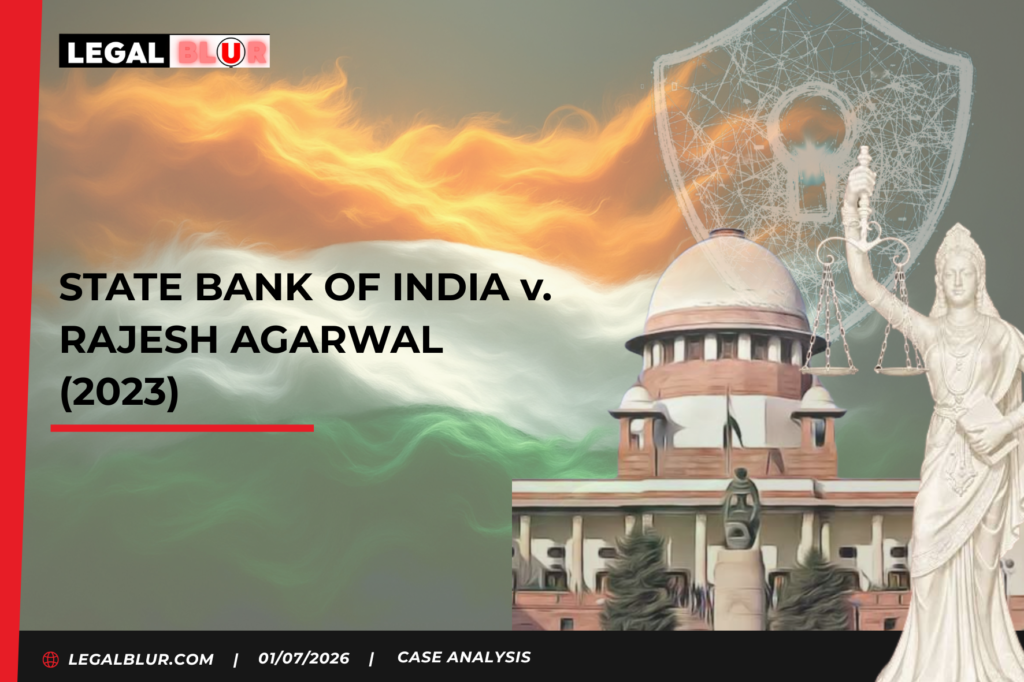
Audi Alteram Partem in Banking Regulation: How State Bank of India v. Rajesh Agarwal (2023) Reshaped Fraud Classification of Borrower Accounts
Banking regulation in India has long balanced two competing imperatives: the need for lenders to act swiftly against fraudulent borrowers, and the constitutional guarantee that no person should be condemned without a hearing. The Reserve Bank of India’s Master Directions on Frauds, Classification and Reporting by Commercial Banks and Select FIs, 2016 permitted banks to declare a borrower’s account as “fraud” based on forensic audit findings alone, without affording the borrower any opportunity to respond before the classification took effect. Such a declaration carried severe consequences: blacklisting from future credit facilities, debarment of promoters and directors for several years, and reputational harm that often preceded any criminal trial.
The question of whether this administrative process violated the principles of natural justice reached the Supreme Court of India in State Bank of India & Ors. v. Rajesh Agarwal & Ors., decided on 27 March 2023, reported at (2023) 6 SCC 1. The judgment, delivered by a bench comprising the then Chief Justice D.Y. Chandrachud and Justice Hima Kohli, continues to shape the legal framework governing fraud classification and has been reaffirmed in subsequent judicial decisions.
Background and Facts
The dispute arose when borrower companies, whose accounts had turned into non-performing assets, were subjected to forensic audits by a Joint Lenders’ Forum led by public sector banks including the State Bank of India. Based on the audit findings, the lenders classified the accounts as “fraud” under the 2016 Master Directions without prior notice or a hearing to the borrowers or their promoters. One of the lead petitioners only learnt of the classification after receiving a copy of an FIR, well after the decision had already been made.
Aggrieved borrowers challenged the classification before the High Court of Telangana, which in December 2020 held that natural justice must be read into the Master Directions. Similar challenges before other High Courts yielded varying outcomes, creating a split that the RBI and lending banks brought before the Supreme Court through a batch of civil appeals led by Civil Appeal No. 7300 of 2022.
Issues Before the Court
- Whether the principles of natural justice, particularly audi alteram partem, are implicit in the RBI’s Master Directions on Frauds even though the text of the Directions does not expressly provide for a hearing.
- Whether classifying a loan account as “fraud”, with its attendant civil and penal consequences, amounts to a “civil consequence” sufficient to attract constitutional due process protections under Article 14 and Article 21 of the Constitution.
Arguments of the Parties
Counsel for the borrowers argued that fraud classification was not a mere internal banking formality but a quasi-penal label with civil consequences comparable to blacklisting or debarment, both of which Indian courts have long held require a prior hearing. They contended that the absence of an opportunity to respond to forensic audit findings, which often form the sole basis for classification, rendered the process arbitrary and violative of Article 14.
The banks and the RBI, on the other hand, argued that fraud classification was a preliminary, fact-finding exercise meant to enable timely reporting to regulators and law-enforcement agencies, that introducing a hearing requirement would cause damaging delays, and that affected parties retained adequate remedies through subsequent civil or criminal proceedings where they could contest the findings.
Holding and Reasoning
The Supreme Court ruled in favour of the borrowers, holding that the principles of natural justice, particularly audi alteram partem, must be read into the Master Directions even though they are not expressly stated therein. The Court reasoned that classifying an account as fraudulent triggers significant civil consequences for the borrower and its directors, including a bar on raising future credit, exclusion from restructuring schemes, and exposure to criminal reference, well before any independent examination of the allegations.
Such consequences, the Court held, meet the threshold for civil consequences recognised under Article 21, obliging banks to act fairly. The bench relied on settled administrative law doctrine, including its own precedents on blacklisting and debarment that courts will read in a fair hearing requirement whenever a decision visits civil or penal consequences, even where the governing regulation is silent on procedure. At the same time, the Court clarified that natural justice does not apply at the stage of registering a First Information Report, since criminal law operates independently of the administrative classification process.
The Court accordingly directed banks to issue a show cause notice along with relevant portions of the forensic audit report, consider any reply, and pass a reasoned order before classifying an account as fraud.
Comparison with Earlier Jurisprudence
The reasoning in Rajesh Agarwal builds directly on a settled line of Indian administrative law. In Maneka Gandhi v. Union of India, (1978) 1 SCC 248, a seven-judge bench held that any person prejudicially affected by a decision entailing civil consequences must be given an opportunity of being heard, reading fairness into Article 21 itself. In Erusian Equipment & Chemicals Ltd. v. State of West Bengal, (1975) 1 SCC 70, the Court held that blacklisting a contractor without a hearing violates natural justice because it inflicts serious civil and reputational consequences. Rajesh Agarwal extends this same logic to fraud classification, treating it as functionally analogous to blacklisting given its impact on a borrower’s access to credit and standing.
This continuity is significant: the Court was not creating a novel right but applying an established constitutional principle to a new regulatory context, which strengthens the precedent’s durability against future challenge.
Subsequent Clarification
The precedent set in Rajesh Agarwal has continued to generate litigation over its precise scope. Several High Courts, including the Delhi High Court in cases such as Punjab National Bank v. TV Vision Limited and Ashish Gupta v. State Bank of India, read the judgment as requiring banks to furnish the complete forensic audit report and, in some instances, a personal hearing, leading to further appeals by lending banks.
In 2026, a bench of Justice J.B. Pardiwala and Justice K.V. Viswanathan resolved this uncertainty in appeals brought by the State Bank of India and Bank of India against the Calcutta and Delhi High Courts. The Court held that Rajesh Agarwal did not recognise any inherent right to a personal or oral hearing, and that a detailed show-cause notice, a minimum twenty-one-day window to respond in writing, and a reasoned order the procedure since codified in the RBI’s 2024 Master Directions fully satisfy the audi alteram partem standard. The bench cautioned against the “unnatural expansion of natural justice” without regard to the practical realities of fraud detection, noting the scale of fraud reporting across the banking sector and the risk that mandatory personal hearings could allow borrowers to dissipate assets or destroy evidence.
This clarification illustrates how the 2023 ruling continues to operate as the foundational precedent, with later benches calibrating its practical application, particularly on the oral-versus-written hearing question, rather than departing from its core holding. Separately, in Central Bureau of Investigation v. Surendra Patwa & Ors., the Court clarified that setting aside a fraud classification for breach of natural justice does not, by itself, invalidate an FIR or criminal proceedings already initiated on that basis, reaffirming that administrative and criminal processes operate on independent tracks.
Critical Analysis
The judgment strengthens procedural fairness within the banking sector. Before this ruling, borrowers could suffer severe and often irreversible consequences: loss of access to credit, reputational harm, and exposure to criminal reference without any opportunity to explain their position. By treating fraud classification as carrying “civil consequences” within the meaning of Article 21, the Court closed a significant gap through which administrative convenience had been allowed to override constitutional due process.
At the same time, the Court was careful not to impose an unworkable burden on banks. By requiring a notice-and-written-reply mechanism rather than a mandatory oral hearing a position the 2026 bench later made explicit the Court balanced borrower protection against the banking sector’s legitimate interest in timely fraud detection and reporting. This calibrated approach offers a workable template for how courts can harmonise constitutional values with regulatory efficiency in other fast-moving areas of financial regulation, including insolvency and securities enforcement.
Significance of the Precedent
- It reaffirms that regulatory silence on procedure cannot bypass constitutional due process, extending natural justice jurisprudence into banking regulation.
- It recalibrates the relationship between regulators such as the RBI and the borrowers they oversee, requiring a more transparent classification process.
- It had direct regulatory impact: the RBI superseded the 2016 Master Directions with new Master Directions on Fraud Risk Management in 2024, formally incorporating a show-cause-notice-and-reply mechanism consistent with the Court’s directions.
Finally, it illustrates the evolving judicial approach to balancing institutional efficiency against individual rights across India’s financial regulatory architecture a tension that recurs in banking, insolvency, and securities law, and one that subsequent benches have continued to refine rather than reopen.
Conclusion
State Bank of India v. Rajesh Agarwal stands as a significant affirmation that procedural fairness cannot be sacrificed at the altar of administrative convenience, even within the technical and fast-moving world of banking regulation. By reading the audi alteram partem principle into the RBI’s Master Directions on Frauds, the Supreme Court ensured that borrowers facing the serious consequences of a fraud classification are no longer silent bystanders to decisions that can permanently affect their financial standing and reputation.
The judgment’s continuing relevance, evident from its invocation in disputes as recent as 2026, confirms its place as binding precedent that lower courts and regulators alike must reckon with. At the same time, the Court’s calibrated approach requiring disclosure and a reasoned written response rather than an elaborate personal hearing in every instance reflects a workable compromise that protects borrower rights without unduly hampering the banking sector’s ability to detect and report fraud. As Indian banking law continues to evolve, this precedent offers a template for how courts can harmonise regulatory efficiency with constitutional due process.
Frequently Asked Questions
1. What did the Supreme Court decide in State Bank of India v. Rajesh Agarwal?
The Court held that banks must observe the principles of natural justice, specifically audi alteram partem, before classifying a borrower’s loan account as “fraud” under the RBI’s Master Directions on Frauds, even though the Directions themselves were silent on the requirement.
2. What is the citation and bench for this case?
The judgment was delivered on 27 March 2023 in Civil Appeal No. 7300 of 2022 and is reported at (2023) 6 SCC 1, by a bench of the Supreme Court of India comprising the then Chief Justice D.Y. Chandrachud and Justice Hima Kohli.
3. Does the ruling require banks to give borrowers a full personal hearing?
No. The Supreme Court directed banks to issue a show cause notice, share relevant forensic audit findings, and consider a written reply before classification. A 2026 ruling by Justice J.B. Pardiwala and Justice K.V. Viswanathan expressly clarified that Rajesh Agarwal never recognised a right to an oral personal hearing, and that the written notice-and-reply procedure now codified in the RBI’s 2024 Master Directions satisfies the fairness standard.
4. Why is this judgment considered a landmark precedent?
It extends constitutional due process protections into banking regulation, prompted the RBI to formally replace its 2016 Master Directions with new Master Directions on Fraud Risk Management in 2024, and continues to be cited and applied by the Supreme Court in subsequent disputes, making it a foundational authority on natural justice in administrative and financial regulatory action.
5. What consequences follow when an account is classified as fraud?
Consequences include a bar on the borrower and its promoters or directors from accessing fresh institutional credit, exclusion from debt restructuring schemes, and exposure to criminal reference to investigating agencies, all of which the Supreme Court recognised as significant civil consequences warranting due process protection.