This article is written by Sujal Tyagi, Vivekananda Institute of Professional Studies (VIPS), New Delhi.
Keywords: Election Commission of India, Appointment Process, Judicial Activism, Electoral Independence, Article 324 of the Indian Constitution.
The credibility of the organization which conducts the elections is the backbone of a democracy. In India, it is the Election Commission of India (ECI) established by Article 324 of the Constitution. Article 324(2) that empowers Parliament to enact rules for the appointment of the Chief Election Commissioner (CEC) and the Election Commissioners (ECs) was never used for almost seventy years. But in its absence, the executive took all decisions regarding appointments and that raised apprehensions about how the ECI could work without the government of the day.
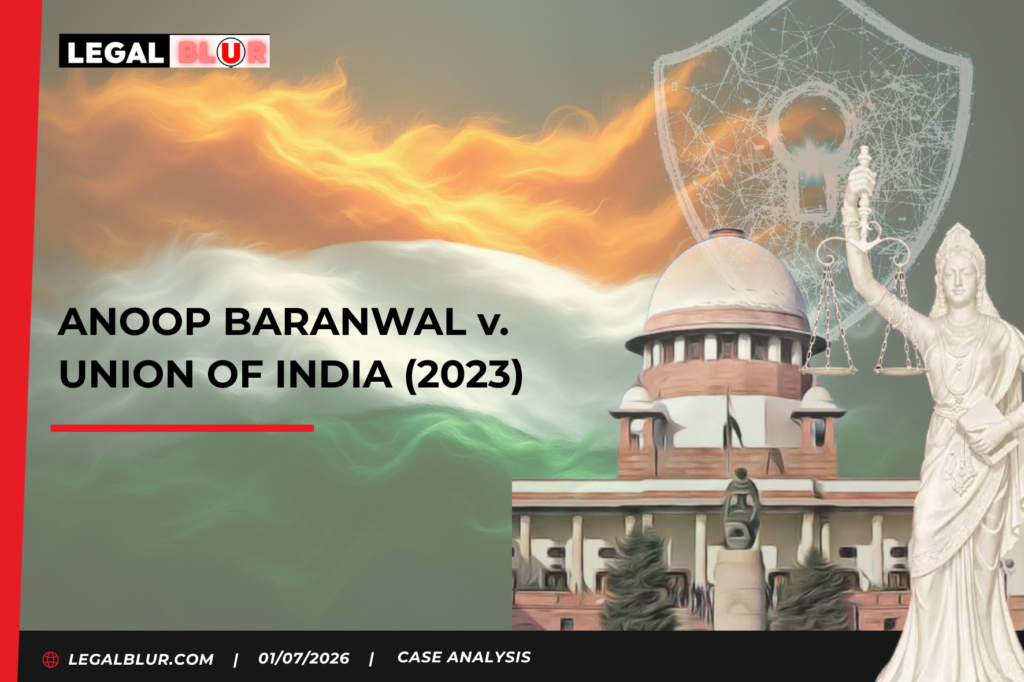
To fill this void, advocate Anoop Baranwal had filed a Public Interest Litigation (PIL) petition in the Supreme Court in 2015. The 5-judge Bench in the case of Anoop Baranwal v. Union of India, (2023 SCC OnLine SC 216) delivered its unanimous judgment on 2 March 2023, stating that until the Parliament passed a law, the CEC and ECs would be appointed on the recommendation of a panel comprising of the Prime Minister, the Leader of the Opposition and the Chief Justice of India. This piece looks at the facts, the rationale of the Court, and the implications of the judgment since.
Background and Constitutional Framework
The President’s appointment of the CEC and the ECs under Article 324(2) is subject to any law Parliament might enact. Parliament didn’t exercise this power and for decades, the appointments were made solely by the executive which would recommend names to the President who would formalise the appointment. It wasn’t illegal but it didn’t sit well with the concept that an umpire of an election should be selected by one of the players. Article 324(5) provides that the Chief Election Commissioner enjoys the same protection from removal as a Judge of the Supreme Court. Other Election Commissioners cannot be removed except on the recommendation of the Chief Election Commissioner.
Issues before the Court
The Bench, which comprised Justices K.M. Joseph, Ajay Rastogi, Aniruddha Bose, Hrishikesh Roy and C.T. Ravikumar, raised three questions: whether the current executive-driven appointment process hurt the independence of the ECI and thus breached the Constitution; whether there was any constitutional vacuum that Parliament could fill, pursuant to a Constitutionally guaranteed separation of powers, and whether the Court, by formulating its own appointment process, would encroach upon the territory of the Parliament.
Arguments Raised
For the petitioners, senior advocate Gopal Sankaranarayanan and Advocate Prashant Bhushan contended that there was no mechanism to check the discretion of the executive in appointments and the criteria were neither transparent nor merit-based, making Article 14 applicable. They claimed that this guarantee also amounted to nothing without an ECI that was truly independent of executive control, since Indira Nehru Gandhi v. Raj Narain (1975) had declared free and fair elections to be an integral part of the basic structure of the Constitution. The Union of India, on the other hand, has come out with a counter-proposal to maintain the status quo, arguing that the proposal to reform must originate from Parliament and not the judiciary and that a mechanism set out by judges would be a “legislating from the bench”.
The Supreme Court’s Judgment
Justice K.M. Joseph authored the principal judgment, while Justice Ajay Rastogi delivered a separate concurring opinion. The Court held that Parliament had created a real constitutional vacuum and it stated that the Court was responsible for filling this void and not allow ECI to lose its independence. It has acted when the legislature failed to act, by relying on the case of Vineet Narain v. Union of India (1998) which established guidelines for appointing the CBI Director until legislation is enacted and the Vishaka v. State of Rajasthan (1997) case which issued binding guidelines on workplace sexual harassment.
On this ground, the Court had directed the President to appoint CEC and ECs by a committee of the Prime Minister, the leader of the opposition in the Lok Sabha (or leader of the largest opposition party, in the absence of any recognised opposition party) and the Chief Justice of India. This was only a temporary measure as it was in till Parliament acts under article 324(2) and passes a law. The Court also recommended that Parliament consider providing comparable protection to Election Commissioners and establishing an independent secretariat with expenditure charged to the Consolidated Fund of India, recommending an independent secretariat (expense to be borne by Consolidated Fund of India).
Legislative Response and Subsequent Controversy
Eventually, Parliament came through with the Chief Election Commissioner and Other Election Commissioners (Appointment, Conditions of Service and Term of Office) Act, 2023, which was passed on 21 December 2023. The Act, however, left the Chief Justice of India out of the committee and substituted that with a Union Cabinet Minister nominated by the Prime Minister. This brings the balance to an executive majority as the two other seats are taken up by the Prime Minister and the Leader of the Opposition, which the Court had hoped to remove.
Conclusion
Anoop Baranwal v. Union of India will likely be remembered as a significant judgment in India’s electoral law, both for what it said about the ECI and about the judiciary’s own role. By directing the inclusion of the Chief Justice of India in the interim appointment process, the Court tried to ensure that the body running elections is not chosen solely by the executive whose own fate those elections decide. It is equally important as an instance of judicial gap-filling, where the Court steps in, at least temporarily, when Parliament’s inaction threatens a constitutional value.
The story, however, is far from settled, as the pending challenge to the 2023 Act shows. What the judgment has firmly established is that the independence of the Election Commission is not a favour the government of the day gets to hand out. It is a basic requirement of democracy itself, one court will keep returning to whenever it is threatened.
Frequently Asked Questions
1. What was the central issue in Anoop Baranwal v. Union of India (2023)?
Whether letting the executive alone appoint the CEC and ECs, with no law under Article 324(2) to guide the process, was constitutionally valid and consistent with the ECI’s independence.
2. What appointment committee did the Supreme Court direct?
A committee of the Prime Minister, the Leader of the Opposition in the Lok Sabha (or the leader of the largest opposition party), and the Chief Justice of India, operative until Parliament passes its own law.
3. Which earlier cases did the Court rely on?
Vineet Narain v. Union of India (1998) and Vishaka v. State of Rajasthan (1997), to justify stepping in where legislation was missing, and Indira Nehru Gandhi v. Raj Narain (1975), to support treating free and fair elections as part of the basic structure.
4. How did Parliament respond to the judgment?
It passed the Chief Election Commissioner and Other Election Commissioners (Appointment, Conditions of Service and Term of Office) Act, 2023, replacing the Chief Justice of India on the panel with a Union Cabinet Minister, a change now under challenge before the Supreme Court.
5. Why does this case matter beyond ECI appointments?
It reaffirmed that constitutional courts may issue interim guidelines to address constitutional vacuums until Parliament enacts an appropriate law, left by legislative inaction, treats free and fair elections as part of the Constitution’s basic structure, and sets a precedent for protecting other constitutional bodies from executive overreach.
References
SCC Online – Breakdown of the 378-page Verdict: https://www.scconline.com/blog/post/2023/03/03/supreme-court-constitution-bench-election-commission-india-appointment-independence-prime-minister-leader-opposition-lok-sabha-cji-consolidated-fund-removal-reakdown-378-pages-verdict/
Gautam Bhatia, Decoding the Supreme Court’s Election Commission Judgment: https://indconlawphil.wordpress.com/2023/03/03/decoding-the-supreme-courts-election-commission-judgment-i/
Constitutional Bench Explainer, Law and Other Things: https://lawandotherthings.com/constitutional-bench-explainer-series-anoop-baranwal-v-union-of-india/
Supreme Court Observer – Challenges to the Appointment of Election Commissioners Act, 2023: https://www.scobserver.in/cases/jaya-thakur-v-union-of-india-challenges-to-the-appointments-of-election-commissioners-act-2023-eci/
Lawctopus – Anoop Baranwal v. Union: Independence of Election Commission: https://www.lawctopus.com/clatalogue/clat-ug/anoop-baranwal-v-union-independence-of-election-commission/