
This article is written by Prapti Modi, Second-Year B.B.A. LL.B. Student, Maharashtra National Law University Nagpur. This article analyses the key features of the Bharatiya Nagarik Suraksha Sanhita (BNSS) relating to speedy trials and E-FIRs and evaluates their impact on citizens, law enforcement agencies, and the administration of criminal justice in India.
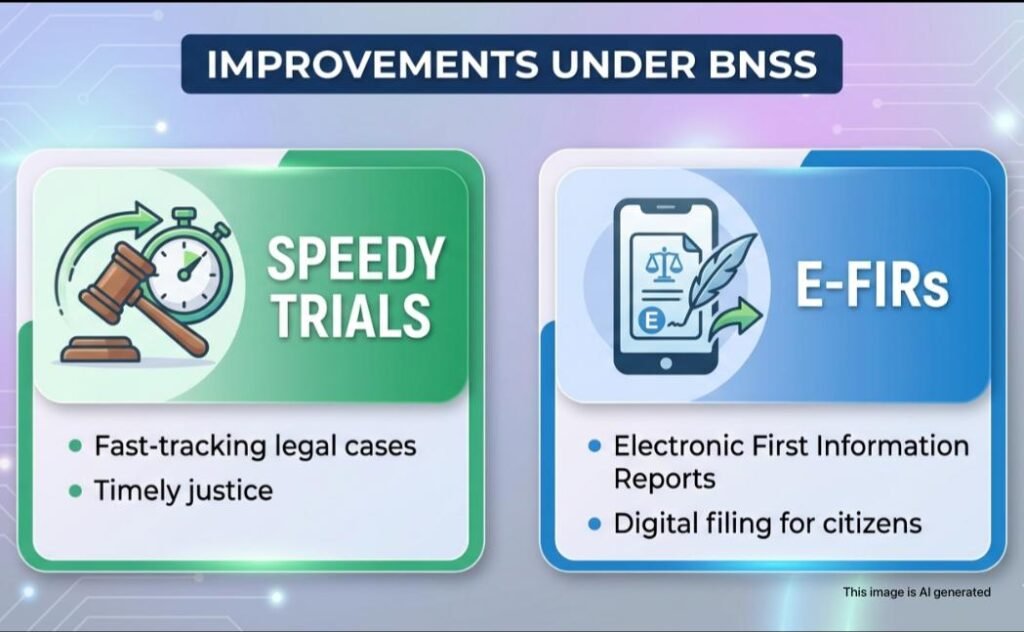
The introduction of the Bhartiya Nagarik Suraksha Sanhita (BNSS) to replace the colonial-era Code of Criminal Procedure (CrPC) 1973 represents a structural overhaul of India’s criminal justice administration. The Bhartiya Nagarik Suraksha Sanhita (BNSS) streamlines the criminal justice process by introducing mandatory statutory timelines for investigations, trials and judgements. It ensures citizens’ right to a speedy trial by introducing strict, legally mandated timelines for all stages of a criminal case. The BNSS seeks to reduce delays by introducing timelines for various procedural stages of investigation and trial, significantly reducing backlogs and ensuring justice delivery.
The BNSS came into force on 1 July 2024 and represents a significant step toward creating a technology-driven, efficient, and citizen-friendly criminal justice system. Among its many reforms, two of the most important are the introduction of Electronic First Information Reports (E-FIRs) and measures aimed at ensuring speedy trials. These reforms are expected to improve access to justice, reduce procedural delays, and strengthen public confidence in law enforcement agencies. This article examines the concept of E-FIRs and speedy trials under the BNSS and analyzes their benefits for both citizens and the police.
Understanding the BNSS
The Bharatiya Nagarik Suraksha Sanhita, 2023, is one of the three new criminal law reforms introduced by the Government of India. It replaces the colonial-era Code of Criminal Procedure and seeks to make criminal procedures more transparent, efficient, and technology-oriented.
The primary objectives of BNSS include:
- Faster delivery of justice.
- Greater use of technology in criminal investigations.
- Improved protection of victims’ rights.
- Enhanced transparency and accountability.
- Reduction in procedural delays.
- Better coordination between citizens, police, and courts.
The law recognizes the increasing role of digital technology in governance and seeks to integrate it into every stage of the criminal justice process.
What Changes for Ordinary Citizens?
Historically, ordinary citizens encountered steep institutional barriers when attempting to engage with the criminal justice system. The old system granted extensive procedural discretion to law enforcement, which frequently resulted in delays at the threshold of registering offenses. The BNSS attempts to democratize access and shield victims through decentralized, digital-first mechanisms.
For most people, dealing with the legal system has historically been confusing, expensive and incredibly slow. The BNSS introduces several features to make the system more accessible and victim-friendly.
Filing a Complaint from Home (E-FIR): You no longer have to physically walk into a police station to report a serious crime. Under Section 173 of the BNSS, you can file an e-FIR using an app or an online portal. The only catch is that you must go to the police station within 3 days to sign the official document.
Filing a Complaint Anywhere (Zero FIR): If a crime happens in one city, but you go to a police station in another city, they cannot turn you away. They must register a “Zero FIR” and transfer it to the right station themselves. This stops the police from wasting time arguing over whose boundary the crime fell into.
The Right to Know: Victims are now legally entitled to get completely free copies of the FIR and police reports within 14 days. The police are also required to send you regular updates on how your case is going.
Relief for Jail Overcrowding: If someone is accused of a crime but has not been proven guilty yet (an undertrial), they used to sit in jail indefinitely waiting for their trial. Now, under Section 479, if a first-time offender spends one-third of the maximum possible jail time waiting for their trial, the court must let them out on bail.
What changes for the Police?
For law enforcement, the new law replaces old-school manual paperwork with mandatory digital monitoring and strict accountability.
Mandatory Video Recording: To stop the police from planting or forcing confessions, they are now legally required to film search and seizure operations on their phones or digital cameras.
Scientific Backing (Forensics): For any serious crime that carries a punishment of 7 years or more in prison, a forensic science expert must visit the crime scene to gather fingerprints, DNA, and digital evidence. The entire process of collecting this evidence must be videorecorded.
Biometric Data: The police now have more power to collect voice samples and finger impressions, even from individuals who have not been formally arrested yet, to speed up identification.
The Statutory Clock: Deconstructing the Trial Management Timeline
The core structural change within the BNSS is the creation of a strict “statutory clock.” Where the old CrPC left the scheduling of proceedings to the discretion of individual judges leading to chronic court congestion, the BNSS introduced specific deadlines for key stages of criminal trials.
| Procedural Stage | Statutory Deadline under BNSS | Jurisprudential Objective |
| Preliminary Inquiry | Must be concluded within 14 days of specified offences. | Prevents open- ended non- committed pre investigation delays. |
| Supply of Documents | Magistrate must supply chargesheet, statements and Fir Copies within 14 days. | Secures the accused’s rights to prepare a defense delay. |
| Framing of Charges | Magistrate must apply frame charges within 60 days from the first hearing. | Limits prolonged pre- charge detention periods. |
| Plea Bargaining | Applications must be filled within 30 days of charge- framing. | Accelerates the disposal of minor cases through fast- track mechanisms. |
| Delivery of Judgement | Verdict must be delivered withing 30- 45 days of concluding the arguments. | Ends the practice of reserving judgements for months |
This timeline attempts to resolve the issue of systemic delays by holding the police and the judiciary to uniform standards of efficiency. By prescribing a 60-day window for the framing of charges and a strict 30-to-45-day deadline for the final verdict, the BNSS treats the trial process as a time-bound administrative function.
Systemic Challenges and Implementation Vulnerabilities
While the statutory architecture of the BNSS is modern, its success in practice depends heavily on infrastructural capacity and technological alignment across multiple state institutions.
- The Forensic Compliance and Digital Infrastructure Gap
Mandating forensic processing for all offenses carrying a punishment of 7 years or more requires an immediate, exponential increase in mobile forensic units across India’s police districts (Patel, 2026). Without this infrastructure, strict adherence to Section 176(3) risks creating a bottleneck where investigations stall because a certified forensic expert is unavailable to process the scene.
Furthermore, mandatory audiovisual recording of searches, seizures, and witness statements creates a massive data governance challenge. Law enforcement agencies require secure,
tamper-proof, and high-capacity cloud storage architectures that comply with digital chain-of-custody and data privacy mandates.
- Algorithmic Pressures on the Judiciary
The introduction of strict 60-day charge-framing and 45-day judgment timelines places significant pressure on trial courts (Pradeep, 2025). India’s subordinate judiciary handles millions of pending cases. Imposing rigid statutory deadlines without addressing judicial vacancies or expanding court infrastructure could inadvertently incentivize a superficial evaluation of evidence as judges rush to meet statutory compliance targets.
Conclusion
The transition from the CrPC to the BNSS represents a fundamental shift in India’s procedural jurisprudence (Pradeep, 2025). By codifying the e-FIR, establishing mandatory timelines, and anchoring investigations in digital and forensic science, the BNSS provides a modernized framework designed to protect citizen rights and enforce police accountability. However, the realization of these statutory goals depends on institutional support. The “statutory clock” can only eliminate systemic delays if police forces, forensic laboratories, and trial courts are provided with the physical, financial, and digital infrastructure required to sustain this new pace of criminal justice delivery.