
This article is written by Kashish Yadav, CSJM University, Kanpur. This article examines the theoretical underpinnings of VR-based legal training, surveys the existing landscape of technology-assisted legal pedagogy, explores specific applications of VR to training on new codes, addresses the challenges and ethical concerns that must be confronted, and ultimately makes a case for institutional adoption of VR as a forward-looking instrument of legal education reform.
Keywords: Virtual Reality, Legal Education, Bharatiya Nyaya Sanhita, Experiential Learning, Technology in Law
Introduction
The landscape of legal education in India has witnessed momentous disruption in recent years, most notably with the enactment of the three transformative criminal codes the Bharatiya Nyaya Sanhita, 2023 (BNS), the Bharatiya Nagarik Suraksha Sanhita, 2023 (BNSS), and the Bharatiya Sakshya Adhiniyam, 2023 (BSA) which together replaced the century-old Indian Penal Code, 1860, the Code of Criminal Procedure, 1973, and the Indian Evidence Act, 1872, respectively. The sheer breadth and novelty of these reforms present a formidable pedagogical challenge: how does one equip law students not merely with theoretical familiarity with new provisions, but with the practical competence to navigate an entirely reformed legal architecture?
It is within this context that Virtual Reality (VR) emerges as a compelling and timely pedagogical instrument. Far from being a novelty confined to the domain of entertainment or military simulation, VR technology has steadily carved a credible space in professional education from surgical training in medical schools to crisis simulations in business management programmes. The argument advanced in this article is straightforward yet significant: Virtual Reality holds transformative potential for legal education, particularly in assisting law students to internalise, apply, and critically engage with new and unfamiliar legislative codes in an immersive, experiential, and contextually rich environment.
The Inadequacy of Traditional Legal Pedagogy in the Face of Legislative Reform
The traditional law school model in India built substantially on the Socratic method, textbook instruction, moot court exercises, and internship-based exposure has served generations of legal practitioners reasonably well. However, it is demonstrably ill-equipped to handle the speed and scale of modern legislative transformation. When foundational statutes are replaced wholesale, as has occurred with the new criminal codes, the pedagogical challenge is not merely one of updating reading materials. It demands a fundamental reconstitution of the learning experience.
Consider the challenge a third-year BA LLB student faces today. The BNS has introduced significant structural changes, including the addition of provisions on organised crime and terrorism, revised sentencing frameworks, and the inclusion of community service as a form of punishment concepts entirely absent from the IPC. The BNSS introduces electronic records as part of the trial process, mandates video-conferencing for certain hearings, and restructures the framework for bail and remand. The BSA substantially revises the admissibility of electronic evidence, with implications that cut across civil and criminal proceedings alike. Absorbing these changes through lecture notes and case-law discussion alone is a task that risks producing graduates who are technically aware of the new law but practically unprepared to operate within it.
The experiential gap in legal education is well-documented. Legal scholars such as William Sullivan, in the Carnegie Foundation’s landmark report on legal education, have observed that law schools too often privilege abstract doctrinal analysis over the development of practical competencies. In India, this critique is no less valid. Clinical legal education programmes, while growing, remain unevenly distributed and are frequently constrained by resource limitations. The introduction of complex new codes into this already strained pedagogical system makes the search for innovative instructional methods not merely desirable but urgent.
Understanding Virtual Reality as a Pedagogical Tool
Virtual Reality, in its most relevant educational application, refers to a computer-generated simulation that immerses the user in a three-dimensional environment, typically experienced through a head-mounted display (HMD) and interactive controllers. Unlike passive audio-visual instruction, VR enables active participation within a simulated environment, allowing users to engage with scenarios, make decisions, and observe the consequences of those decisions in real time.
The pedagogical value of VR rests upon well-established principles of learning theory. Edgar Dale’s Cone of Experience, articulated in the mid-twentieth century, posits that individuals retain significantly more information from active, participatory learning than from passive reception. Constructivist learning theory, advanced by scholars such as Jean Piaget and Lev Vygotsky, further holds that learners construct knowledge most effectively through direct engagement with their environment. VR, by its very architecture, operationalises these principles. A student who conducts a virtual cross-examination under the new rules of the BSA retains and comprehends the evidentiary framework far more deeply than one who reads about it in a statute.
In the context of professional training, VR has demonstrated measurable efficacy across multiple disciplines. Medical institutions have deployed VR for surgical simulations, enabling trainee surgeons to rehearse complex procedures without risk to patients. The United States military has long used immersive simulation for combat readiness training. More recently, corporate training programmes have adopted VR for scenarios ranging from workplace harassment sensitisation to financial compliance training. The common thread across these applications is the capacity of VR to create high-stakes, emotionally resonant learning experiences in a consequence-free environment a quality of obvious relevance to legal training.
Specific Applications of Virtual Reality in Training on New Legal Codes
The potential applications of VR in the context of India’s new criminal codes are both varied and concrete. Several illustrative use cases merit detailed examination.
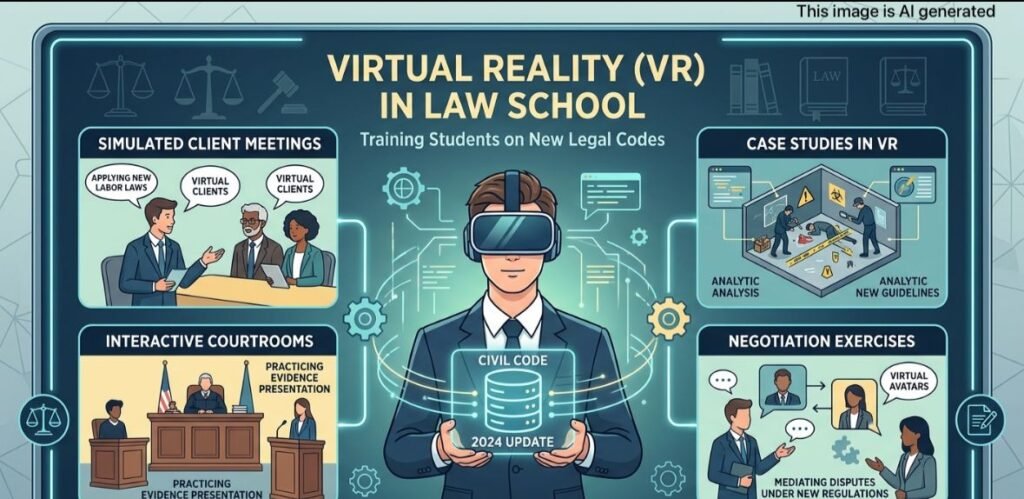
First, and perhaps most significantly, VR can simulate courtroom proceedings governed by the new procedural framework of the BNSS. Students can be placed within a virtual courtroom and tasked with conducting or defending a bail application under the revised bail provisions, handling an application for remand, or navigating the requirements for the summoning of electronic records as evidence. The virtual environment can replicate the procedural formalities, the presence of opposing counsel, and the interventions of a simulated magistrate or judge, thereby requiring the student to apply the new code in a setting that approximates the psychological and professional pressures of an actual courtroom. This is fundamentally different from a moot court exercise conducted in a classroom, precisely because VR can introduce variables, unexpected objections, procedural irregularities, the dynamics of witness examination in a manner that demands adaptive, real-time application of legal knowledge.
Second, VR can be deployed for crime scene reconstruction and forensic analysis scenarios under the BNS. The new code has introduced provisions specifically addressing offences such as organised crime and terrorism, which have distinct evidentiary and investigative characteristics. A VR simulation that places a student within a reconstructed crime scene requiring them to identify relevant offences under the BNS, assess the admissibility of available evidence under the BSA, and advise an investigating officer on procedural compliance would achieve a depth of integrative learning that no conventional classroom method can replicate. Such simulations can also be designed to train students in the identification of new forms of offences introduced by the BNS, including cybercrimes, where the physical and digital dimensions of an offence must be simultaneously understood.
Third, VR affords particular value in the context of victim and witness interaction training. The new codes place greater emphasis on the protection of vulnerable witnesses and the rights of victims, including provisions for in-camera proceedings and the use of intermediaries for vulnerable complainants. Training students to interact appropriately and sensitively with witnesses in such contexts is a dimension of legal education that is notoriously difficult to achieve through textual instruction alone. VR simulations that cast students in the role of an advocate or investigating officer dealing with a vulnerable witness — with AI-driven responses that vary based on the student’s approach can develop both the legal knowledge and the human competencies that this area of law demands.
Fourth, VR can serve as a platform for multi-party negotiation and alternative dispute resolution training, increasingly relevant given the emphasis of both new codes and recent judicial policy on mediation and pre-trial settlement. Students can participate in simulated mediation sessions that require knowledge of the new procedural framework, developing skills in both legal analysis and professional judgment in a contextually realistic setting.
The Role of Artificial Intelligence in Enhancing VR Legal Simulations
The potency of VR as a legal training tool is substantially amplified when integrated with Artificial Intelligence (AI). Standalone VR simulations, while immersive, are limited by their scripted nature they present predetermined scenarios to which the student responds along pre-defined pathways. The integration of AI, particularly large language models and generative AI, transforms VR simulations into dynamic, adaptive learning environments capable of responding intelligently to the unique inputs of each student.
An AI-integrated VR courtroom, for instance, can present a simulated opposing counsel whose arguments, objections, and cross-examination strategies are generated in real time in response to the student’s own submissions. A simulated magistrate can pose difficult questions, identify lapses in the student’s procedural compliance, and offer contextually calibrated feedback upon conclusion of the simulation. The AI can further generate performance analytics identifying patterns in a student’s procedural errors, gaps in their citation of new code provisions, or recurring weaknesses in their advocacy and use these analytics to tailor subsequent simulation experiences to address identified deficiencies. This degree of personalised, adaptive instruction is simply beyond the capacity of any human faculty operating within the constraints of a conventional law school curriculum.
Furthermore, AI-driven VR can be used to train students in the interpretation of novel or ambiguous provisions of the new codes, a skill of particular contemporary relevance given that the BNS, BNSS, and BSA are still in the early stages of judicial interpretation. By presenting students with scenarios that do not have settled answers and requiring them to construct reasoned arguments drawing on statutory text, constitutional principles, and comparative jurisprudence, AI-enhanced VR cultivates the quality of legal reasoning that the legal profession most demands but that traditional legal education most struggles to teach.
Challenges, Limitations, and Ethical Considerations
A candid assessment of VR as a tool for legal education must acknowledge the challenges that attend its adoption, lest enthusiasm for the technology outpace the institutional capacity to deploy it responsibly and equitably.
The most immediate challenge is one of access and equity. VR technology quality head-mounted displays, computing infrastructure, and the development of bespoke legal simulations represents a significant financial investment. The Indian legal education system is characterised by considerable institutional heterogeneity: the resources available to a National Law University are vastly different from those of an affiliated college in a Tier-3 city. The risk of VR becoming yet another dimension along which elite institutions pull further ahead of their under-resourced counterparts is a concern that must be addressed at the level of policy, through mechanisms such as the Bar Council of India mandating shared digital infrastructure or the UGC facilitating the development of open-access legal VR platforms.
A second challenge concerns the quality and legal accuracy of VR content. A simulation that models incorrect procedure, misrepresents the provisions of the new codes, or embeds implicit assumptions about the operation of the law that are subsequently contradicted by judicial interpretation, risks causing more pedagogical harm than good. The development of VR legal training modules must therefore involve close collaboration between legal educators, practising lawyers, and technologists, with robust mechanisms for review and updating as the law evolves. This is not a trivial undertaking, and it raises real questions about the institutional architecture required to sustain high-quality VR legal education at scale.
Third, VR does not replace the irreplaceable dimensions of legal education: the mentorship of experienced practitioners, the ethical formation that comes from supervised clinical work, and the capacity for professional judgment that is developed through real-world exposure to the unpredictability of clients, courts, and colleagues. VR is best understood as a powerful supplement to, rather than a replacement for, these dimensions of legal training. The risk of over-reliance on simulation of producing graduates who are technically proficient within a virtual environment but emotionally and professionally unprepared for the human complexity of legal practice is one that law schools must consciously guard against.
Finally, there are genuine ethical questions about the use of AI in legal simulations, particularly where those simulations involve the recreation of sensitive scenarios such as the examination of crime victims or the portrayal of marginalized communities. The design of VR legal training must be attentive to the risk of reinforcing biases, stereotyping parties to legal proceedings, or trivialising the gravity of the legal situations being simulated. These concerns do not argue against VR but they do argue for its careful, ethically informed, and institutionally accountable deployment.
The Way Forward: Institutional Adoption and Policy Recommendations
The case for integrating VR into Indian legal education, particularly in light of the new criminal codes, is sufficiently compelling to warrant concrete institutional action. Several recommendations merit consideration by law schools, the Bar Council of India, and the University Grants Commission.
Law schools should, at minimum, explore the development of pilot VR modules specifically designed around the BNS, BNSS, and BSA, possibly in partnership with technology companies and practising lawyers specialising in criminal law. Such pilots would generate empirical evidence of pedagogical efficacy and surface design challenges before wider rollout is attempted.
The Bar Council of India, in its ongoing review of the legal education curriculum, should consider explicitly recognising technology-assisted simulation including VR as a legitimate component of clinical legal education requirements. This would create an incentive for institutional investment and signal the profession’s commitment to pedagogical modernisation.
At the national level, there is a strong argument for the establishment of a centralised repository of open-access VR legal training modules, developed under the auspices of the National Law School community or the Ministry of Education, and made freely available to all affiliated law colleges. This would address the equity concerns identified above and ensure a baseline standard of VR-assisted legal training across the country.
Finally, law schools should invest in the training of their own faculty in the design and facilitation of VR-based instruction. Technology is only as effective as the pedagogy that deploys it; the integration of VR into legal education will succeed only if it is accompanied by genuine faculty engagement with its possibilities and limitations.
Conclusion
The enactment of the Bharatiya Nyaya Sanhita, the Bharatiya Nagarik Suraksha Sanhita, and the Bharatiya Sakshya Adhiniyam represents a watershed moment in Indian legal history, one that places extraordinary demands on the institutions tasked with training the next generation of legal professionals. Virtual Reality, with its capacity to create immersive, experiential, and adaptive learning environments, offers a response to these demands that is both technologically sophisticated and pedagogically grounded.
The challenge of internalising the BNS’s restructured offences, the BNSS’s reformed procedural landscape, and the BSA’s revised evidentiary framework is one that conventional instruction addresses only partially. The promise of VR is the promise of learning by inhabiting the legal situations that these codes govern, rather than merely reading about them.
This promise is neither a guarantee nor a panacea. The challenges of access, content quality, and ethical design are real and must be confronted with seriousness. But they are challenges to be managed, not reasons for abstention. Indian legal education has, at this juncture, both the opportunity and the obligation to meet the demands of legislative reform with pedagogical innovation equal to the task. Virtual Reality is a powerful instrument in that endeavour, and its time, in the law school of the twenty-first century, has come.
References
1. Sullivan, W.M., Colby, A., Wegner, J.W., Bond, L., & Shulman, L.S. (2007). Educating Lawyers: Preparation for the Profession of Law. Carnegie Foundation for the Advancement of Teaching. https://www.carnegiefoundation.org/resources/publications/educating-lawyers
2. Piaget, J. (1952). The Origins of Intelligence in Children. International Universities Press. https://archive.org/details/originsofintelli00piag
3. Vygotsky, L.S. (1978). Mind in Society: The Development of Higher Psychological Processes. Harvard University Press. https://archive.org/details/mindinsocietydevelopmentvygotsky
4. Bar Council of India. (2008). Bar Council of India Rules (Legal Education Rules, 2008). Bar Council of India Trust. https://www.barcouncilofindia.org/legal-education
5. University Grants Commission. (2022). UGC Guidelines on Legal Education. University Grants Commission, India. https://www.ugc.gov.in/e-book/legal-education
6. Merchant, Z., Goetz, E.T., Cifuentes, L., Keeney-Kennicutt, W., & Davis, T.J. (2014). Effectiveness of Virtual Reality-Based Instruction on Students’ Learning Outcomes in K-12 and Higher Education: A Meta-Analysis. Computers & Education, 70, 29-40. https://doi.org/10.1016/j.compedu.2013.07.033
7. Radianti, J., Majchrzak, T.A., Fromm, J., & Wohlgenannt, I. (2020). A Systematic Review of Immersive Virtual Reality Applications for Higher Education: Design Elements, Lessons Learned, and Research Agenda. Computers & Education, 147, 103778. https://doi.org/10.1016/j.compedu.2019.103778
8. National Law University Delhi. (2023). Curriculum Review Committee Report on Technology in Legal Education. NLU Delhi Press. https://nludelhi.ac.in/academic.aspx
9. Ministry of Home Affairs, Government of India. (2023). Compendium on New Criminal Laws. National Crime Records Bureau. https://www.mha.gov.in/MHA1/Par2017/pdfs/par2023-pdfs/NewCriminalLaws_Compendium.pdf