This article was written by Roma Shakya, Prestige Institute of Management and Research, Gwalior.
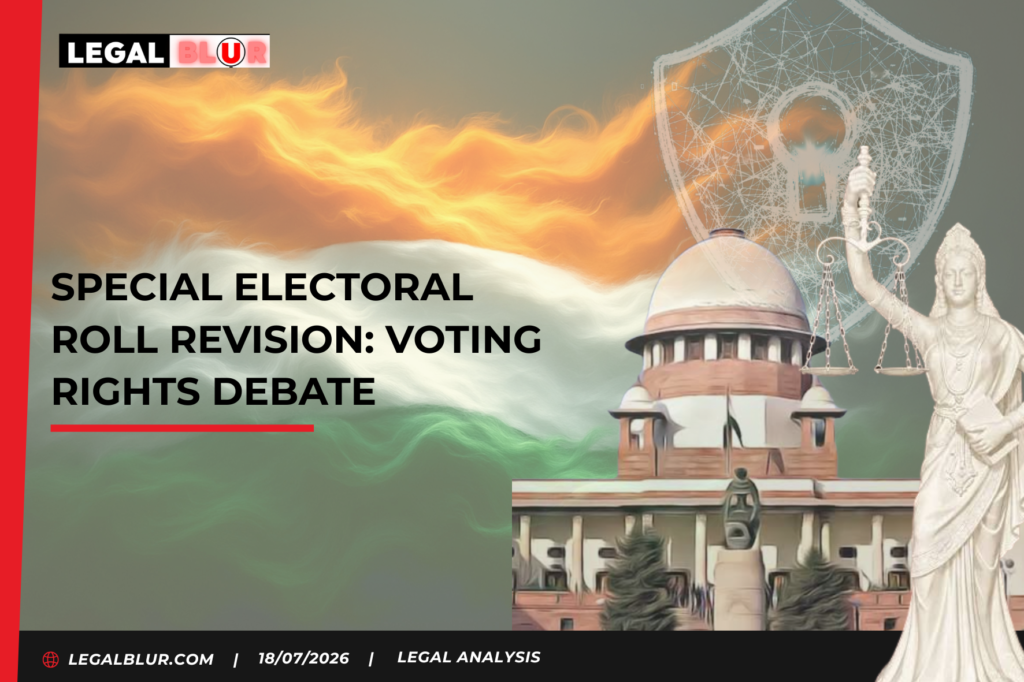
When the Election Commission launched its Special Intensive Revision of Bihar’s electoral rolls in 2025, it triggered one of the biggest legal fights over voting rights India has seen in years. Nearly 65 lakh names were initially flagged for deletion; after objections were heard, that number fell to around 47 lakh, while 21.5 lakh new voters were added to the rolls. This article traces the legal battle from its roots in Mohinder Singh Gill v. Chief Election Commissioner (1978), which established that the Commission’s powers under Article 324 are subject to judicial review, to the Supreme Court’s ruling in Association for Democratic Reforms v. Election Commission of India (27 May 2026), which upheld SIR as constitutional but held that the Commission cannot be the final authority on citizenship. The central argument of this article is that while the Special Intensive Revision is constitutionally permissible, its implementation must remain subject to procedural fairness, transparency, and judicial oversight.
Keywords: Special Intensive Revision (SIR); electoral rolls; Election Commission of India; Article 324; voting rights; due process; Bihar elections; constitutional law; disenfranchisement; judicial review.
1. Introduction
Democracy depends on a simple promise: the legitimacy of a democratic system rests on ensuring that every eligible citizen can exercise the right to vote by being included on the electoral roll. In 2025, that promise was tested in Bihar, where the Election Commission carried out its most extensive electoral roll revision in more than two decades. The stated aim was straightforward: remove the dead, the duplicates, and the relocated. But the method was far more controversial: citizens were asked to prove, often within weeks, that they still belonged on a list they had been on for years. What followed was not just an administrative correction, but a constitutional debate over who gets counted as a voter.
1.1 Background of the Bihar Special Intensive Revision (SIR), 2025
In June 2025, the Election Commission of India ordered a Special Intensive Revision of Bihar’s electoral rolls the first such exercise since 2003. Citing migration, urbanisation, and unreported deaths, the Commission required house-to-house verification of every voter, with fresh documentary proof demanded from those not listed in the 2003 rolls. Nearly 65 lakh names were provisionally marked for deletion, while 21.5 lakh new voters were added, reshaping the electorate ahead of the state assembly elections.
1.2 The Constitutional Controversy
The exercise triggered an immediate legal challenge. Petitioners argued that excluding common documents like Aadhaar and ration cards, combined with a compressed timeline, shifted the burden of proof onto citizens and risked mass disenfranchisement of poor and migrant voters. The Election Commission defended the revision as a lawful exercise of its constitutional mandate under Article 324. The dispute forced the Supreme Court to weigh electoral integrity against the citizen’s right to remain on the roll.
2. Constitutional and Statutory Framework Governing Electoral Rolls
Article 326 guarantees universal adult suffrage, while Article 324 empowers the Election Commission to supervise elections. Sections 21 to 23 of the Representation of the People Act, 1950, govern roll revision and correction, and the Registration of Electors Rules, 1960, provide the procedural detail.
2.1 Universal Adult Suffrage under Article 326
Article 326 establishes universal adult suffrage as the constitutional foundation of Indian democracy, guaranteeing every citizen aged eighteen and above the right to vote, subject only to limited disqualifications. This makes inclusion the constitutional default. Any process that narrows the electorate must therefore justify itself against that baseline of participation.
2.2 Powers of the Election Commission under Article 324
Article 324 vests the Election Commission with superintendence, direction, and control over elections, including the preparation of electoral rolls. Courts have read this power broadly, allowing the Commission to act where no specific law governs a situation. However, this authority is not unlimited. Where Parliament has legislated, the Commission must operate within that statutory framework rather than override it.
2.3 Representation of the People Act, 1950
Section 21 empowers the Commission to prepare and revise electoral rolls, including special revisions when it is satisfied that existing rolls are inaccurate. Section 22 provides for correction of erroneous entries, while Section 23 allows for inclusion of names that were wrongly omitted. Together, these provisions form the statutory mechanism for correcting roll errors.
2.4 Registration of Electors Rules, 1960
These Rules prescribe the procedural details for revision, claims, objections, and publication of the final roll. Their purpose is to ensure that the revision process remains administratively fair in practice.
3. Bihar’s Special Intensive Revision (SIR), 2025
3.1 Objectives of the SIR Exercise
The Election Commission ordered the SIR in June 2025 to address decades of accumulated inaccuracy in Bihar’s rolls. The state’s last intensive revision had been in 2003. The stated goals were to remove deceased, duplicate, and permanently relocated voters, correct underreported deaths, and enrol newly eligible young citizens, while also addressing concerns about non-citizens appearing on the rolls.
3.2 Procedure Adopted by the Election Commission
The exercise required house-to-house verification of every elector by Booth Level Officers. Voters not listed in the 2003 rolls were required to submit fresh documentary proof of eligibility from a list of eleven specified documents. The initial notification notably excluded commonly held IDs such as Aadhaar and ration cards. The entire process was compressed into a few weeks, with a final deadline of 25 July 2025 ahead of the state assembly elections.
3.3 Scale of Deletions, Additions and Public Response
Nearly 65 lakh names were provisionally marked for deletion, while 21.5 lakh new voters were added. After claims and objections were processed, the deletion figure was later refined to around 47 lakh. The scale of the exercise triggered widespread political backlash, with opposition parties calling it a tool for mass disenfranchisement of migrant and poor voters and prompting litigation before the Supreme Court.
3.4 Major Constitutional Concerns Raised
Petitioners argued that the process violated Articles 14, 19, and 21 by shifting the burden of proof onto citizens, using an exclusionary document list, and compressing the timeline beyond what fair administration could reasonably absorb. They also argued that mass deletions, if erroneous, would violate the constitutional guarantee of a single, non-discriminatory electoral roll and universal adult suffrage.
4. Constitutional Challenges to the Bihar SIR
The Bihar SIR was challenged before the Supreme Court on multiple constitutional grounds, primarily through Association for Democratic Reforms v. Election Commission of India (W.P.(C) No. 640/2025).
Article 14 (Equality): Petitioners argued that the exercise was arbitrary and manifestly unreasonable because it treated voters listed before 2003 differently from those enrolled later, without a rational basis.
Article 19(1)(a): Petitioners argued that the initial lack of clarity around deletion criteria and reasons for exclusion undermined the information necessary for meaningful democratic participation.
Article 21 (Due Process): The central challenge was that requiring citizens to prove their own eligibility on a compressed timeline reversed the normal burden of proof and denied fair procedure to millions, particularly the poor and less literate.
Exclusionary Documentation Requirements: The initial list of eleven acceptable documents excluded Aadhaar, voter ID cards, and ration cards, raising concerns of indirect discrimination against migrants and the poor.
Threat to Universal Franchise: Critics argued that mass deletions, if erroneous, would violate Articles 325 and 326.
Procedural Unfairness: The shortened timeline was said to be incompatible with fair administrative process, given the scale of verification and the shortage of trained Booth Level Officers.
Judicial Response: The Supreme Court addressed these concerns through interim directions requiring booth-level publication of deletion lists and broader acceptance of Aadhaar, before ultimately upholding the validity of SIR in May 2026.
5. Recent Case Law on Electoral Integrity vs. Voting Rights
5.1 Mohinder Singh Gill v. Chief Election Commissioner (1978) 1 SCC 405
This case defined the outer boundary of the Election Commission’s power under Article 324. The Supreme Court held that Article 324 gives the Commission broad, even plenary, powers to ensure free and fair elections, but those powers are not absolute. They must be exercised consistently with natural justice and remain subject to judicial review. The Court also explained that Article 324 operates in the “silences” of the law, filling gaps where Parliament has not legislated, but it cannot override express statutory provisions. This became the doctrinal foundation for later challenges to the Commission’s powers, including the Bihar SIR litigation.
5.2 Association for Democratic Reforms v. Election Commission of India (2026)
Decided on 27 May 2026 by a bench led by Chief Justice Surya Kant, this case directly tested the Bihar SIR against the Mohinder Singh Gill standard. The Court held that SIR was a legally valid exercise of the Commission’s powers under Article 324 and Section 21(3) of the Representation of the People Act, 1950, and could not be struck down merely because it departed from the ordinary revision process. At the same time, the Court preserved the Gill limitation on unchecked power: it ruled that while the Commission could examine citizenship questions for electoral purposes, it could not make final determinations on citizenship, and disputed cases had to be referred to the Central Government under citizenship law. In effect, the Court upheld the Commission’s authority while reinforcing the constitutional guardrail that authority is not the same as finality.
Conclusion
The Bihar Special Intensive Revision demonstrates that electoral roll revision is not merely an administrative exercise but a constitutional responsibility. While Article 324 empowers the Election Commission to ensure accurate electoral rolls, that power must be exercised within the limits of fairness, transparency, and judicial oversight. As reaffirmed in Association for Democratic Reforms v. Election Commission of India (2026), electoral integrity and voting rights are complementary constitutional values, and neither can be protected at the expense of the other.
Frequently Asked Questions
What is Special Intensive Revision?
A deeper electoral-roll check to remove errors, duplicates, dead voters, and ineligible entries while adding eligible voters.
Why did Bihar’s 2025 SIR become controversial?
Because it used a tight deadline, demanded fresh proof, and risked wrongful deletion of genuine voters.
What is the legal basis for SIR?
It rests mainly on Article 324 and Section 21(3) of the Representation of the People Act, 1950.
Does the Election Commission have unlimited power under Article 324?
No. Its power is broad, but limited by the Constitution, statute, and judicial review.
What did the Supreme Court decide on 27 May 2026?
It upheld Bihar’s SIR as constitutional, while holding that the Commission cannot finally decide citizenship disputes.
Why is the citizenship issue important?
Because voter eligibility may be checked for elections, but citizenship cannot be conclusively decided by the Commission alone.