This article is written by Namrata Jana, of Fakir Mohan University, Balasore, Orissa.
Online gaming in India has emerged as a rapidly expanding digital industry, raising complex legal and constitutional questions. The absence of a unified national legislation has led to a fragmented regulatory framework governed by state gambling laws, judicial precedents and recent central regulatory intervention under the Information Technology Act,2000. Central to the legal debate is the judicial distinction between “games of skill” and “games of chance”, as established in landmark cases such as State of Bombay vs. R.M.D.Chamarbaugwala and State of Andhra Pradesh vs. K. Satyanarayan
Introduction
The digital revolution has significantly transformed entertainment and commerce in India, with online gaming emerging as one of the fastest – growing sectors in the digital economy. From fantasy sports and online rummy to eSports and casual mobile gaming, millions of users participate daily in virtual gaming platforms. With increasing smartphone penetration, affordable internet access and seamless digital payment systems, the industry has witnessed exponential growth.
Despite its economic potential, online gaming occupies a legally contested space. Gambling and betting fall within the legislative competence of states under the constitution of India, resulting in diverse and sometimes conflicting state- level regulations. At the same time, the digital nature of online platforms brings them within the regulatory scope of central legislation such as the Information Technology Act, 2000. This overlap has generated federal tensions and legal uncertainty.
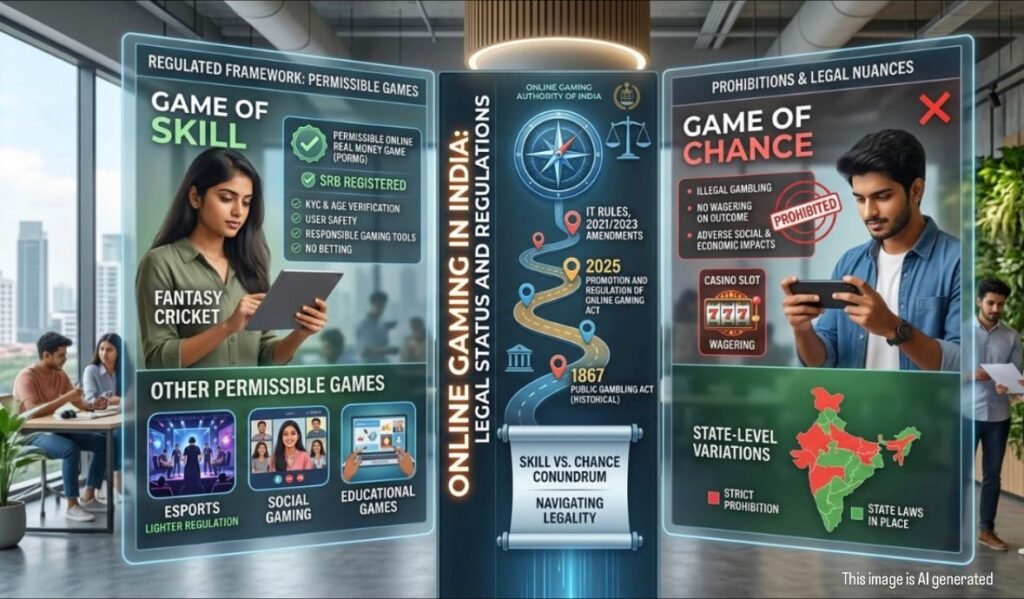
Online games
Real – Money Skill- based Games
These games generally rely on skill and are often defended as legal under the “predominance test”
- Online Rummy
- Online Poker
- Fantasy Sports (e.g., Dream 11- style platforms)
- Online chess Tournaments
Card & Strategy Games
- Call break
- Teen patti gold
- Ludo king
Multiplayer Battle/eSports Games
These are skill-intensive and often part of competitive eSports:
- Battlegrounds Mobile India
- Free fire
- Call of duty: mobile
- Valorant
Sports Simulation Games
- Fifa
- eFootball
- Online cricket simulation platforms
Casual & Puzzle games
These are typically free–to–play with in – app purchase
- Candy Crush Saga
- Subway Surfers
- Clash of Clans
Chance – based / Casino – style Games
These are often treated as gambling and regulated or prohibited under state laws derived from the Public Gambling Act, 1867.
Historical Legal Framework
The foundation statute governing gambling in India is the Public Gambling Act, 1867, a colonial – era law prohibiting the operation of common gaming houses. However, this Act primarily addresses physical gambling establishments and does not explicitly contemplate online or digital gaming platforms.
Under the Constitution of India –
- “Betting and gambling” fall under Entry 34 of the State List, granting states legislative competence.
- This has resulted in varied state – level laws regulating or prohibiting online gaming.
States such as Telangana, Andhra Pradesh and Tamil Nadu have enacted amendments to restrict online real-money gaming, leading to legal challenges and judicial scrutiny.
Constitutional Analysis of Online Gaming in India –
Online gaming in India sits at the intersection of fundamental rights, federalism, public morality, and economic freedom. Since there is no single comprehensive legislation, constitutional principles and judicial Precedents shape the legal landscape.
This analysis examines how online gaming Regulation interacts with key constitutional provisions.
Legislative Competence (Seventh Schedule)
Under the Constitution of India, legislative powers are divided between the Union and the states through the Seventh Schedule:
- Entry 34, state List – “Betting and gambling”
- Entry 31, Union List – “Telecommunications, broadcasting and internet”
- Entry 97, Union List – Residuary Powers (subjects not in State or Concurrent List)
Traditionally, gambling is a state subject. However, since online gaming operates through the internet (which falls under Union control), regulatory overlap has emerged. This creates constitutional tension between state power over gambling and union power over digital platforms.
Article 19(1)(g): Freedom of Trade and Profession –
Article 19(1)(g) guarantees the right to practice any profession or carry on any trade or business
In State of Bombay vs. R.M.D Chamarbaugwala, the Supreme Court held that:
- Gambling is not protected under Article 19 (1)(g).
- However, competition involving substantial skill is a legitimate business activity.
Later, in Dr. K.R. Lakshmanan vs. State of Tamil Nadu, betting on horse racing was recognised as a game of skill and therefore constitutionally protected.
Constitutional Issues:
If Online gaming is predominantly skill- based (e.g., rummy, fantasy sports), a blanket ban may violate Article 19 (1)(g), unless justified as a reasonable restriction under Article 19 (6).
Article 14: Equality and non-arbitrariness –
Article 14 prohibits arbitrary State Action.
State – level band often:
- Allows physical rummy but prohibits rummy.
- Regulate some platforms but not others.
Constitutional Issues:
Such a distinction may fail the reasonable classification test:
- Intelligible differentia
- Rational nexus with objective
If online and offline skill- based games are essentially similar, differential treatment could be arbitrary.
Article 21: Personal Liberty and Autonomy
The right to privacy and personal autonomy, recognised in Justice K.S. Puttaswamy vs. Union of India,may extend to individual choices in entertainment, including gaming
However, the state can justify regulations if it protects public health, prevents exploitation, or addresses addiction – related harm.
Legal Framework Governing Online Gaming in India
Online gaming in India is regulated under a complex and evolving legal framework, combining Central laws, state- specific legislation and regulatory guidelines. The legal approach largely depends on whether the game involves skill, chances or real money.
Primary Legislation
- Public Gambling Act, 1867– An old colonial–era law that prohibits operating or visiting gambling houses. However:
- It applies mainly to physical gambling.
- States have the power to legislate on gambling under the Constitution (State list)
- State–specific Gambling laws –
States like:
- Telangana, Andhra Pradesh, Tamil Nadu – Banned online gambling, including some real- money games.
- Sikkim – Allows licensed online gaming.
- Nagaland – Allows licensing of skill – based online games.
So, legality depends on the state.
Some states permit certain skill – based games.
Skill vs. Chances Distinction
Indian courts have consistently distinguished between:
- Game of Skill – Predominantly based on skill (legal)
- Game of Chance – Based on luck (treated as gambling)
The Supreme Court has held that games where skill predominates are protected under Article 19 (1)(g) (freedom to practice any profession), subject to reasonable restrictions.
Fantasy sports platforms and online rummy operators often rely on this distinction to claim legality.
Information Technology Act, 2000 –
In 2023, the Central Government amended the IT Rules under the:
Section 69A allows the blocking of unlawful websites.
Information Technology Act, 2000
These amendments:
- Introduced a regulatory framework for online gaming intermediaries
- Required self – regulatory bodies (SRBs) to verify permissible online real- money games.
- Mandated due diligence and user protection measures.
The Ministry of Electronics and IT plays a central role in oversight.
GST on Online Gaming
- 28% GST on the full-face value of bets (as per recent amendments).
- Applies to casinos, betting and online gaming platforms.
Judicial Interpretation
In the digital age, the proliferation of online betting applications has emerged as one of the most contentious issues plaguing Indian society. Recent data reveals that 60% of children in urban areas spend up to 3 hours daily on social media and gaming platforms, creating unprecedented exposure to potentially harmful content, including betting platforms.
The Supreme Court in State of Bombay vs. R.M.D. Chamarbaugwala established the foundational principle that “if even a scintilla of skill was required for success, the competition could not be regarded as of a gambling nature. However, this broad interpretation was later refined.
In the champion case, R.M.D. Chamarbaugwala vs. Union of India, the Court clarified that a competition in order to avoid the stigma of gambling must depend to a substantial degree upon the exercise of skill. The Court held that competitions requiring substantial skill were business activities protected under Article 19 (1)(g) of the constitution guarantees the right to trade and business for skill – based activities.
Similar exemptions exist in various state gambling laws, creating a uniform framework for protecting legitimate skill- based gaming. The judiciary has recognised several games as predominantly skill–based through landmark decisions.
Conversely, games of pure chance face strict prohibition under Sections 4 and 5 of the Public Gambling Act, 1867, which forms the foundation of these prohibitions, supplemented by similar provisions in state gambling acts and relevant sections of the Information Technology Act, 2000, for online platforms.
Games classified as chance – based include “three- card” games like Teen Patti Flush, traditional lottery systems except state – run lotteries, casino games such as roulette and Slot machines and pure betting on uncertain events. These activities fall squarely within the gambling prohibitions and carry criminal penalties under various statutes.
Conclusion
Online gaming in India has witnessed remarkable growth over the past decade, driven by increased internet penetration, affordable smartphones, and a young, tech – savvy population. It has evolved from simple entertainment to a major industry that generates Employment, attracts investment and even promotes eSports at national and international levels.
However, alongside its rapid expansion, challenges such as gaming addiction, financial risks in real – money gaming, data privacy concerns and the need for clear regulations have also emerged. Responsible gaming practice and effective government policies are essential to ensure balanced growth.
Overall, online gaming in India holds immense potential for economic development and digital innovation. With proper regulation, awareness and ethical practices, it can continue to thrive as both a form of entertainment and a significant contributor to the digital economy.
References
Frequently Asked Questions
1. What is online gaming?
Online gaming refers to playing games over the internet using mobile phones, computers, tablets, or gaming consoles. It includes skill-based games, fantasy sports, multiplayer games, esports, and casual games.
2. Is online gaming legal in India?
Yes, online gaming is generally legal in India, especially games based on skill rather than chance. However, laws differ from state to state. Some states restrict or prohibit certain forms of online betting and gambling.
3. What is the difference between gaming and gambling?
Gaming usually involves skill, strategy, and knowledge. While gambling mainly depends on luck or chance and involves betting money. Indian courts have often recognised skill-based games as legal.
4. Are fantasy sports legal in India?
Yes, fantasy sports are considered legal in many Indian states because they are treated as games of skill. Participants create virtual teams based on real players and earn points according to actual performance.
5. What are skill-based games?
Skill-based games are games where success depends mainly on the player’s knowledge, strategy, practice, and experience. Examples include chess, rummy, fantasy sports, and some esports competitions.