This article is written by Khushboo Bharti of Jiwaji University, Gwalior.
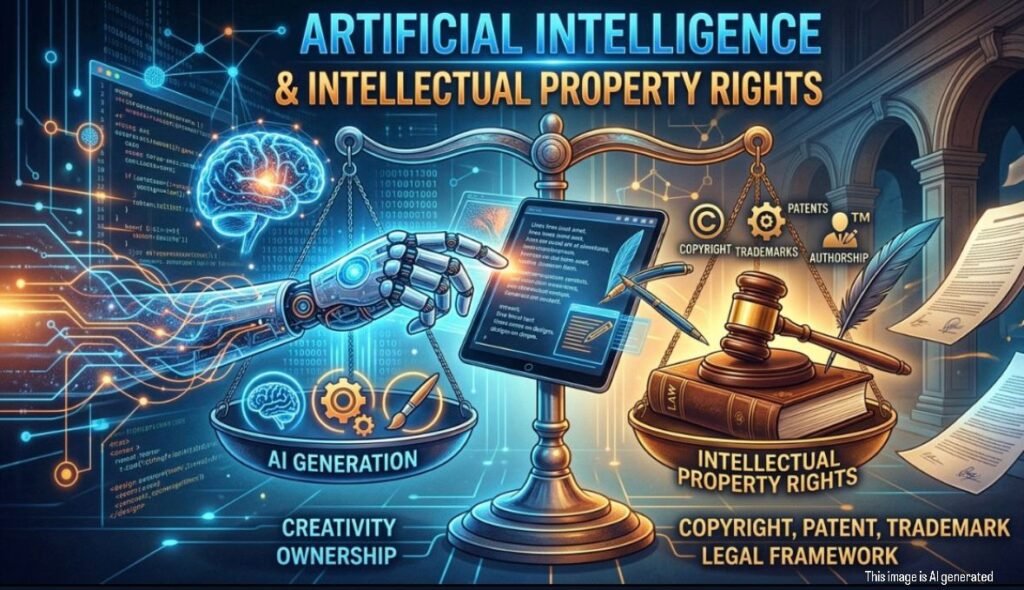
The Artificial Intelligence (AI) has dramatically changed the scene of creativity, innovation, and intellectual property due to its exponential growth. AI has already become able to create artistic pieces, literary texts, and technological innovations with little or no human participation. Though this development presents a whole lot of opportunities, it also presents a complex legal challenge in the field of Intellectual Property rights (IPR). The concept of human authorship and inventorship is what traditional IPR frameworks are founded on, and is now under scrutiny in the age of machine-generated outputs.
The article will thoroughly examine the intersection of AI and IPR in the form of copyright, patents, trademarks, liability concerns, and data use concerns. It also explores the legal trends across the world, especially in the United States, the European Union, and India, and reviews the sufficiency of current laws in combating issues related to AI. The article has ended by suggesting some reforms in the law to ensure that there is a balance between innovation and protection so that the IPR regime is not outdated in the fast-changing world of technology.
Keywords: Artificial Intelligence, Intellectual Property, Copyright, Patent Law, AI-generated works, Innovation, Legal Reform, Digital Economy.
Introduction
Artificial Intelligence has turned out to be one of the most revolutionary technologies in the contemporary world. AI is transforming industries and reinventing human abilities in the sphere of healthcare and finance to entertainment and education, among others. The creation by AI is one of the most fascinating elements of AI. Artificial intelligence now has the capability to create music, artwork, articles, product designs, as well as create new technology. These abilities disrupt the conventional perception of creativity, which has traditionally been seen as a uniquely human characteristic.
Intellectual Property Rights (IPR) have been important in safeguarding innovative and creative work. They give legal protection and economic rewards to creators and inventors, thus promoting innovation and culture building. Nevertheless, with the emergence of AI-generated content, the relevance of current IPR statutes becomes subject to serious doubts. Is it possible that a machine can be an author or inventor? Who is the owner of AI-generated works? What is the correct way of establishing the liability in the case of infringement?
These are not theoretical questions but have great practical implications. The disproportion between the possibilities of technologies and law is expanding as AI is becoming more and more developed. This paper attempts to fill this gap by examining how AI is threatening IPR, and how this can be addressed.
The article is called Evolution of Intellectual Property in the Technological Era
Intellectual property is an innovation that has been developed to keep pace with technology. Since the invention of the printing press up to the digital revolution, every technological milestone has brought changes in the IPR laws. The digital era brought about new problems like online piracy, digital reproduction, and spread all over the world.
AI is the next step in this development. AI is not just a tool, like other technologies used in the past, but a co-creator in the creative process. It is capable of processing huge volumes of data, discerning patterns, and it can produce work that can often pass as human-made work. This change necessitates a reconsideration of principles of IPR.
Copyright Law AI-Generated Works
1. Authorship Dilemma
Authorship is one of the key problems of the copyright law. The traditional laws can only acknowledge natural persons as authors. Nevertheless, the author of works created by AI is not a person. This leaves a legal gap.
In other jurisdictions, the law gives credit to the individual who makes the required arrangements to create the work. Although this method will offer a short-term fix, it fails to resolve the issues of self-directed AI systems.
2. Originality and Creativity
One of the requirements of copyright protection is originality. Many AI generated works do not fail this criterion but the fact that they are based upon existing data makes one question whether they are original or not. The boundary between inspiration and imitation is unclear.
Copyright violation and training data: This section addresses the issue of copyright infringement along with the training data.
Large datasets are trained on AI systems and might contain copyrighted content. This brings about serious legal and ethical concerns. In the case when an AI system utilizes the copyrighted work, training it without authorization, is it considered infringement? Besides, who does the work, when output is similar to those already in existence?
The latest discussions in the world have been on whether the use of copyrighted content to train AI should be considered as a fair use exception or a fair dealing exception. Lack of proper guidelines poses a challenge to both developers and creators.
Patent law and AI innovations are two related topics
1. AI as an Inventor
Whether AI can be considered an inventor or not has been a debatable issue. This issue was highlighted by the DABUS case where an AI system was indicated as the inventor in patent applications.
Such applications have been rejected by most jurisdictions such as the United States and India with a strong focus being on the fact that an inventor must be a human being. Nevertheless, this solution might not be sustainable as AI systems can evolve.
Although AI can not be identified as an inventor, it is difficult to identify who owns AI-generated inventions. Possible stakeholders include the developer, the user, and the organization that owns the AI system.
The effects on the ecosystem of innovation are as follows:
Failure to protect AI-generated inventions by patent may deter investment in AI research. On the other hand, this kind of protection without clear directions can result in monopoly and discouragement of competition.
The Trademark Law and AI
AI is also affecting the trademark law, especially in brand creation and interactions with consumers. Artificial intelligence is able to produce logos, brand names, and marketing strategies. This poses issues of ownership and accountability.
Also, AI-based applications have the capability of examining consumer behavior and forecasting market trends that provide businesses with a competitive edge. But AI usage in trademarks also brings up questions of deception and consumer protection.
The New Intellectual Property Data
1. Importance of Data in AI
Data is the backbone of AI systems. The performance of AI models is directly dependent on the quality and quantity of data. This has made data itself a valuable asset.
2. Data Ownership and Data Privacy
The application of personal and proprietary data in AI warrants major legal concerns. Who is a data owner of the data used to train AI systems? What is the best way of protecting privacy?
3. Intersection with IPR
There is no data that fits into the conventional IPR categories. Although databases can be secured, raw data are not always legally secured. This poses problems with the regulation of AI development.
Responsibility and Accountability in AI Systems
The case of AI and liability is complicated to determine. When an intellectual property right is violated by the AI system, it is difficult to tell who is at fault.
Possible approaches include:
- Blaming the designers of the system, the developers.
- Blaming users with the implementation of the system.
- Implementing a shared liability approach.
This problem is further complicated by the absence of transparency of AI systems.
Global Legal Developments
United States
The U.S. has been very firm regarding human authorship, not allowing AI-generated work to be covered by copyright unless it has been created by humans.
European Union
The EU is implementing a holistic regulatory strategy, including ethical AI and responsibility.
India
India remains at the nascent stage when it comes to solving AI-related IPR concern. Although there is some guidance in the current legislation, we require particular legislation
AI and IPR Ethical Iss
In addition to legal issues, AI is ethically questionable. Such problems like bias, transparency, and misuse of AI-generated content should be handled. Further regulations are dependent on ethical considerations.
Difficulties in the Existing Law
Unclear-authorship and ownership.
Difficulty with enforcing rights
- Quickly changing technology that is ahead of legal reforms.
- International discrepancies in laws.
Proposed Legal Reforms
1. AI-Assisted Creation Recognition
AI-assisted works and AI-generated works should be separated by laws and be given corresponding protection.
2. New Type of Right
A distinct AI-generated rights can be established to deal with special issues.
3. Precise instructions on the use of data
Laws are needed to state how data can be used to train AI.
4. International Cooperation
There is a need to harmonize laws globally to tackle cross-border issues.
5. Accountability Framework
There should be clear provisions on liability to bring about accountability.
Conclusion
The crossroads of Artificial Intelligence and Intellectual Property Rights is one of the most important legal issues of the 21st century. On the one hand, AI provides innovative opportunities never seen before, on the other hand, it challenges the conventional legal ideas. Current systems of IPR are not well positioned to solve these problems and so, extensive reforms are required.
There must be a middle ground, one that fosters creativity and safeguards the rights of creators and a middle ground that will ensure that technology is used in an ethical manner. Policymakers need to be proactive in coming up with legal frameworks which are flexible, inclusive and progressive.
Frequently Asked Questions
How does AI affect intellectual property rights?
AI challenges traditional concepts of authorship, ownership, and originality.
Can AI-generated work receive copyright protection?
Different countries follow different approaches, and the issue remains debated.
Why are AI patents controversial?
Questions arise over whether AI can qualify as an inventor.
What global trends are emerging in AI regulation?
Countries are developing frameworks balancing innovation with legal accountability.
What is the future legal concern regarding AI and IP?
The major issue is adapting existing IP laws to rapidly evolving technologies.
References
USPTO Guidance on AI and Intellectual Property
Official U.S. guidance on AI-generated inventions, inventorship, and patentability.
WIPO: Artificial Intelligence and Intellectual Property
Global resource on AI-related copyright, patents, and policy discussions.
World Intellectual Property Organization (WIPO)
Official international source for IP laws, treaties, and emerging AI-IP developments.