
This article is written by Gaurav Jain, University of Rajasthan, Law College.
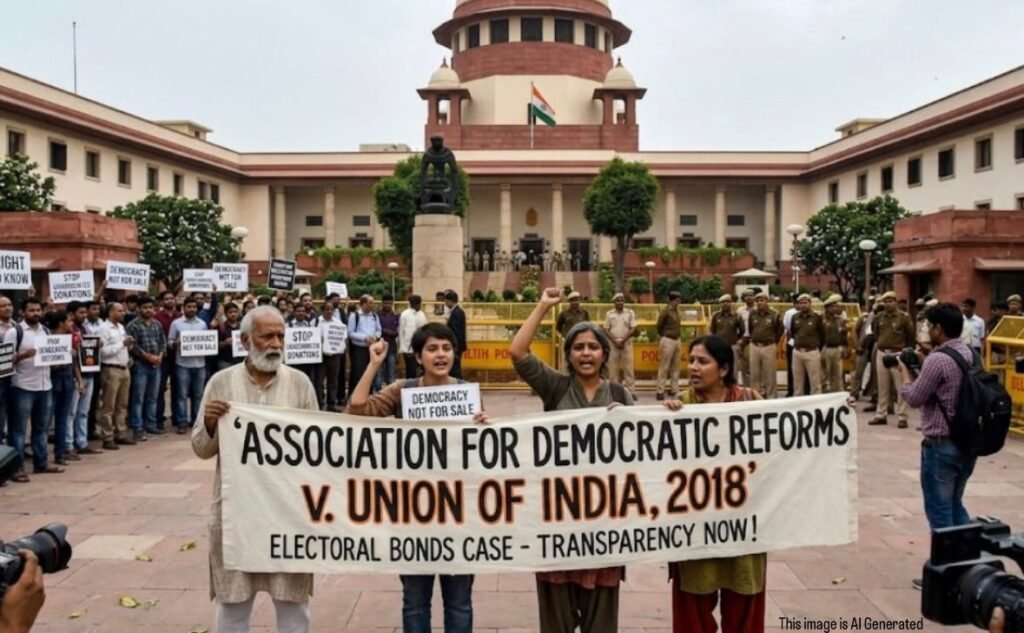
A five-judge Constitution Bench of the Supreme Court of India delivered a unanimous judgment on 15 February 2024, striking down the Electoral Bonds Scheme, 2018, on constitutional grounds.
The ruling in Association for Democratic Reforms v. Union of India is considered to be a turning point in constitutional interpretation with respect to electoral democracy by confirming that the right to access information as set forth in Article 19(1) (a) also includes information about political parties’ finances, and that the absence of transparency regarding political party financing is incompatible with the fundamental principles of a democratic polity to operate freely and fairly.
The Union Government launched the Electoral Bonds Scheme in January 2018 as a purportedly clean way to make donations to political parties without using cash. Under this scheme any citizen or company in India can buy electoral bonds (interest-free bearer instruments) sold by the State Bank of India and then donate these anonymously to a registered political party. The bonds can only be redeemed through the registered bank account of the political party and there is no record made of who donated the bonds in the public domain.
The petitioners led by the Association for Democratic Reforms (ADR) and the Communist Party of India have challenged the scheme on the basis that it violates voters’ rights to know who funds political parties, facilitates quid pro quo arrangements between corporate donors and the ruling party, lifted the cap on corporate donations, and violated the principle of free and fair elections. The Government defended the scheme as a means to combat “black money” in electoral financing, as well as to provide for donor privacy.
Legal Analysis & Case Laws
1. Core Holding
A Constitution Bench in its two joint opinions (Chief Justice Chandrachud and Justice Sanjiv Khanna) unanimously ruled that the Electoral Bonds Scheme violates Articles 19(1) (a) and 14 of the Constitution. Therefore, as part of the order, the Supreme Court of India directed SBI to cease issuances of Electoral Bonds immediately. Further, SBI is required to supply to the ECI a complete set of data related to electoral bonds so that they can be entered into the public record.
2. Article 19(1)(a) – The Right to Information
The Court relied upon earlier precedents recognising the voter’s right to information as part of Article 19(1)(a). It held that political funding influences public policy and electoral outcomes; therefore, citizens have a constitutional right to know the financial contributors behind political parties in order to make informed electoral choices.
3. Violation of Article 14
The SBI, as an agent for the Union Government, had the ability to identify the purchaser of each bond and the party to which the bond was donated when viewed in light of the fact that there was a discrepancy in the ability of the ruling party to access and assess this information compared to the lack of access for the other political parties, voters and the general public. There was a violation of the right to equality because the Union Government’s ability to potentially access such information through government channels gives it a competitive advantage in the political process.
4. Balancing Donor Privacy Against Right to Know
The Union of India contended that a legitimate reason for maintaining anonymous donor information was that donors were at risk from political retribution by opposition parties for donating to the ruling party. The Court agreed that donor privacy was a legitimate concern, but that it must yield to the greater interest of the public to have transparency in elections. The Court used the doctrine of proportionality to conclude that the complete anonymity of the scheme was excessive compared to what would be necessary to protect donor privacy.
- Directions Issued
The Supreme Court issued directions:
- The SBI was directed to stop issuing electoral bonds immediately.
- The SBI was directed to submit details of all electoral bonds purchased since inception (April 2019) to the Election Commission of India by 6 March 2024.
- The Election Commission was directed to publish the information received on its official website by 13 March 2024.
- Electoral bonds which had not yet been encashed were directed to be returned to the purchaser by the political party, and the SBI was directed to refund the amounts.
- Reliance on Earlier Precedents
The judgment drew heavily on the following precedents, which cumulatively established the constitutional framework within which the Electoral Bonds Scheme was tested:
- S.P. Gupta v. Union of India, AIR 1982 SC 149 — established the principle that in a republican democracy, the right to know about the functioning of state and quasi-state institutions is inherent in free speech.
- Union of India v. Association for Democratic Reforms, (2002) 5 SCC 294 — Extended the right to know to pre-election disclosure obligations of candidates.
- People’s Union for Civil Liberties v. Union of India, (2003) 4 SCC 399 — Confirmed that voters’ right to information about candidates is an integral component of Article 19(1) (a).
- Kuldip Nayar v. Union of India, (2006) 7 SCC 1 — Affirmed that free and fair elections are a basic feature of the Constitution.
Significance & Precedential Value
The Supreme Court has asserted its authority through the Electoral Bonds ruling by affirmatively stating that it considers the financing of elections to fall within its purview and is therefore a matter of constitutional concern as opposed to just legislative policy. The Court has made it very clear that it intends to protect democracy’s information infrastructure by striking down a very extensive piece of legislation, supported by Parliament, which was created to safeguard the anonymity of political party and candidate funding.
The ruling also creates several key precedents that will have long-lasting importance in the context of electoral financing. The Court held that the right to information under Article 19(1) (a) extends not only to governmental records and so forth, but also to the funding of political parties.
Conclusion
In the 2024 case Association for Democratic Reforms v Union of India, the Supreme Court held that constitutional democracy is not just a system of governance, but also an accountability framework that needs transparency. By unanimously striking down a programme that enabled approximately ₹16000 crore in non-transparent political donations across five years, the Court has redefined the line between a voter’s right to know about who funds political power and legitimate donor privacy.
The judgment does not stop individuals or corporations from donating to political parties; however, it does require that these donations be made publicly, traceable, and with full transparency, which is crucial for developing an educated electorate and therefore representative democracy. Additionally, this ruling affirms the institutional role of the Election Commission of India in preserving honest elections and sets a high judicial bar for future legislation that attempts to hide from public scrutiny, the source of political funding.
Frequently Asked Questions
1. What was the Electoral Bonds Scheme?
The Electoral Bonds Scheme, 2018 was a mechanism introduced by the Union Government that allowed Indian citizens and companies to purchase bearer instruments (bonds) from the State Bank of India and donate them to registered political parties anonymously. The donor’s identity was not disclosed in any public record.
2. Why did the Supreme Court strike down the scheme?
The Court held that the scheme violated the voters’ fundamental right to information under Article 19(1) (a) of the Constitution. The anonymity of the scheme prevented voters from knowing who was funding political parties, thereby impairing their ability to make informed electoral choices. The Court also found it violated Article 14 due to an information asymmetry favoring the ruling government.
3. What is the precedential significance of this judgment?
A: This is the first time the Supreme Court has authoritatively held that the right to information under Article 19(1) (a) extends to political party financing. It also applies the proportionality standard to assess restrictions on this right and holds that information asymmetry created by state action can independently violate Article 14.
4. Are donations to political parties now prohibited?
A: No. The judgment does not prohibit donations. It mandates that donations must be traceable and publicly disclosed. Donations through cheques, banking channels, electoral trusts, and other disclosed modes remain fully permissible.
5. What happens to the data of bonds already purchased?
A: The Supreme Court directed the State Bank of India to submit all electoral bond transaction data to the Election Commission of India, which was subsequently required to publish the information on its official website, making it available to the public.