This article is written by Muskan Kaur, of St. Wilfried Law College, Jaipur.
Criminal law forms the backbone of any justice system, shaping how societies respond to crimes and protect victims by upholding constitutional values.
In 2023, India took a historical overhaul of the colonial era criminal laws by introducing three new Acts:
- Bharatiya Nyaya Sanhita, 2023 which replaced The Indian Penal Code, 1860
- Bharatiya Nagarik Suraksha Sanhita, 2023 which replaced The Code of Criminal Procedure, 1973
- Bharatiya Sakshya Adhiniyam, 2023 which replaced The Indian Evidence Act, 1872
They aim to modernize the framework by addressing contemporary legal challenges. The new bill also rebalances police powers, incorporation of necessary safeguards to prevent misuse while enhancing transparency in detention and custody procedures. They also introduced revised bail provisions and detention rules to better protect the rights of undertrial prisoners. It is aligned with human rights guidelines and ensures fairer treatment of the accused.
Understanding of these acts are necessary for future civil servants as it shapes criminal justice and its implementation provides them with a comprehensive knowledge of legal and procedural governance in India.
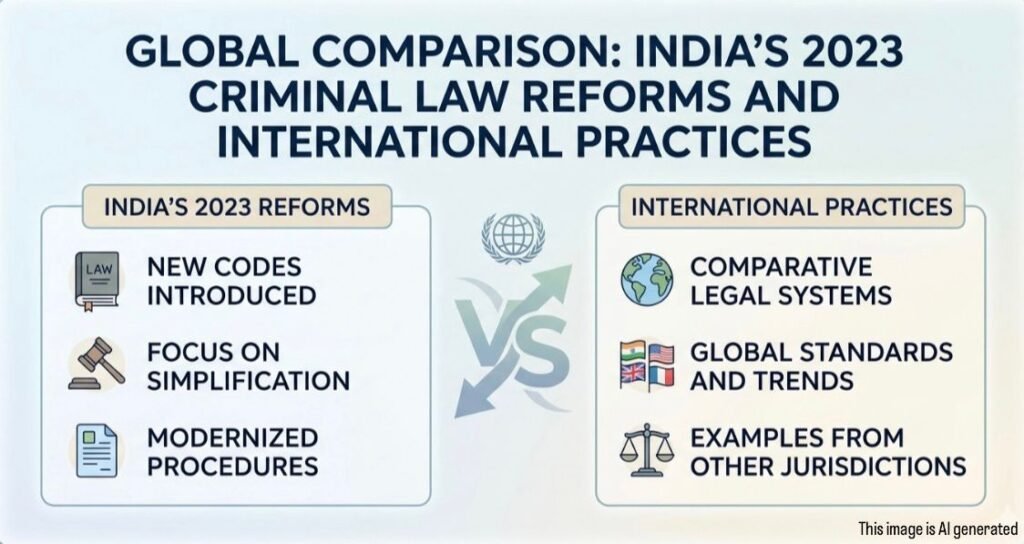
This reform aims to modernize criminal justice by prioritizing the victim rights approach and reducing procedural delays. Countries like the U.K., U.S.A. and Australia have also introduced reforms in recent decades focusing on restorative justice, digital evidence and speedy trials.
India’s 2023 reforms invite comparison with global practices by analysing case laws, highlighting similarities and divergences, and assessing whether the Indian criminal justice system now aligns with international standards.
Comparative Analysis between India and Other Countries
- Victim Centric Approach
India’s reforms emphasize victim rights by introducing provisions for community service as punishment, by recognizing sexual offences against women and by mandating speedy trial.
Similarly, in other countries there are victim rights acts and a victim centric approach.
- Digital and Forensic Evidence
The 2023 bill mandates forensic investigation for serious crimes; it leverages modern technology to strengthen evidence collection and criminal investigation.
Similarly, in other countries self-authentication of electronic rights of electronic records and digital evidence are admissible.
- Speedy trials and procedural efficiency
India’s reforms introduced strict timelines like
- Police must file charge sheet within 90 days
- The reforms encourage procedural efficiency and prescribe timelines for investigation and trial-related processes.
- Video conferencing for witness examination is permitted etc.
Similarly, other countries also focused on speedy trials and strict case management to avoid delay.
- Abolition of sedition and introduction of terrorism provisions
The reforms repealed the colonial offence of sedition under Section 124A IPC, while introducing new provisions relating to acts endangering sovereignty, unity, and integrity of India.
Similarly, other countries also abolished sedition laws and focused on national security laws. Example:
UK – restorative justice and CCTV policing
USA – digital evidence and plea bargaining
Australia – victim compensation frameworks
Canada – community sentencing models
- Community service and alternative sentencing
India’s reforms introduced community service as punishment for minor offences as a progressive step.
Similarly, other countries have also been using community service as a rehabilitative model and developing the feeling of belongingness and responsibility.
- Police accountability and use of technology
India’s reforms mandates zero FIRs, digital FIR and CCTV recording of searches
Similarly, in other countries it is mandatory to have body cameras and rely on digital documentation and community policing.
- Streamline procedures
The 2023 bill clarifies the categories of offences and responsibilities within the judicial process. It aims to reduce procedural ambiguities and overlaps with existing laws, ensuring more coherent and effective legal proceedings.
Similarly, in other countries it is mandatory to streamline procedures.
Case Laws
Mukesh & Anr v State (NCT of Delhi) (2017), commonly known as the Nirbhaya case, exposed systemic gaps in victim protection and highlighted the chronic delays in sexual offence trials. The Supreme Court upheld the death penalty for the convicts, emphasizing the gravity of crimes against women.
The 2023 reforms responded to such concerns by mandating faster disposal of sexual offence cases, stricter timelines for investigation and prioritizing victim centric justice.
Sunita Gandharva v. State of Madhya Pradesh (2010)
The accused was charged with a relatively minor offence. The High Court, while considering the circumstances, emphasized that not all offenders should be subject to harsh custodial sentences. The judgement highlighted that the court must differentiate between hardened criminals and first time or petty offenders.
The court observed that minor offenders such as those offenders that do not have prior criminal record should be given opportunity for reform and rehabilitation rather than being pushed into prison where they might be exposed to criminals.
Although the case does not directly order community service, the reasoning laid down by the court reflected reformative sentencing principles which were introduced in the 2023 reforms.
Hussainara Khatoon v. State of Bihar (1979)
In Hussainara Khatoon v. State of Bihar (1979), the Supreme Court recognised the right to speedy trial as a fundamental right under Article 21 of the Constitution. The 2023 reforms attempt to strengthen procedural efficiency and reduce delays in criminal proceedings.
Prakash Singh & Ors vs Union Of India And Ors on 22 September, 2006
The court stated that by mandating structure changes it ought to insulate the police from political interference ensuring accountability and enhance professionalism.
The 2023 reforms are made based on the foundations stated in this case regarding use of technology and statutory mandates to further strengthen police accountability.
Conclusion
The 2023 criminal law reforms represent a bold attempt to modernize its justice system aligning with global practices in victim rights, digital evidence, speedy trial and alternative sentencing. These changes marked a decisive break from colonial legacies and attempt to modernize the justice system in line with constitutional values and global best practices.
By introducing victim centric approach, recognizing digital, forensic evidence, mandating speedy trials, abolishing sedition, and adopting community service as an alternative punishment these reforms reflect a forward looking vision.
However challenges remain in implementation of judicial capacity and balancing state security with civil liberties.
Comparatively other countries have long embraced restorative justice, technological integration and strict trial timelines.
However India’s reforms represent a significant step toward catching up with these global standards. The success of these reforms depend not merely on legislative intent but also on the effective implementation, judicial training and institutional accountability.
India’s reforms are a step toward structured and advanced India but their success solely depends on the effective enforcement and judicial training. The success of these reforms will depend not merely on legislative intent but on effective implementation, judicial training and institutional accountability. If they are enforced with sincerity India’s criminal justice system can evolve into one that is efficient and balances the twin goals of protecting society and safeguarding individual rights.
Frequently Asked Questions
1. What are the names of the 2023 criminal laws?
In 2023 three new criminal laws were introduced to replace colonial-era codes namely:
- Bhartiya Nyaya Sanhita
- Bhartiya Nagarik Suraksha Sanhita
- Bhartiya Sakshya Adhiniyam
2. What is the reason behind the abolition of sedition in India?
Sedition was criticised as a colonial relic supporting free speech. The 2023 reforms abolished sedition as it was against the freedom of speech and fundamental rights.
3. What is community service punishment?
It is a non-custodial sentence where offenders perform social work to develop the feeling of responsibility and belongingness instead of imprisonment and this aligns with global restorative judicial practices.
4. What are the challenges in India’s criminal law reforms?
- There are several judicial backlog
- Lack of judicial infrastructure
- Potential misuse of terrorism
- Inadequate forensic labs
5. How do these reforms impact victims of sexual offences?
The reforms mandate faster disposal of cases and they prioritize victim rights by strengthening protection. The 2023 reforms responded to such concerns by mandating faster disposal of sexual offence cases, stricter timelines for investigation and prioritizing victim centric justice.