This article is written by Divyanshu Tyagi, Vivekananda Institute of Professional Studies.
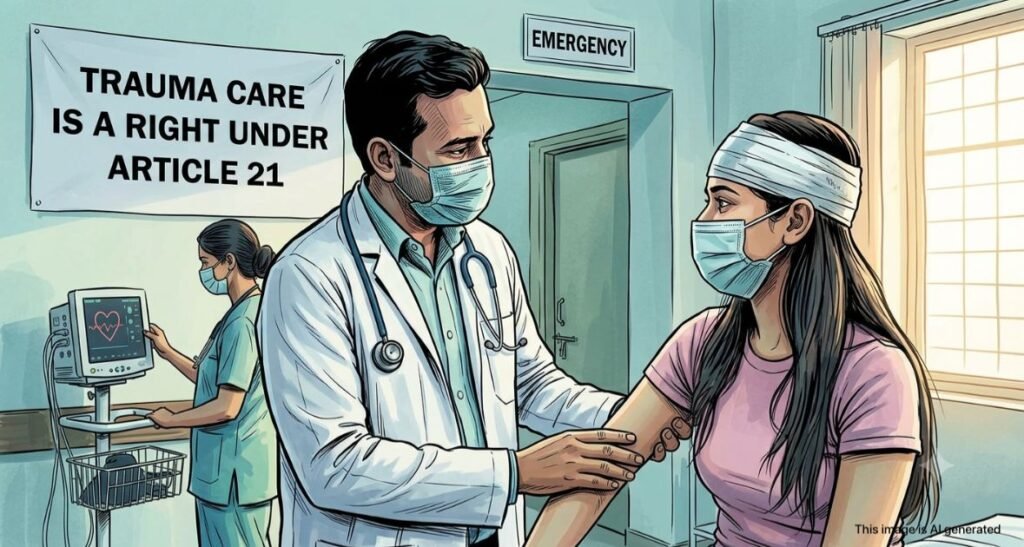
In a landmark interim order dated 26 May 2026 in the case of SaveLIFE Foundation & Anr. v. Union of India & Ors. (Writ Petition (Civil) No. 726 of 2024), a Division Bench of the Supreme Court comprising Justice J.K. Maheshwari and Justice Atul S. Chandurkar held that the right to trauma care is an integral facet of the right to life under Article 21.
The order came following a public interest litigation filed under Article 32 by the SaveLIFE Foundation, which argued that India’s fragmented emergency-response system led to the death of many accident victims due to delays in providing them medical attention. The ruling is significant for its doctrinal and operational details. According to official road safety data, India records nearly 1.7 lakh road accident fatalities annually, while studies by NITI Aayog and AIIMS indicate that timely trauma care during the ‘Golden Hour’ could prevent a significant proportion of these deaths. However, only around one in five victims previously reached medical care within that window, and India maintained an ambulance density far below the World Health Organization’s (WHO) recommendations.
By linking the emergency response directly to Article 21, the Court has turned a field of executive discretion into a justiciable constitutional right with binding and time-bound directions across the country.
Keywords: Trauma Care, Article 21, Right to Life, Emergency Healthcare, Supreme Court of India
Constitutional Framework and Right to Health
Article 21 provides that ‘no person shall be deprived of his life or personal liberty except according to procedure established by law.’ For decades, this guarantee was read narrowly as a defense against arbitrary executive deprivation. Since the late 1970s, the Supreme Court began widening the concept of ‘life’ beyond mere animal existence to include dignity, health, livelihood, shelter and a clean environment. This principle was subsequently applied in the field of public health in Consumer Education and Research Centre v. Union of India (1995), where the Supreme Court recognised the right to health and medical care as an integral component of Article 21. Read with Article 47, it transformed a non-justiciable aspiration into a justiciable part of Article 21. The trauma care decision in 2026 is the latest and most operationalized installment of this ongoing constitutionalisation of public health governance.
Supreme Court’s Recent Decision on Trauma Care
The petition referred to India’s decentralised emergency-care ecosystem involving multiple helpline numbers (100, 101, 102, 108, 1033, 1091), non-uniform ambulance standards, lack of trauma registries and ‘economic triaging’ by hospitals that delay treatment until payment in advance.
The Court had to determine if these failures were a breach of the victims’ right to life, and what orders were required. The Bench observed, at the interim stage, that access to timely trauma care forms an integral component of the right to life under Article 21.
It directed for time-bound integration of all emergency helplines into the unified number 112 in three months; Good Samaritan grievance-redressal mechanisms with nodal officers; a standardised medical rescue protocol; AIS-125 ambulance compliance with GPS/VLTD integrated with 112; adoption of the NCAHP EMT curriculum; State Trauma Registries linked to a National Trauma Registry; grading of hospitals as trauma-care facilities; full operationalisation of PM RAHAT; and multilingual awareness campaigns.
States will have to submit periodic compliance reports through Chief Secretaries and it will be reviewed after four months. What matters is the approach it took. Instead of legislating anew, the Court turned to the existing tools-Sections 134A and 162 of the Motor Vehicles Act, the National Ambulance Code, the NCAHP Act, 2021 and PM RAHAT.
Case Laws
Pt. Parmanand Katara v. Union of India (1989)
Facts: A scooterist involved in a road accident and seriously injured, bled to death because hospitals refused to give him treatment on the ground that they were not authorised to deal with medico-legal cases.
Issue: Whether the medical practitioners are under obligation to provide emergency treatment irrespective of procedural formalities.
Ruling: The Court held that ‘the preservation of human life is paramount’ and every doctor, public or private, has the duty to extend immediate aid, procedural formalities giving way to saving life.
Relevance: The 2026 judgment is a natural evolution of the foundational precedent of Katara for emergency aid under Article 21, extending it into a systemic, infrastructural mandate.
Paschim Banga Khet Mazdoor Samity v. State of West Bengal (1996)
Facts: A labourer, who suffered serious head injuries in a train accident, was turned away by seven government hospitals in Calcutta, due to non-availability of beds. He had to get costly treatment in a private hospital.
Issue: Whether such denial violates Article 21 and whether financial constraints excuse it.
Ruling: The Court held that denial of timely treatment by a government hospital violates the right to life and that financial incapacity is no defence; it ordered stabilisation units, bed-tracking systems, and equipped ambulances.
Relevance: This brought the focus away from individual practitioners to State accountability, as evidenced in the order of the 2026 judgment for an infrastructural overhaul.
Consumer Education and Research Centre v. Union of India (1995)
Facts: The case related to occupational health hazards in the asbestos industry.
Issue: Is health and medical care part of Article 21?
Ruling: The Court held that under Article 21, ‘life’ includes the right to health and medical aid necessary to protect dignity and physical well-being, and that the State bears a positive constitutional obligation to protect public health.
Relevance: This is the doctrinal bridge between Article 21 and health, and the 2026 order relies on this to regard emergency response as a constitutional entitlement.
Legal and Policy Implications
The judgment places specific duties on both levels of government. The Union Ministries of Health and Road Transport should issue notification regarding medical rescue protocol and registry formats. States should operationalise 112 integration, AIS-125 compliance, training as per NCAHP, hospital grading, trauma registries, Good Samaritan cells and PM RAHAT.
The Court avoided encroaching on State competence by grounding directions in Article 21 and, for PM RAHAT, in the Motor Vehicles Act under the Concurrent List – bridging a long-standing federalism gap in health governance, since ‘public health’ is under Entry 6 of List II (State List). India currently has about one ambulance per 80,000-100,000 people, against the WHO-recommended one per 50,000 and much of the private fleet is not AIS-125 compliant.
The retrofitting of vehicles, installation of GPS/VLTD systems and the hiring of certified paramedics within three months will entail huge capital expenditure, raising questions about subsidies for private operators. PM RAHAT aims to stop ‘economic triaging’ by offering cashless treatment up to ₹1.5 lakh for seven days, reimbursed through TMS 2.0 linked to the police e-DAR system, funded by the Motor Vehicle Accident Fund.
The Court clarified that authorities violate the Motor Vehicles Act when they fail to implement PM RAHAT. To ensure compliance, the Court directed the Chief Secretaries to submit monthly reports and scheduled a review after four months.
Critical Analysis
The power of the judgment is in translating a policy environment that tends to be under-enforced into justiciable obligations with real deadlines. It closes the gap between schemes such as AIS-125, the NCAHP curriculum and PM RAHAT, and their implementation. By locating these directions within Article 21 and not in new legislation, the Court preserves legislative primacy but also prevents constitutional guarantees from becoming illusory due to administrative inertia. But the directive sparks concerns about the feasibility of compressed timelines given stark inter-State disparities in fiscal capacity; poorer States may find it hard to retrofit fleets or set up registries within months without dedicated funding. There is also a recurrent debate on the judicial directions on matters concerning resource allocation that traditionally fall within the executive domain, but courts have justified such interventions under Article 32 read with Article 142 where fundamental rights are in question.
Conclusion
SaveLIFE Foundation & Anr. v. Union of India & Ors. is a watershed in the constitutional health jurisprudence of India, completing the doctrinal arc that began with Parmanand Katara and Paschim Banga Khet Mazdoor Samity by translating the abstract guarantee of the right to life into an enforceable, time-bound framework for emergency care. The judgment mandates a concerted revamp of the communication, transport, training, registry and financing mechanisms of India’s public healthcare system and if implemented in earnest, can significantly cut down the high burden of preventable trauma deaths in the country. The ruling firmly situates trauma care in the burgeoning canon of socio-economic entitlements read into Article 21.
References
Ministry of Road Transport and Highways, Press Information Bureau, PM RAHAT Scheme Launch. https://www.pib.gov.in/PressReleasePage.aspx?PRID=2228172
Ministry of Road Transport and Highways, Press Information Bureau, PM RAHAT Implementation Dashboard Details. https://www.pib.gov.in/PressReleasePage.aspx?PRID=2238637
PMF IAS, ‘PM RAHAT Scheme: Detailed Analysis’. https://www.pmfias.com/pm-rahat-scheme/
Indian Express, ‘Trauma care integral part of right to life: Supreme Court directs states to merge emergency numbers into 112’ (28 May 2026). https://indianexpress.com/article/legal-news/supreme-court-trauma-care-right-to-life-112-helpline-order-10712187/
Moneycontrol, ”Right to trauma care part of right to life’: Supreme Court issues nationwide directions for road accident emergency care’ (2026). https://www.moneycontrol.com/news/india/right-to-trauma-care-part-of-right-to-life-supreme-court-issues-nationwide-directions-for-road-accident-emergency-care-13934600.html
LiveLaw, ”Trauma Care Part Of Right To Life’: Supreme Court Directs To Integrate Emergency Helplines Into 112, Implement PM RAHAT & Good Samaritan Scheme’ (28 May 2026). https://www.livelaw.in/top-stories/trauma-care-part-of-right-to-life-supreme-court-directs-to-integrate-emergency-helplines-into-112-implement-pm-rahat-good-samaritan-scheme-536001
Economic Times, ‘Right to trauma care of citizens integral part of right to life, Supreme Court says’ (2026). https://economictimes.indiatimes.com/news/india/right-to-trauma-care-of-citizens-integral-part-of-right-to-life-supreme-court-says/articleshow/131366118.cms
Times of India, ‘India gets constitutional right to trauma care; SC orders nationwide overhaul of emergency response’ (2026). https://timesofindia.indiatimes.com/india/india-gets-constitutional-right-to-trauma-care-sc-orders-nationwide-overhaul-of-emergency-response/articleshow/131366143.cms
Times of India, ‘Integrate all emergency helplines into ‘112’ in three months, says SC’ (2026). https://timesofindia.indiatimes.com/india/integrate-all-emergency-helplines-into-112-in-three-months-says-sc/articleshow/131377657.cms
Onmanorama, ‘Right to trauma care is major part of Right to Life, says SC; Issues instructions for Helpline 112’ (28 May 2026). https://www.onmanorama.com/health/healthcare/2026/05/28/right-to-trauma-care-sc-directions-passed.html
TFI Post, ‘Supreme Court Mandates Trauma Care as Fundamental Right, Orders Full-Scale Reform of India’s Emergency Medical Response System’ (2026). https://tfipost.com/2026/05/supreme-court-mandates-trauma-care-as-fundamental-right-orders-full-scale-reform-of-indias-emergency-medical-response-system/
Health and Human Rights Journal, ‘Saving Time, Saving Lives: The Golden Hour as a Constitutional Guarantee in India’ (30 September 2025). https://www.hhrjournal.org/2025/09/30/saving-time-saving-lives-the-golden-hour-as-a-constitutional-guarantee-in-india/