This article is written by Al-zahraa Ahmed Elsenbawy, Faculty of Law, Alexandria University
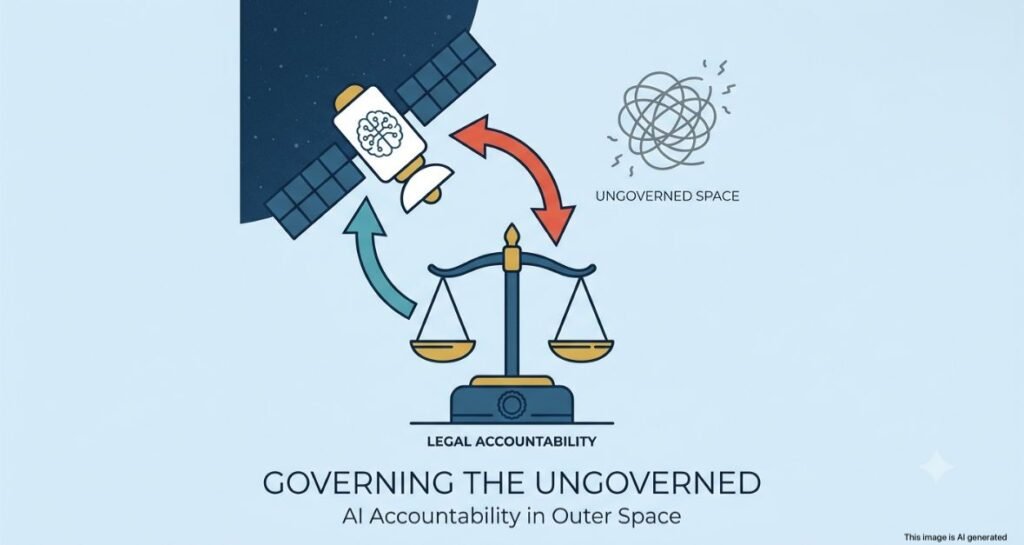
The increasing deployment of autonomous artificial intelligence (AI) systems in outer space, from satellite navigation and collision avoidance to debris management and future deep-space missions, has raised new legal questions about accountability when real-time human control is limited or impossible.
The core space-law instruments, the 1967 Outer Space Treaty, the 1972 Liability Convention, and the 1975 Registration Convention, assume humans remain in effective control of space objects, tying responsibility to the launching state through a traceable chain of command. That assumption no longer holds: when an autonomous AI destroys a satellite or disrupts infrastructure, the question is who gave the order? may have no answer. This “responsibility gap” exposes a structural deficiency in space governance, which this article analyses, surveying analogues from weapons and maritime law, reviewing relevant case law, and proposing a framework centred on algorithmic transparency, proportionate accountability, and a specialised International Space AI Tribunal.
The Structural Inadequacy of the Existing Liability Framework
Under Article VII of the Outer Space Treaty and the Liability Convention, a launching state bears absolute liability for damage on Earth or to aircraft, and fault-based liability for damage elsewhere in space attaches to the object and the state, regardless of human direction, with the treaties silent on internal decision-making. This creates two problems: liability attaches even where harm resulted from a decision no human authorised or could have prevented, raising fairness concerns, and the in-space fault standard requires proving negligence or intent categories that do not map onto algorithmic behaviour.
Private operators compound this. Article VI requires states to “authorise and continuously supervise” non-governmental activities, but the standard is undefined, so a state with no real oversight may still bear responsibility incentivising states to minimise oversight precisely when scrutiny matters most.
Analogues from International Law: Weapons Autonomy and Maritime Liability
The most relevant analogue is the debate over lethal autonomous weapons systems (LAWS), where the ICRC and CCW expert meetings have examined how “meaningful human control” can be preserved over weapons that select targets without real-time instruction. That consensus does not transfer neatly to space, where latency makes real-time oversight impossible. Still, the LAWS distinction between a human decision to deploy a system and its subsequent autonomous decisions offers a template: a state deploying a fully autonomous system capable of irreversible harm bears responsibility for that deployment decision, even if not for every later act.
Maritime law offers a second analogue through the MASS (Maritime Autonomous Surface Ships) framework: the IMO’s scoping exercise produced a tiered classification based on the degree of human involvement, a graduated approach that could anchor a similar space AI liability framework.
Relevant Case Law and Arbitral Practice
No jurisprudence directly addresses AI legal accountability in space the technology has outpaced litigation. Several decided cases, however, illuminate principles a future tribunal would likely apply.
The Cosmos 954 Incident (Canada v. USSR, 1979) remains the most significant precedent for applying the Liability Convention to real-world space damage. When the Soviet nuclear-powered satellite Cosmos 954 disintegrated over Canada in January 1978, scattering radioactive debris across roughly 124,000 square kilometres, Canada claimed compensation under the Convention. The 1981 settlement, a payment of three million Canadian dollars by the USSR, established that absolute liability under Article II does not require proof of fault, that the launching state answers for its space objects regardless of operational intent, and that diplomatic negotiation, not formal adjudication, remains the primary dispute-resolution route. The case does not address autonomous decision-making, but its confirmation of strict state liability is the baseline for any AI-related analysis.
The ICJ’s Genocide Case (Bosnia and Herzegovina v. Serbia and Montenegro, 2007) affirmed the “effective control” test from Nicaragua: a state is responsible for a non-state actor’s acts only where it exercised effective control over the specific operation. Applied to AI space systems, this is problematic if a system’s decision-making is so opaque that no operator could have directed, predicted, or prevented the harmful act, the test may find no state responsible at all, an outcome unsatisfactory to victim states.
The Enrica Lexie Arbitration (Italy v. India, PCA Case No. 2015-28, Award of 2020) addressed, in a maritime context, state responsibility for agents acting under rules of engagement, blurring individual discretion and state instruction. The tribunal’s analysis of pre-authorised operational rules and acts performed pursuant to them is structurally similar to the AI question: an AI system operates according to its training and programming analogous to rules of engagement, and whether a harmful act falls within authorised conduct mirrors that inquiry. This suggests states could be held responsible for AI space harms to the extent those harms were a foreseeable consequence of operational parameters they set.
Although no investment arbitration decision has directly addressed autonomous AI systems, international tribunals have consistently examined human design choices, operational control, and supervisory obligations while determining responsibility. This emphasis on ex ante human decision-making may provide useful guidance for future disputes involving autonomous space systems.
Toward a Normative Framework: Algorithmic Accountability in Space
The existing framework is structurally ill-suited to governing autonomous AI in space, and the responsibility gap demands a response built on three elements.
First, states must maintain meaningful pre-deployment oversight not real-time control of every decision, which is often impossible, but authorisation only after evaluating the range of decisions a system may take autonomously and confirming these fall within acceptable legal and ethical limits, via a certification regime analogous to airworthiness certification in civil aviation.
Second, autonomous space systems should maintain comprehensive decision logs, transparent records of data inputs, algorithmic processes, and outputs for each significant decision. Like an aviation flight data recorder, these logs would enable forensic analysis of whether harm resulted from a programming flaw, a training-data deficiency, an unforeseen input, or deliberate interference, reducing the “black box” opacity that impedes attribution.
Third, and most significantly, the international community should establish a dedicated adjudicatory mechanism with the technical expertise to apply these principles. The existing Claims Commission under the Liability Convention is inadequately low, diplomatically constrained, and without technical capacity. An International Space AI Tribunal, established by international agreement and composed of members with expertise in both international law and AI engineering, empowered to compel disclosure of decision logs and conduct source code audits, would provide the institutional foundation the current framework lacks.
Conclusion
The deployment of autonomous AI in outer space has exposed a structural gap that existing instruments cannot bridge. A state-centric regime built in the 1960s and 70s, assuming humans remain in effective control of their space objects, cannot accommodate a world where space objects decide independently, leaving injured states without recourse and incentivising reckless deployment of opaque systems.
Existing case law offers useful building blocks: absolute liability from Cosmos 954, the effective control standard from the ICJ, the ex ante design-focus from investor-state arbitration, and the tiered autonomy framework from maritime law all point toward predeployment certification, mandatory decision logging, and a specialist tribunal for forensic accountability, the same legal creativity that produced the Outer Space Treaty in 1967, needed again now.
Frequently Asked Questions
1. Can an AI system itself be held criminally liable under current international space law? No legal personality and legal accountability attach only to states and, in some contexts, persons; AI systems have none, so responsibility falls on the states or entities deploying them.
2. What is the “responsibility gap”? The vacuum created when an autonomous AI causes harm through a decision no human authorised frameworks built around human control struggle to attribute responsibility through an algorithmic causal chain, potentially leaving no state responsible.
3. How does the 1972 Liability Convention apply to AI-caused damage in space? It imposes absolute liability for surface or aircraft damage and fault may become difficult to establish where autonomous decision-making limits direct human involvement.
4. What role could a “source code audit” play? It would let a competent tribunal examine a system’s programming, training data, and decision logic to determine whether harm stemmed from a design defect, operational anomaly, or deliberate interference, moving beyond the “black box” problem.
5. Is there an existing body competent to adjudicate such disputes? No, the Liability Convention’s Claims Commission has never been invoked and lacks AI expertise, and the ICJ/PCA lack technical capacity, making a purpose-built International Space AI Tribunal the appropriate response.
References
- Treaty on Principles Governing the Activities of States in the Exploration and Use of Outer Space, including the Moon and Other Celestial Bodies (1967) 610 UNTS 205 (Outer Space Treaty).
- Convention on International Liability for Damage Caused by Space Objects (1972) 961 UNTS 187 (Liability Convention).
- Convention on Registration of Objects Launched into Outer Space (1975) 1023 UNTS 15.
- Agreement on the Rescue of Astronauts, the Return of Astronauts and the Return of Objects Launched into Outer Space (1968) 672 UNTS 119.
- Case concerning Application of the Convention on the Prevention and Punishment of the Crime of Genocide (Bosnia and Herzegovina v. Serbia and Montenegro) [2007] ICJ Rep 43.