This article is written by Unnati Dixit (4th semester), BA.LLB (Hons.) from Arya Kanya Degree College (aff. University of Allahabad). This article examines what Indian Copyright Law actually says about AI-generated content, how courts in India and around the world are beginning to respond, and what the stakes are for creators, developers and the legal system itself. It is to the cases that have started shaping this conversation that we now turn.
Keywords: Artificial Intelligence, Authorship, AI-Generated Content, Intellectual Property, Section 2(d), Generative AI, Originality
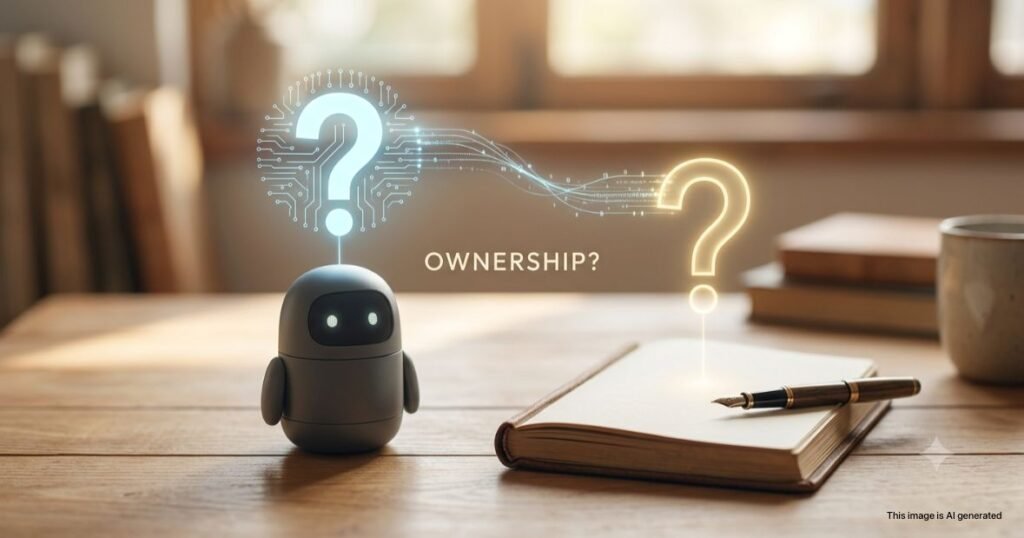
Open your phone and type a prompt into ChatGPT, either ask it to write you a poem on any theme, or compose a song; in about thirty seconds, you would have something that is original looking, something that you might want to use, sell or publish. And then comes the question nobody has a clean answer to yet: who owns it?
Not you, necessarily. No, the AI definitely is a machine and machines cannot hold rights. Not the company that developed the AI, at least not automatically. Lastly not the millions of artists, writers and musicians whose work was fed into the model as training data without their knowledge or consent. In the world of generative artificial intelligence, creativity has become abundant and authorship has become invisible.
This is not just any hypothetical problem; it is actually happening right now. Midjourney is generating artwork in the style of living artists. Suno is producing music that sounds eerily like songs already written. ChatGPT is reproducing journalist content and attributing fabricated quotes to real news agencies. The law, meanwhile, is running several years behind this technology and in India, it is running faster than most.
India’s Copyright Act, 1957 was written in a world where every creative work had a human face behind it. The statute’s definition of “author” under Section 2(d) is built entirely around natural persons, basically who writes, composes, draws, or directs. There is one provision, Section 2(d)(vi) provides that, in relation to a computer-generated literary, dramatic, musical or artistic work, the author is “the person who causes the work to be created.” But that provision was inserted in 1994, written for basic software outputs, and has never been tested against a generative AI-model that produces an entire novel from a three-word prompt. The result is a legal lag at the heart of one of the fastest-growing technological shifts with the changing time of ours.
Case Laws
The law on AI-generated content is still being written mostly in courtrooms and following are the cases that matter the most.
ANI Media Pvt. Ltd. v. OpenAI Inc. & Anr., CS(COMM) 1028/2024 (Delhi High Court)
This is India’s first real AI copyright case, and it is still ongoing. In November 2024, Asian News International which is one of India’s largest news agencies filed a suit in the Delhi High Court alleging that OpenAI had trained its ChatGPT models on ANI’s copyrighted news articles, including paywalled content, without permission or payment. ANI further alleged that ChatGPT is damaging not just its copyright but its credibility too.
OpenAI challenged the suit on jurisdictional grounds, arguing that its servers are not in India, and claimed it had already blocked ANI’s website from future training data. The Delhi High Court admitted the matter and issued notice to OpenAI as a signal that the court considered the issues raised are genuinely worthy of judicial examination. This case raises three questions that Indian law has never formally answered: Does training an AI on copyrighted content constitute infringement under Section 51 of the Copyright Act? Is there a fair dealing defence under Section 52 for such use? And can a news agency sue a foreign AI company in an Indian court? The answers, when they come, will shape India’s entire AI copyright landscape.
Thaler v. Vidal, 43 F.4th 1207 (U.S. Court of Appeals for the Federal Circuit, 2022)
Stephen Thaler is an AI researcher who built a system he called DABUS that stands for “Device for the Autonomous Bootstrapping of Unified Sentience”. DABUS, he claimed, had independently invented two things i.e., a beverage holder with a fractal surface and an emergency light beacon. Thaler applied for patents in multiple countries, listing DABUS as the inventor. Every major jurisdiction said no.
In the United States, the Federal Court of Appeals held in 2022 that the Patent Act’s use of personal pronouns as ‘himself’ and ‘herself’, when referring to inventors, has made it plain that the Court intended only natural persons to be inventors. While this case dealt with patents rather than copyright, its reasoning explains directly that intellectual property rights are built on the assumption of a human creator.
GEMA v. OpenAI, Case No. 42 O 14139/24 (Regional Court of Munich, November 2025)
The most recent and arguably the most significant case in this came from Germany in November 2025. GEMA is the German music rights society which sued OpenAI for training ChatGPT on copyrighted song lyrics without a licence. The Munich Regional Court ruled in GEMA’s favour, holding that when an AI model ‘memorises’ copyrighted content during training and later reproduces it in outputs, this constitutes as an act of reproduction and public communication under copyright law. The court found OpenAI liable for infringement.
As the matter is comparatively recent and jurisdiction-specific, its persuasive value outside Germany will depend on how other courts approach AI training and copyright.
This judgment matters for India because it directly answers a question ANI v. OpenAI is circling around that is, “does AI training on copyrighted content violate copyright, and can the resulting outputs be considered infringing if they reproduce the original?” Germany said yes. India’s courts have not yet spoken. But the GEMA ruling gives Indian courts a better international precedent to work with, and signals that the world is moving toward holding AI developers accountable for what goes into their models and not just what comes out.
Conclusion
Ask yourself a simple question: if you commission an artist to paint a portrait and then you generally own the painting but if you buy a camera and take a photograph then the photograph is yours. Now, if you type a prompt into an AI and a painting appears then you are not quite sure and so, Neither is the law.
That uncertainty is the defining legal challenge of the generative AI era. Indian copyright law as it stands was not designed for this world. Section 2(d) assumes a human author. Section 2(o)’s “person who causes the work to be created” standard was written for a time when computers were tools and not co-creators. In May 2025, the Ministry of Commerce and Industry constituted an eight-member expert panel to evaluate whether the Copyright Act, 1957 adequately addresses generative AI. The panel is reportedly considering introducing a new chapter as Chapter XII-A which would specifically address AI-generated works, ownership, and liability.
On the other hand, creators are losing like for artists whose work trained in Midjourney receive no royalty, journalists whose articles trained ChatGPT get no credit and musicians whose recordings shaped Suno have no remedy under current Indian law. The ongoing ANI case may begin to change that but only if the Delhi High Court is willing to read a 1957 statute through a 2025 lens.
The question this article began with was who owns what artificial intelligence makes? This does not yet have a legal answer in India. What it does have is urgency that every day which passes without clarity is a day that creators are unprotected, developers are uncertain, and the courts are unprepared. India has always had the legal tradition to rise to complex constitutional and economic challenges. The AI copyright question is the next one and this is a high time to govern it.
Frequently Asked Questions
1. Can AI be an author under Indian copyright law?
No. Section 2(d) of the Copyright Act, 1957 defines “author” in terms that presuppose a natural person like the writer of a literary work, the composer of music, the artist of an original work. AI has no legal personality and cannot hold rights or bear responsibilities.
2. If I create something using AI, do I own the copyright?
Possibly we do, but it depends on how much creative input we contributed. Like if we provided a detailed, creative prompt and shaped the output meaningfully, then we may have a stronger copyright claim.
3. What is Section 2(d)(vi) of the Copyright Act and does it help?
Section 2(d)(vi) provides that, for computer-generated literary, dramatic, musical or artistic works, the author is the person who causes the work to be created.
4. What is India doing to address AI and copyright law?
In May 2025, the Ministry of Commerce and Industry formed an expert panel to review the Copyright Act, 1957 in light of generative AI. The panel is considering introducing a dedicated chapter on AI-generated works. The DPIIT has also issued guidance on AI training data. Legislative reform is expected, but no amendment has been passed as of the date of this article.