This article is written by Bhoomi Chaturvedi, Atal Bihari Vajpayee School of Legal Studies, CSJMU Kanpur.
Case Details
Case Name: Shishupal @ Shish Ram & Ors. v. Surjeet & Ors.
Judgement Date: 11 June 2026
Citations: 2026 INSC 634 | 2026 SCO.LR 6(3)[13]
Bench: Sanjay Karol J, N.K. Singh J
I. Introduction
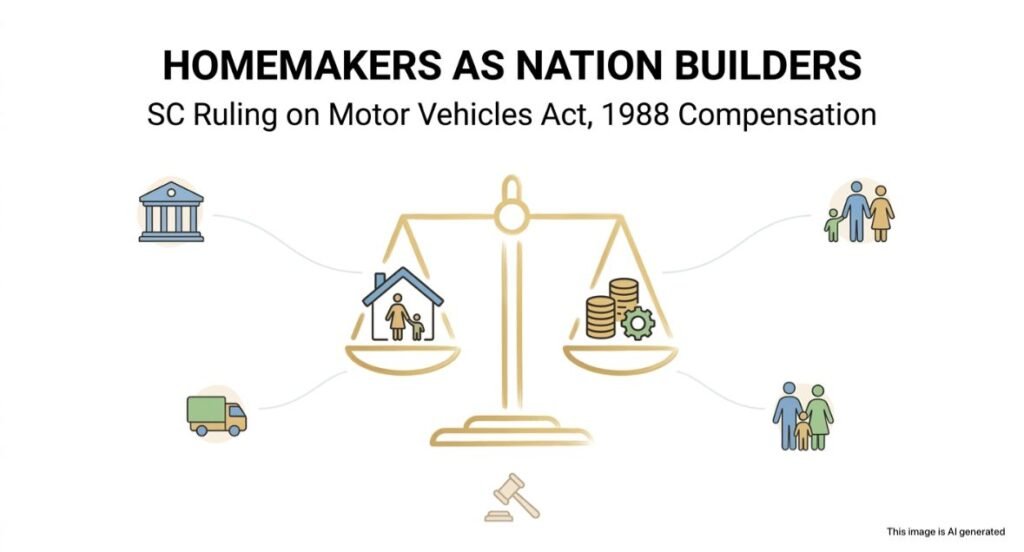
On 11 June 2026, the Supreme Court of India delivered a judgment that promises to transform the landscape of motor accident compensation law and, more broadly, the legal recognition of unpaid domestic labour in India. In Shishupal @ Shish Ram & Ors. v. Surjeet & Ors., a bench comprising Justice Sanjay Karol and Justice N. Kotiswar Singh held that homemakers are “nation builders” and fixed a minimum notional monthly income of Rs. 30,000 for calculating the loss of domestic-care services in motor accident claims under the Motor Vehicles Act, 1988.
The ruling is significant on multiple levels. First, it introduces “loss of domestic care” as a new and independent head of compensation, supplementing the existing heads recognised in the constitutional bench judgment of National Insurance Co. Ltd. v. Pranay Sethi (2017). Second, it challenges decades of judicial undervaluation of homemakers’ contributions by assigning a concrete monetary floor to work that has historically been treated as economically invisible. Third, it carries profound implications for gender justice, given that the overwhelming majority of homemakers in India are women whose labour sustains families and, by extension, the national economy.
India’s road accident statistics lend urgent practical importance to this judgment. According to the Ministry of Road Transport and Highways, road accidents claim over 1.5 lakh lives annually. A significant proportion of victims are women engaged in household work. For decades, their families received minimal compensation because courts pegged their notional income to minimum wage rates for unskilled labour. The Supreme Court’s ruling in Shishpal decisively rejects this approach and provides a principled basis for more equitable compensation awards going forward.
II. Legal Framework: The Motor Vehicles Act, 1988 and Compensation Jurisprudence
Compensation for motor accident victims in India is primarily governed by Sections 163-A and 166 of the Motor Vehicles Act, 1988 (MVA). Claims are adjudicated before Motor Accident Claims Tribunals (MACTs), with appeals lying to the respective High Courts and ultimately the Supreme Court. The Act mandates “just compensation” but does not prescribe a fixed formula, leaving it to courts to devise equitable methodologies.
The principal framework for calculating compensation was laid down by the Supreme Court in Sarla Verma v. Delhi Transport Corporation (2009) 6 SCC 121, which standardised the multiplier method: the deceased’s notional annual income is multiplied by a factor based on age to arrive at the compensation for loss of dependency. This framework was refined and expanded in the constitutional bench decision in Pranay Sethi (2017), which added conventional heads such as loss of estate, loss of consortium, and funeral expenses as fixed amounts. However, both Sarla Verma and Pranay Sethi left unresolved the precise monetary valuation of a homemaker’s contribution beyond the notional income calculation.
The 2026 ruling in Shishpal fills this gap by creating an entirely new head of damages. “Loss of domestic care” now stands alongside the heads recognised in Pranay Sethi as a mandatory consideration whenever a homemaker is the victim. This is not merely an enhancement of the notional income figure; it is a conceptually distinct recognition that the family’s loss of care, nurture, and household management deserves independent compensation separate from dependency loss.
III. Case Laws and Judicial Evolution
1. National Insurance Co. Ltd. v. Pranay Sethi, (2017) 16 SCC 680
The constitutional bench in Pranay Sethi standardised the heads of compensation available in motor accident claims, fixing loss of consortium at Rs. 40,000 for a spouse, Rs. 40,000 for each parent, and Rs. 15,000 for each child, along with loss of estate and funeral expenses. It also held that future prospects must be added to the notional income of self-employed and fixed-salary earners. The Shishpal judgment explicitly builds upon Pranay Sethi by declaring “loss of domestic care” an additional head of compensation not enumerated in the 2017 ruling.
2. Sarla Verma v. Delhi Transport Corporation, (2009) 6 SCC 121
Sarla Verma established the multiplier method as the standard for calculating compensation, structured around the deceased’s age and notional income. The court also held that one-third of the income should be deducted for personal expenses in cases where the deceased had dependents. While Sarla Verma acknowledged homemakers as victims entitled to compensation, it did not specify a minimum valuation. The 2026 ruling corrects this lacuna by setting a concrete floor of Rs. 30,000 per month.
3. Lata Wadhwa v. State of Bihar, (2001) 8 SCC 197
In this early recognition of homemaker compensation, the Supreme Court held that the services rendered by a housewife must be assigned a monetary value for computing just compensation. The bench observed that domestic services are real and valuable economic contributions to the family, thereby establishing the foundational principle upon which subsequent jurisprudence, including Shishpal, has been built.
4. Hem Raj v. Oriental Insurance Co. Ltd., (2018) 8 SCC 469
This judgment held that future prospects must apply equally whether the notional income is based on actual documentary evidence or on a court’s estimate, rejecting any distinction between the two bases of assessment. The ruling reinforced that homemakers should not be penalised for the absence of formal pay slips. The principle from Hem Raj was relied upon in subsequent homemaker compensation cases and informed the Shishpal bench’s reasoning that a fixed minimum floor for domestic care is both legally sound and constitutionally necessary.
5. Shishpal @ Shish Ram & Ors. v. Surjeet & Ors. (2026)
The lead judgment, delivered on 11 June 2026, arose from a motor accident claim involving the death of a homemaker from Punjab. The family had been pursuing compensation through successive courts. Justice Sanjay Karol, writing for the bench, held that the loss of a homemaker’s domestic care constitutes a distinct category of loss that cannot be subsumed within the conventional heads of Pranay Sethi or the multiplier-based dependency calculation. The bench fixed a minimum notional monthly value of Rs. 30,000 for domestic services, directed High Courts to monitor implementation of the new directions, and expressed hope that the term “homemaker” would henceforth carry the meaning of “nation builder” in legal discourse.
IV. Constitutional Dimensions
The judgment has strong constitutional underpinnings. Article 14 of the Constitution guarantees equality before law and equal protection of laws. For decades, the legal system’s undervaluation of homemakers’ work has produced inequality in practice: families of deceased salaried earners received substantially higher compensation than families of deceased homemakers performing equally essential functions. By fixing a meaningful monetary floor, the Supreme Court corrects this structural inequality.
Article 15(1) prohibits discrimination by the State on grounds of sex. The gendered nature of homemaking in India, where, according to Census data, over 15 crore women identify as engaged in domestic work compared to a negligible proportion of men, means that the systematic undervaluation of homemakers’ services amounts, in effect, to sex-based discrimination in the award of compensation. The Shishpal ruling implicitly recognises this dimension by framing the homemaker’s contribution as a matter of national importance rather than a domestic, and therefore lesser, activity.
Article 21 protects the right to life and dignity. The Supreme Court’s recognition that homemakers are “nation builders” whose loss deserves independent legal acknowledgment is consistent with the expansive interpretation of dignity that has characterised Article 21 jurisprudence since Francis Coralie Mullin v. Administrator, Union Territory of Delhi (1981). Dignity, the Court has repeatedly held, includes recognition of one’s contribution to society.
V. Conclusion
The Supreme Court’s judgment in Shishpal @ Shish Ram v. Surjeet represents a decisive step toward recognising the true economic and social value of unpaid domestic work in India. By fixing Rs. 30,000 per month as the minimum notional value of a homemaker’s services and creating “loss of domestic care” as a new, independent head of compensation, the Court has both corrected a historical injustice and set a forward-looking standard for Motor Accident Claims Tribunals across the country.
Several follow-up questions merit attention. First, the Rs. 30,000 figure, while a significant improvement over minimum wage benchmarks, may still undervalue domestic labour in urban contexts where equivalent hired services cost considerably more. Courts will need to treat it as a floor, not a ceiling, and adjust upwards based on facts. Second, the ruling’s application to cases where the homemaker survives but is incapacitated must be clarified, since the principle of lost domestic care applies with equal force to such situations. Third, the broader implications for insurance pricing and MACT practice will require prompt regulatory attention from the Ministry of Road Transport and Highways.
Ultimately, the true significance of this judgment lies beyond the law of torts. By declaring homemakers to be nation builders, the Supreme Court has sent a message to the entire legal system — and to society at large — that work performed within the home is as worthy of legal protection and recognition as work performed in the marketplace. That message, reinforced through consistent application by tribunals and courts, has the potential to reshape how India thinks about the relationship between domestic labour, gender, and the law.
VI. FREQUENTLY ASKED QUESTIONS
1. What is the significance of the Supreme Court’s June 2026 ruling on homemaker compensation?
In Shishpal @ Shish Ram v. Surjeet (2026), the Supreme Court fixed a minimum notional monthly income of Rs. 30,000 for homemakers in motor accident claims and introduced “loss of domestic care” as a new independent head of compensation. This is significant because it moves beyond treating homemakers as unskilled workers and recognises their indispensable contribution to family and society.
2. What was the legal position before this judgment?
Prior to Shishpal, compensation for homemakers was generally calculated by applying the multiplier method to a notional income pegged at minimum wages for unskilled or semi-skilled labour. Conventional heads under Pranay Sethi (consortium, loss of estate, funeral expenses) were added but there was no separate head specifically for the loss of domestic care as a distinct category of damage.
3. Does this judgment apply to all Motor Accident Claims Tribunals in India?
Yes. The Supreme Court’s binding precedent under Article 141 of the Constitution applies to all courts and tribunals in India. The bench also directed Chief Justices of all High Courts to monitor the implementation of the new directions, ensuring uniform application across MACTs.
4. Can the Rs. 30,000 figure be increased by tribunals?
Yes. Rs. 30,000 per month is explicitly stated as a minimum. Tribunals retain discretion to award higher amounts based on the facts of each case, including the nature of domestic services performed, the urban or rural context, and evidence of the homemaker’s specific skills such as childcare, eldercare, or running a family business from home.
5. What is the constitutional basis for recognising homemakers’ economic value?
The ruling draws upon Articles 14 (equality), 15(1) (non-discrimination on grounds of sex), and 21 (right to life and dignity) of the Constitution of India. The systematic undervaluation of homemakers’ work, given its overwhelmingly gendered character, constitutes both an equality violation and a denial of the dignity that Article 21 protects.
VII. REFERENCES
Disclaimer: This article is intended solely for educational and informational purposes. It is based on the Supreme Court judgment and publicly available legal sources available at the time of writing and should not be construed as legal advice.