This article is written by Aditi Kulkarni, a student at Brainware University.
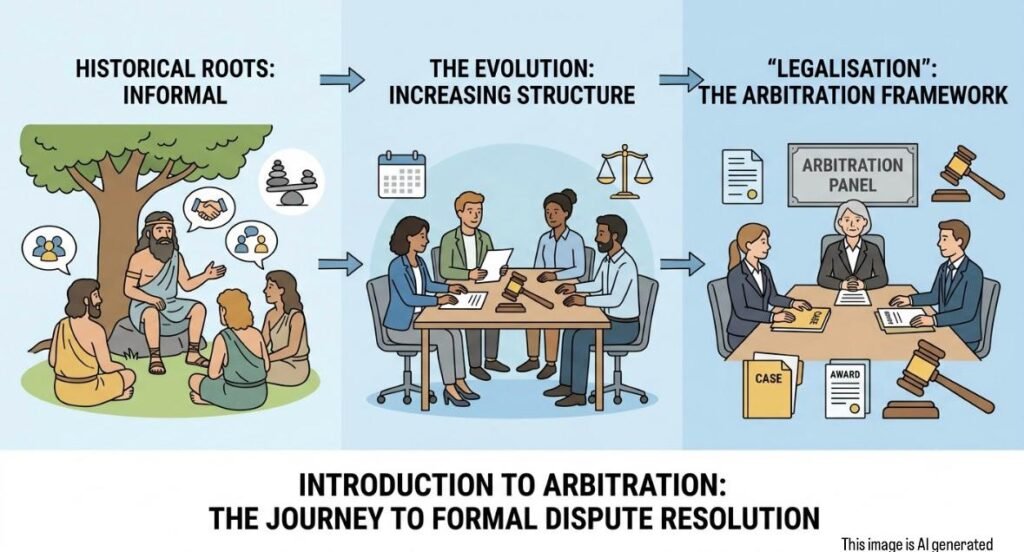
The field of conflict resolution is undergoing a significant transformation. Arbitration, once conceived as a streamlined alternative to the “needless contention” of court trials, has increasingly assumed the characteristics of formal litigation and is now often described as the “new litigation. ” Simultaneously, mediation, originally developed as an informal and consensual process, is evolving toward an adjudicatory model and is increasingly regarded as the “new arbitration.”
Arbitration as the “New Litigation
Modern commercial arbitration has changed a lot from its original purpose of being quick, flexible, and less formal. Today, it often resembles court proceedings. For example, instead of simple hearings, parties now face creeping legalism, lawyers file lengthy motions, use
e-discovery to sift through thousands of emails, and hearings can drag on for weeks. Alongside this, hardball advocacy has become common: lawyers bring the same aggressive, “win at all costs” style they use in court, which increases costs and delays. Finally, the supposedfinaliry of arbitration awards is no longer guaranteed.
In the U.S., for instance, after the Supreme Court’s decision in Hall Street Associates v. Mattel, parties cannot easily expand judicial review under the Federal Arbitration Act. Still, they sometimes look for loopholes in state laws to challenge awards. In practice, this means arbitration: once seen as a faster, cheaper alternative can now feel just as complex, adversarial, and uncertain as litigation.
The Indian Perspective on Arbitration
India s Arbitration and Conciliation Act of, 1996 was meant to modernise arbitration and move away from the old 1940 law, which treated arbitration with suspicion. The 1996 Act, inspired by the UNCITRAL Model Law, tried to make arbitration more independent and less controlled by courts. For example, Section 5 clearly says that courts should not interfere except in specific situations, and Section 16 allows the arbitral tribunal itself to decide whether it has the authority to hear a case. The idea was that arbitration awards should be as final and binding as court judgments.
However, Indian courts have sometimes gone against this spirit. A famous example is the ONGC v. Saw Pipes Ltd. case, where the Supreme Court widened the meaning of “public policy” under Section 34 to include “patent illegality.”
This meant that courts could reopen and re-examine the merits of an arbitral award, which defeated the purpose of arbitration being quick and final. Legal experts like FS. Nariman criticised this as a backward step, because instead of limiting court involvement, it gave judges more power to interfere. In practice, this shows how India’s attempt to make arbitration more efficient has often been slowed down by judicial intervention, making arbitration feel more like regular litigation.
The Arbital Tribunal
Section 16 of the Arbitration and Conciliation Act, 1996 plays a crucial role in defining the jurisdiction of the arbitral tribunal. It allows the tribunal to decide for itself whether it has the authority to hear a case, including questions about the existence or validity of the arbitration agreement. Importantly, the arbitration clause is treated as independent from the main contract. This means that even if the contract is declared null and void, the arbitration clause does not automatically become invalid.
If the tribunal rejects an objection to its jurisdiction, it continues with the proceedings and issues an award. Any challenge to that award can only be made later. On the other hand, if the tribunal accepts that it lacks jurisdiction, the matter can be appealed in court. This approach shows India’s strong intent to limit court interference in arbitration. In fact, it goes further than the UNCITRAL Model Law, which allows court recourse even when the tribunal rejects a jurisdictional challenge. By keeping courts out until the award stage, the Indian legislature emphasized its commitment to building confidence in arbitration as an independent process.
ONGC v. Saw Pipes Ltd.: A Retrogressive Step
The ONGC v. Saw Pipes Ltd. judgment is often seen as a backward move in Indian arbitration law because it weakened the principle of finality that the 1996 Arbitration Act was designed to protect. Before this case, courts could set aside an arbitral award only on narrow “public policy” grounds, such as if it violated fundamental Indian law, national interests, or basic justice and morality.
But in Saw Pipes, the Supreme Court expanded “public policy” to include patent illegality, meaning that if an award had a clear legal error, courts could reopen it. This opened the door for judges to re-examine the merits of arbitration decisions, which went against the Act’s intent of limiting judicial interference.
The judgment also introduced a merits-based review, allowing awards to be challenged if they violated the Arbitration Act, other substantive laws, or even the terms of the contract itself. In effect, courts gained the “last word” on both facts and law, undermining arbitration’s role as a faster, independent process.
Another key issue was the difference between domestic and foreign awards. The Court argued that foreign awards already had safeguards in their home jurisdictions, so Indian courts didn’t need to scrutinise them as much. But domestic awards had no such external checks, so they were subjected to heavier judicial review. Ironically, this made domestic arbitration less final than foreign arbitration in India.
The impact was significant: arbitration became slower, more expensive, and less reliable as an alternative to litigation. Critics like F.S. Nariman said the ruling “virtually set at nought” the purpose of the 1996 Act, which was to build trust in arbitration and reduce court involvement. Instead, Saw Pipes brought back the old problems of the 1940 Act judicial interference, delays, and uncertainty, making arbitration less effective as a true alternative dispute resolution mechanism.
Creeping Legalism in Modern Arbitration
In modern arbitration, the idea of “creeping legalism” describes how arbitration has shifted from being a simple, flexible alternative to court into something that now looks very much like litigation. Instead of quick, informal hearings, arbitration often involves the same complex procedures used in civil courts. For example, parties now engage in extensive
pre-hearing discovery, including depositions and e-discovery, where thousands of documents and emails are reviewed, making the process slow and expensive. There is also motion practice, where lawyers file detailed pre-hearing motions just like in court. Finally, hearings themselves have become prolonged, because arbitrators, worried that their awards might be overturned, tend to admit all evidence and avoid quick rulings like summary judgments. This cautious approach stretches proceedings out, increasing costs and delays. In short, arbitration, once meant to be faster and simpler, has started to resemble traditional litigation, which is why many scholars now call it the “new litigation.”
Mediation’s Identity Crisis: The “New Arbitration”
As arbitration has become more formal and litigation-like, many parties have turned to mediation for speed, lower cost, and greater control. But mediation itself is now facing an identity crisis. One issue is the blurring of boundaries: in “legal mediation,” lawyers often dominate the process, turning it into something like a private settlement conference. This brings adversarial tactics such as “mediator spinning” (trying to sway the neutral) and aggressive posturing. Another problem is the loss of self-determination. Instead of helping parties craft interest-based solutions, mediators increasingly use an evaluative style-offering opinions on the merits of the case-which makes mediation feel like a watered-down version of adjudication.
There is also an ethical gap: unlike arbitration, mediation is not legally defined as a tribunal, so lawyers can engage in puffing or bluffing without the same duty of candour that applies in arbitration.
Analysts warn against treating ADR as a monolith, where one model fits all disputes. The real strength of arbitration and mediation lies in choice-parties can design the process to suit their needs. But when contracts simply insert standard boilerplate clauses, parties often end up with a rigid, legalised model that defeats the purpose. Context matters too: rules that protect consumers in adhesion contracts (like strict disclosure standards in California) can be misused in complex business disputes, where they may derail proceedings midstream.
In short, mediation is struggling to preserve its unique values of flexibility and party control, while arbitration has drifted toward litigation. The challenge for modem ADR is to resist one-size-fits-all approaches and keep the focus on tailoring processes to the nature of the dispute.
Conclusion
Alternative Dispute Resolution (ADR) today stands at a turning point. Arbitration, once valued for its speed and simplicity, has become weighed down by creeping legalism, while mediation struggles with its own identity crisis. To restore trust in these processes, ADR must return to purposeful design rather than mimic litigation. In India, this means shedding the “baggage of the past”especially judicial precedents like Saw Pipes that reintroduced heavy court interference and building a culture where arbitration is truly final and efficient. Globally, the strength of ADR lies in deliberative choice: parties should be able to tailor the process to their needs, whether through arbitration or mediation, instead of relying on rigid, boilerplate clauses. Only then can ADR fulfil its promise as a genuine alternative to litigation, rather than becoming just another extension of it.