
This article is written by Abha Bajpai, Atal Bihari Vajpayee School of Legal Studies, CSJMU, Kanpur
Keywords: Terrorism, Bharatiya Nyaya Sanhita 2023, Section 113, UAPA, National Security
India has dealt with terrorism long before the law caught up with it.
For decades, prosecuting a terrorist act meant navigating through a set of special statutes namely; the Unlawful Activities (Prevention) Act, 1967 (UAPA), the Terrorist and Disruptive Activities (Prevention) Act (TADA), and the Prevention of Terrorism Act (POTA). The Indian Penal Code, 1860 never actually defined terrorism as a standalone offence. This meant that the general criminal law and counter-terrorism law operated in separate lanes, creating confusion in investigation, prosecution, and sentencing. The Bharatiya Nyaya Sanhita, 2023 transformed this.
For the first time, terrorism has been expressly incorporated into India’s general criminal code, although similar definitions previously existed in special anti-terror legislation such as UAPA. This isn’t just a drafting exercise, it reflects a conscious policy shift treating terrorism not as something handled only through emergency legislation, but as a mainstream criminal offence.
Section 113 defines a terrorist act as any conduct carried out with the intent or a clear likelihood of threatening India’s unity, sovereignty, integrity, security, or economic interests, or of spreading terror among the public, inside the country or abroad. The methods covered are wide explosives, firearms, hazardous substances, radioactive or nuclear materials, cyber-attacks, counterfeit currency, and hostage-taking. It brings terrorism into ordinary criminal law. It gives investigators and prosecutors a general legal tool alongside the UAPA, not as a replacement but as a meaningful addition. Which statute applies in a given case is determined by an officer not below the rank of Superintendent of Police, as specified in the Explanation of the section.
The Four Elements That Must Be Proven
Not every violent act is terrorism. Section 113 is careful about this. Four things must be established:
Intent: There must be a clear purpose of threatening India’s unity, integrity, sovereignty, security, or economic stability. Violence without this objective does not cross the threshold.
Method: The act must involve one of the prohibited means listed in the section like explosives, firearms, hazardous substances, and similar instruments.
Consequence: The act must result in or be likely to result in grievous harm, death, injury, damage to property, disruption of essential services, or threats to public safety.
Nexus: There must be a direct link between the conduct and the goal of spreading terror or compelling governmental action through fear.
Punishments
The penalties under Section 113 are calibrated to the nature of the offence. Each category is treated differently.
Where death results: Section 113(2)(a) prescribes death penalty or life imprisonment, with fine in terrorist acts resulting in death.
Where death does not result: Section 113(2)(b) prescribes a minimum five years imprisonment, extendable to life, with fine for such acts. An unsuccessful attack is no less dangerous in its intent.
Conspiracy, abetment, facilitation: Section 113(3) prescribes imprisonment of minimum five years, extendable to life, with fine. Anyone who plans, instigates, advocates, or assists even without direct participation is liable. Preparatory activities are also explicitly covered.
Training and recruitment: Section 113(4) prescribes imprisonment of minimum five years, extendable to life. Training and recruitment strengthen the operational capacity of terrorist organisations and are therefore treated as independent offences. Recruitment is how organizations sustain themselves. Hence both are targeted.
Membership of a terrorist organisation: Section 113(5) punishes membership of an organisation involved in a terrorist act with imprisonment which may extend to life imprisonment, along with fine.
Possession of property linked to terrorism: Section 113(7) punishes any person who knowingly possesses property derived from or obtained through a terrorist act with imprisonment which may extend to life imprisonment, along with fine.
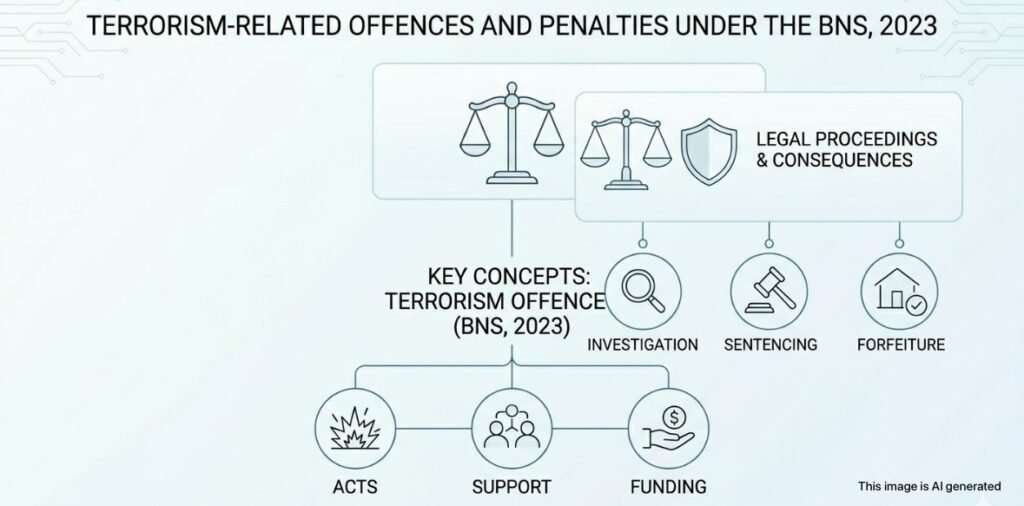
Support, Recruitment and Assistance: Section 113 punishes persons who organise terrorist camps, recruit individuals for terrorist activities, harbour or conceal terrorists, or otherwise provide assistance to terrorist organisations. Depending on the nature of involvement, the punishment may extend to life imprisonment along with fine.
Property Connected with Terrorism: The provision also targets property and financial resources linked to terrorist activities. Persons who knowingly deal with or possess such property may face severe punishment, including imprisonment and fine, reflecting the law’s focus on disrupting terrorist financing and support networks.
Case Laws
Section 113 of the BNS is new but its roots go back to the UAPA and earlier anti-terror laws in which the judiciary has established a large body of precedent. The following cases are very illustrative of the perspective of courts on terrorism related offences in India.
Mohd. Arif @ Ashfaq v. State (NCT of Delhi), (2014) 9 SCC 737
This case arose from the terrorist attack on the Red Fort in Delhi in 2000. The Supreme Court upheld the conviction of the accused under anti-terror laws and emphasized that terrorist acts are not ordinary crimes against individual victims but offences against the nation and society as a whole. The Court observed that terrorism seeks to create fear, destabilize public order, and challenge the authority of the State. The decision remains significant in understanding the seriousness with which Indian courts view terrorism-related offences and the balance between national security and procedural fairness.
In National Investigation Agency vs Zahoor Ahmad Shah Watali, the Supreme Court has ruled that the courts are not expected to go into the detailed evaluation of the evidence at the bail stage under UAPA. The standard is whether the accusations are prima facie true based on the material on record. The case holds great importance because it introduced evidence rules for terrorism trials and will impact Section 113 proceedings too.
In Hamid Rahim Shaikh vs The State Of Maharashtra AIRONLINE 2019 BOM 773,The Bombay High Court discussed the difference between an act of terror and an ordinary criminal act. Whether it is undertaken with the intent to create a state of instability or terror among a large segment of the population, the court said, is the difference, which is now provided for in Section 113.
In People’s Union for Civil Liberties v. Union of India, 2004 9 SCC 580, the Supreme Court considered the constitutional validity of POTA and gave a wide interpretation to the definition of ‘terrorist act’, that the legislature has a discretion in defining the offence which poses a threat to national security. The broad definition of “business” under Section 113 of the BNS is justified by this precedent.
In the landmark judgment of Kartar Singh v State of Punjab (1994) 3 SCC 569, the Supreme Court has upheld the constitutionality of TADA but has struck down some of its procedural aspects in violation of Article 14, 20 & 21. The court stated that the anti-terror law has to be balanced with regard to national security interests and the protection of fundamental rights, which is the same principle that is being applied when the anti-terror law is applied today.
Conclusion
The inclusion of Section 113 of the Bharatiya Nyaya Sanhita, 2023 is a significant addition to the Indian legal system, not as an alternative to the existing laws, but because it fills a gap in the legal landscape that had existed for more than 160 years.
The provision extends to all kinds of terrorist action, including direct action, economic sabotage, hostage-taking, conspiracy, recruitment and training, harbouring and funding. Punishment follows the gravity scale of five years to life to death.
Most importantly, it does something that the IPC never did. It provides a definition of ‘terrorism’ which is now in the middle of India’s main criminal law statute, not at the edges.
Frequently Asked Questions
1. What is Section 113 of the BNS, 2023?
Section 113 of India’s main criminal code (Bharatiya Nyaya Sanhita, 2023) is the first part of the law to specifically mention and punish the crime of ‘terrorism’ as an independent act. Before its enactment, the prosecution of terrorism was done mainly under special laws such as the UAPA.
2. Will Section 113 supersede the UAPA?
Section 113 is not an alternative to Unlawful Activities (Prevention) Act, 1967. These two are complementary systems. The facts and circumstances of a case are used to decide by a senior police officer which statute is to apply (not less than the rank of Superintendent of Police).
3. What does Section 113 cover?
The section 113 applies to many behaviours, such as the use of explosives, firearms, hazardous or radioactive substances, and cyber-attacks, making of counterfeit money, taking or abuding hostages to force the government to act. The overall condition is that the act should aim to endanger the unity of the Indian nation, its sovereignty, its integrity, its security and economic interests.
4. What is the highest sentence given in Section 113?
Where death is caused by a terrorist act, Section 113(2)(a) provides for life imprisonment or death (and a fine). Life imprisonment is the punishment for membership of a terrorist group and possession of property used for terrorism.