This article is written by Vedant Raj Chopra, Vivekananda Institute of Professional Studies.
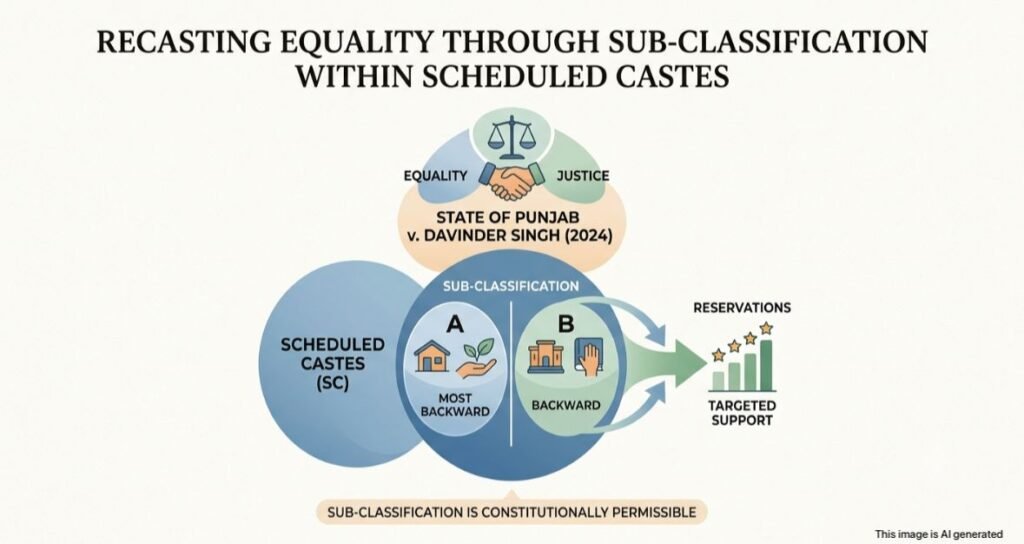
State of Punjab v. Davinder Singh (2024): Recasting Equality Through Sub-Classification Within Scheduled Castes
The Supreme Court’s seven-judge decision in State of Punjab v. Davinder Singh, delivered on 1 August 2024, is a major constitutional ruling on reservation law. The case arose from Punjab’s attempt to distribute benefits within the Scheduled Caste quota so that communities such as Balmikis and Mazhabi Sikhs, which the State considered more deeply marginalised and less represented in public employment, could receive a fairer share of reservation benefits. The central question was whether Scheduled Castes form a single, indivisible class for all reservation purposes, or whether the State may recognise internal inequalities and respond through sub-classification.
In a 6:1 majority, the Supreme Court held that sub-classification within Scheduled Castes is constitutionally permissible if it is supported by quantifiable data, directed toward substantive equality, and designed so that other Scheduled Castes are not completely excluded from reservation benefits. In doing so, the Court overruled the earlier Constitution Bench ruling in E.V. Chinnaiah v. State of Andhra Pradesh, which had treated Scheduled Castes as a homogeneous class that States could not internally classify. The judgment therefore marks a major shift from formal equality toward a more realistic understanding of equality under Articles 14, 15(4), and 16(4) of the Constitution.
Punjab’s policy had earlier been invalidated after E.V. Chinnaiah, and the dispute eventually reached a seven-judge Bench consisting of Chief Justice D.Y. Chandrachud and Justices B.R. Gavai, Vikram Nath, Bela M. Trivedi, Pankaj Mithal, Satish Chandra Sharma, and Manoj Misra. Justice Bela M. Trivedi dissented, while the remaining six judges upheld sub-classification. What makes this judgment a landmark is that it accepts that social oppression within the Scheduled Caste category is not experienced uniformly. Some communities remain trapped in harsher forms of exclusion, stigma, and occupational disadvantage than others. If reservation is meant to remedy structural injustice, the State must have room to ensure that benefits do not get concentrated in the hands of relatively better-placed groups within the same category.
Case Laws
The most important precedent examined by the Court was E.V. Chinnaiah v. State of Andhra Pradesh. In that case, the Supreme Court had struck down an Andhra Pradesh law that divided Scheduled Castes into separate groups for reservation purposes. The earlier Bench held that once castes were included in the Presidential List under Article 341, they formed a single integrated class, and any attempt by a State to create internal categories would amount to impermissible tampering with that constitutional list. Davinder Singh rejects this reasoning. The majority clarified that Article 341 is a mechanism for identifying who belongs to the Scheduled Caste category; it does not create a fiction that every listed caste is equally situated for all legal purposes. As long as the State does not add to or delete from the Presidential List, but only regulates the distribution of reservation benefits among already listed castes, it does not violate Article 341(2).
A second foundational precedent was Indra Sawhney v. Union of India. Though associated with OBC reservations, its broader doctrinal importance lies in accepting sub-classification among backward classes. The Court in Davinder Singh relied on this principle to hold that if the Constitution permits the State to distinguish between backward and more backward groups within OBCs, there is no convincing reason to deny a similar power when serious internal inequalities exist among Scheduled Castes. Substantive equality cannot be applied selectively.
The judgment also draws on the State of Kerala v. N.M. Thomas, which helped establish that reservation is not an exception to equality but an instrument of equality. This idea strongly influenced the majority. The Court rejected the assumption that identical treatment of all listed Scheduled Castes is necessarily fair. Where backwardness operates in unequal degrees, equal treatment may actually intensify inequality. Therefore, the constitutional promise of equality may require differential treatment within a larger protected class if that is necessary to ensure a more equitable distribution of opportunities.
The Court’s reasoning is also consistent with later reservation cases such as M. Nagaraj v. Union of India and Jarnail Singh v. Lachhmi Narain Gupta, especially in its insistence that affirmative action must be justified by evidence. Davinder Singh repeatedly emphasises that sub-classification cannot rest on broad political claims or convenient assumptions. A State must demonstrate, through quantifiable and reliable material, that there is inter se backwardness within the Scheduled Caste category and that some communities remain inadequately represented in State services. This evidentiary requirement is one of the judgment’s strongest safeguards because it prevents sub-classification from becoming a tool of electoral bargaining.
Another important contribution of the judgment lies in its treatment of Article 335 and the idea of administrative efficiency. Instead of treating efficiency as a rigid objection to reservation, the majority adopted a more inclusive view. It suggested that a public administration that meaningfully represents the most marginalised is not in conflict with efficiency. Democratic legitimacy and social inclusion are themselves constitutional values. This clarification weakens the old tendency to treat merit and social justice as opposites.
At the same time, the Supreme Court did not grant States an unrestricted power to redesign reservation policy. It laid down important constitutional limits. First, there must be demonstrable data showing relative backwardness and inadequate representation. Second, the model adopted cannot result in the total exclusion of other Scheduled Castes from the reserved pool. The Court distinguished between preference models and exclusionary models. A State may reserve a defined share of the Scheduled Caste quota for especially underrepresented groups, but it cannot construct a system that effectively shuts out the remaining listed communities. Third, any such policy remains subject to judicial review and must satisfy the tests of intelligible differentia and rational nexus. These safeguards show that the judgment does not approve fragmentation for its own sake; it approves targeted constitutional correction.
The decision is also notable for the discussion on the creamy layer principle. Some of the concurring opinions, particularly those of Justices B.R. Gavai, Pankaj Mithal, and Satish Chandra Sharma, favoured identifying relatively advanced individuals within Scheduled Castes and Scheduled Tribes so that reservation benefits may better reach those who remain truly disadvantaged. This part of the ruling has triggered debate because the basis of Scheduled Caste oppression is tied not merely to educational or economic backwardness, but to entrenched caste stigma and untouchability. Therefore, while the creamy layer discussion is influential and may shape future cases, the clearest binding core of Davinder Singh remains the recognition that sub-classification is constitutionally permissible when supported by evidence and carefully structured.
Justice Bela M. Trivedi’s dissent is also important. She maintained that once the President notifies the Scheduled Castes under Article 341, the category must be treated as indivisible unless Parliament itself changes the list. Although the dissent did not prevail, it preserves the formal equality argument and ensures that future litigation will continue to test the limits of the majority ruling.
Conclusion
State of Punjab v. Davinder Singh is a landmark because it redefines how equality operates within reservation law. By overruling E.V. Chinnaiah, the Supreme Court accepted that Scheduled Castes are not a socially uniform bloc for every legal purpose and that the State may, in carefully justified circumstances, create sub-classifications to secure a fairer distribution of reservation benefits. At the same time, the Court insisted that such policies must be based on data, must not wholly exclude other listed communities, and must survive judicial scrutiny. It strengthens the transformative purpose of the Constitution while preserving safeguards against arbitrariness. In that sense, Davinder Singh does not weaken reservation law; it seeks to make reservation more just, more evidence-based, and more responsive to the lived realities of caste inequality.
Frequently Asked Questions
1. What is the main holding in State of Punjab v. Davinder Singh (2024)?
The Supreme Court held by a 6:1 majority that States can sub-classify Scheduled Castes for reservation purposes if the policy is based on quantifiable data and does not completely exclude other Scheduled Castes from the reserved category.
2. Which earlier case was overruled?
The Court overruled E.V. Chinnaiah v. State of Andhra Pradesh, which had held that Scheduled Castes form a homogeneous class that States cannot subdivide for reservation benefits.
3. Why is the case considered a legal precedent?
It changes the constitutional rule on internal classification within Scheduled Castes and firmly endorses substantive equality over a purely formal equality model.
4. Does the judgment give States unlimited power over Scheduled Caste quotas?
No. States must rely on empirical data, demonstrate inadequate representation and inter se backwardness, and design the policy so that other Scheduled Castes are not entirely shut out.
5. What is the significance of the creamy layer discussion?
Several concurring judges favoured applying creamy layer reasoning to ensure benefits reach the most disadvantaged, but the most settled ratio of the case remains the permissibility of sub-classification itself.