
This article is written by Nameera Meraj, of Aligarh Muslim University, Aligarh.
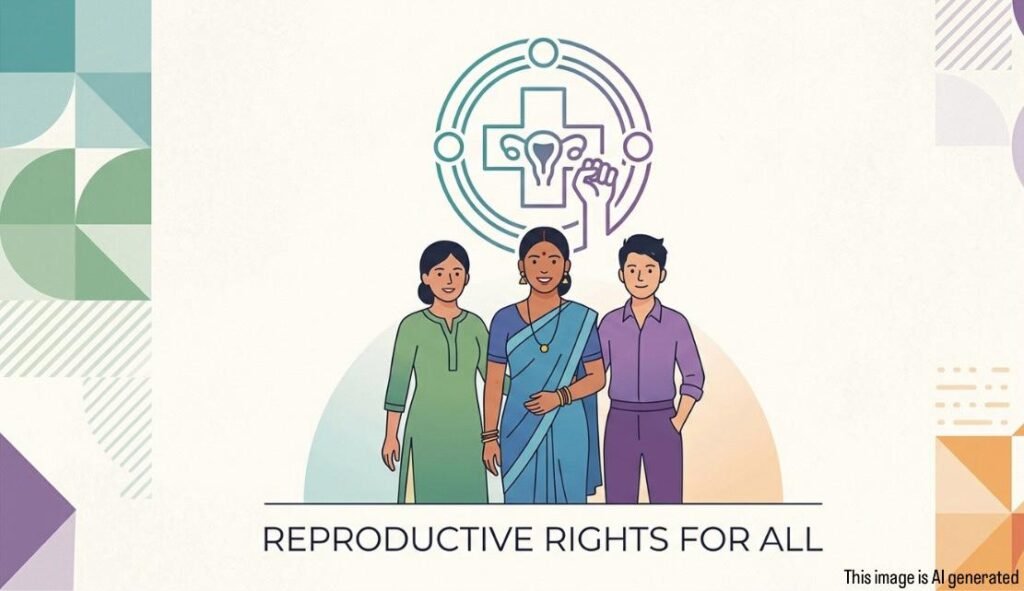
The evolving discourse on reproductive rights for third-gender persons in India reflects a deeper constitutional tension between identity, autonomy, and state control. While judicial pronouncements have progressively expanded the understanding of gender beyond biological determinism, recent legislative developments appear to reverse these gains. The conflict between recognition and regulation raises a fundamental question: can the State impose biological frameworks on identities that the Constitution seeks to liberate?
In May 2024, the Supreme Court’s acknowledgement of the term “pregnant person” marked a critical departure from gender binaries, recognising that reproductive capacity is not exclusive to cisgender women. This affirms that reproductive health choices belong to the individual regardless of marital status, which is crucial for trans people whose relationships may not be legally recognised.
This shift aligned with earlier jurisprudence emphasising that parenthood and care transcend biological essentialism, as reflected in rulings granting maternity benefits to adoptive and commissioning mothers. These cases collectively imply that a person’s gender status is distinct from their capacity to become a parent. The legal definition of “mother” can include a transgender person who gives birth or cares for children, focusing on the parental role rather than biological sex. Such developments indicate a broader constitutional commitment to dignity and inclusivity.
However, the legal landscape shifted significantly with the Transgender Persons (Protection of Rights) Amendment Bill, 2026. The legislation narrows the definition of “transgender person,” limiting recognition to specific socio-cultural identities or those with congenital variations.
This classification has been challenged as violative of Article 14, as it excludes a vast spectrum of gender identities that do not conform to traditional categories.
Judicial Evolution: From Biology to Identity
The foundation of transgender rights in India lies in the landmark decision of National Legal Services Authority v. Union of India, where the Supreme Court recognized the right to self-identification as intrinsic to personal liberty under Article 21.This marked a shift from a biological to a psychological understanding of gender.
The Court grounded its reasoning in transformative constitutionalism and treated the Constitution as a living document capable of adapting to evolving social realities.
These decisions collectively established that identity is not contingent upon anatomy, but rather upon self-perception and lived experience.
Legislative Regression: Medicalization of Identity
The 2026 Amendment introduces a contrasting paradigm by reintroducing the “medical model” of gender identity. By mandating certification from a Medical Board, the law effectively abolishes the principle of self-identification. This shift transforms identity from a fundamental right into an administrative determination.
Critics argue that such “clinical gatekeeping” violates the right to privacy as articulated in JusticeK.S. Puttaswamy v. Union of India, where the Supreme Court recognized decisional autonomy and bodily integrity as core components of Article 21.
Requiring individuals to disclose intimate biological details to state authorities intrudes upon the “private sanctuary” protected by the Constitution.
Moreover, the requirement for medical verification creates structural barriers to accessing reproductive healthcare. By conditioning legal recognition on medical approval, the State indirectly regulates access to gender-specific services, including fertility treatments and parental recognition.
Constitutional Paradox: Fluidity and Rigidity
The current legal framework reveals a paradox in the State’s approach to identity. While the judiciary has promoted fluidity in gender and reproductive rights, it has simultaneously upheld rigid classifications in other contexts. In Chinthada Anand v. State of Andhra Pradesh, the Supreme Court reaffirmed that conversion results in the loss of Scheduled Caste status, adhering to a strict interpretation of the Constitution (Scheduled Castes) Order, 1950.
This divergence highlights a “dual-speed” constitutionalism in which the legal system treats certain identities as dynamic and self-determined while continuing to confine others within historical constraints.The inconsistency raises concerns about equal protection and the coherence of constitutional principles.
Procedural and Democratic Concerns
Beyond substantive rights, the 2026 Amendment has been criticized for procedural impropriety. The reported absence of consultation with the National Council for Transgender Persons undermines the participatory framework envisioned under the 2019 Act.Additionally, the Bill’s passage through a truncated legislative process has raised questions about the quality of democratic deliberation.
The retrospective implications of the law further exacerbate its impact. By suggesting that the statutory definition never included self-identified persons, the Amendment casts doubt on the validity of previously issued identity certificates.This creates legal uncertainty and imposes an undue burden on individuals to re-establish their identity before state authorities.
Reproductive Autonomy and Constitutional Morality
At its core, the debate surrounding the 2026 Amendment concerns the scope of reproductive autonomy. Article 21, as expansively interpreted, encompasses the right to make intimate personal decisions free from state interference . For third-gender persons, this includes the right to be recognized as parents without being forced into binary classifications.
The tension between constitutional morality and legislative action is evident. While the judiciary has emphasized dignity, autonomy, and inclusivity, the legislature’s recent intervention appears to prioritize regulation and classification. This raises a critical constitutional question: can Parliament enact a law that effectively nullifies rights recognized by the Supreme Court?
Conclusion
The trajectory of transgender rights in India reflects both progress and regression. Judicial innovations have expanded the scope of identity and reproductive rights, aligning the law with constitutional values of dignity and equality. However, the 2026 Amendment represents a significant departure from this path, reintroducing biological essentialism and administrative control. The resolution of this conflict will ultimately determine the future of reproductive rights for third-gender persons. If the Constitution is to remain a transformative instrument, it must resist attempts to confine identity within rigid frameworks. The recognition of autonomy cannot coexist with its regulation; one must prevail.
Frequently Asked Questions
What is the focus of the 2026 Amendment debate?
It concerns reproductive rights and legal recognition affecting third gender individuals.
Why is the amendment controversial?
Critics argue it may weaken protections recognised through judicial decisions.
How do reproductive rights relate to constitutional law?
They are linked to dignity, privacy, equality, and personal autonomy under Article 21.
What role has the judiciary played in third gender rights?
Courts have expanded recognition, equality, and protection for transgender persons.
What is the central legal concern?
Whether legislative changes align with constitutional principles and judicial progress.