This article is written by Divya Gupta, Vivekananda Institute of Professional Studies (VIPS-TC), GGSIPU.
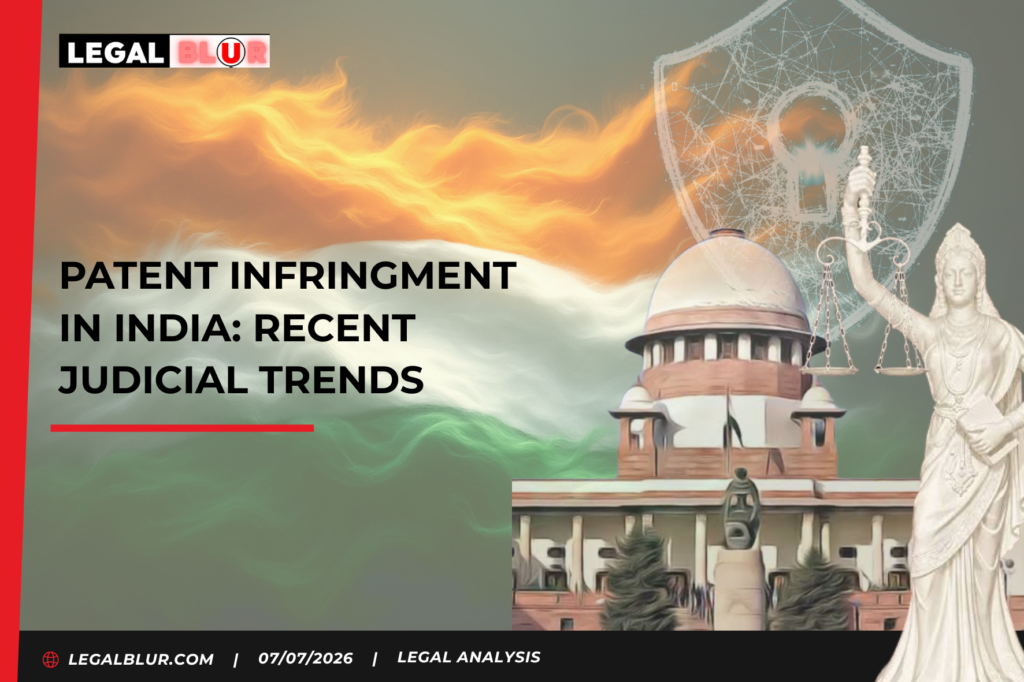
A patent issued to a person grants exclusive rights to manufacture, use, sell or license an invention for a limited period of time. The life – span of the granted patent is 20 years from the date of filing of application, not from the day it is granted. It takes usually 3 to 5 years for a patent to be granted, so the inventors are left with fewer years of effective protection. A patent holder has to pay renewal fee annually to keep the patent alive.Unauthorized making, using, offering for sale, selling or importing a patented invention during the subsistence of a patent amounts to infringement of the patentee’s exclusive rights under Section 48 of the Patents Act, 1970. In recent years, there has been an increase in patent cases in India due to the growth in technology firms, big pharmaceutical companies and international licensing disputes. The Delhi High Court is currently the primary forum for patent litigation in India and recent judgments of the Delhi High Court have had a significant impact on the process of proving patent infringement and standard essential patents in particular. This article examines how the Indian courts have addressed these issues through recent judgments.
Keywords: Patent, Exclusive Rights, Renewal Fee, Patent Infringement, Standard Essential Patents (SEPs)
CASE LAWS
In the case of Canva Pty Ltd v. RxPrism Health Systems (Delhi HC, 2026), the two – step process of patent infringement was reaffirmed by the court. An Indian Technology Company named RxPrism had a patent for the technology which allowed users to create interactive multimedia content comprising a background video, a picture-in-picture effect, and some call-to-action buttons, by using a layered architecture. It was alleged by RxPrism that Canva had copied its patented technology in its popular feature named “Present and Record”. In 2023, an interim injunction against Canva was ordered by the single judge. Then, in January 2026, this injunction order was upheld by the Division Bench.
In the two-step process of patent infringement, firstly, the patent claims are interpreted and then, these patent claims are compared with the product of the defendant. It was also reiterated that the product-to-claim mapping is essential for the issuance of an injunction. If the plaintiff shows that all the patent claims have been incorporated in the defendant’s product, only then the injunction can be maintained. It is a significant case as it has confirmed that Indian courts can issue injunctions on the enforcement of software/technology patents, which is a critical development for such a growing startup ecosystem.
In another case of K K Bansal v. Koninklijke Philips Electronics NV (Delhi HC, May 2026), Philips had an Indian Patent of some DVD decoding technology in which a chip inside every DVD Player converts information of disc into a readable and understandable format. This was a Standard Essential Patent according to Philips. Every manufacturer of a DVD Player must have used this technology according to the standards of DVD. So, Philips sued two small traders in Delhi, for patent infringement. In 2018, the single judge gave an order for royalty payments at FRAND rates by the Bansals. They challenged the ruling and in May 2026, the Division Bench set aside the decree.
The Bench decided that Philips failed to prove the essentiality of the patent at every stage on various grounds:
– They did not prove the essentiality of the patent to the DVD standards by providing appropriate evidence.
– The affidavit of the expert of Philips was inadmissible as he did not appear for cross-examination. – Product-to-claim mapping was not made.
– They had purchased components from the authorized dealers of Philips and thus exhausted the rights of Philips under section 107A(b) of the Patents Act, 1970.
Thus, the above judgment lays down a strict test of evidence in Indian SEP litigation. The patent owners cannot now make any unproven assertions about the essentiality but have to prove it in steps.
In Malikie Innovations Ltd v. Xiaomi Corporation (Delhi HC, April 2026), Malikie Innovations Ltd. held patents essential to the 4G and 5G standards. Xiaomi sells 4G and 5G phones in India but never obtained any license from Malikie. So, it sued Xiaomi for infringement for SEP. The Delhi High Court passed an interim order and asked Xiaomi to deposit the royalties until the court case is concluded. The court applied the two-step test for patent infringement: whether the product complied with that technical standard and whether the patent is essential to that standard. If it fulfills these two, an infringement is presumed. Then the burden of proving the willingness and negotiating in good faith, shifts to the licensee.
A very important thing is that in SEP cases, before seeking injunction, the patent holders are expected to offer licenses on FRAND (Fair, Reasonable and Non-Discriminatory) terms. The royalty price must not be excessively high. However, this does not lead to barring of injunctions entirely. The courts assess whether the implementer is willing to negotiate and if he refuses to negotiate and engagement in good faith risks losing the FRAND obligation protection.
There was another case, Mold-Tek Packaging Ltd v. Pronton Plast Pack Pvt Ltd (Delhi HC, April 2026), where the court dealt with the question whether a defendant who is accused of patent infringement, can resist an interim injunction by merely claiming the patent is invalid but never challenged the validity of that patent before. Pronton Plast Pack Pvt. Ltd. started making and selling very similar packaging for which Mold – Tek had patent for, without taking any permission from it. So, Mold – Tek sued Pronton for patent infringement. An interim injunction was then granted against Pronton by the court.
An important principle was introduced by the court: ‘Clearing the way’, which means if a company or person believes a patent is invalid, it should challenge it before using the patented invention. One should not wait to be sued and should take legal steps to clear the patented invention out of their way as an obstacle. This can be done by filing a pre-grant or post-grant opposition, or seeking a declaration of non-infringement. Without doing that, an injunction cannot be resisted later. There must be a genuine and strong legal reason i.e. ‘a credible challenge’ showing that the patent may be invalid and to defeat an injunction. A mere denial like “I think the patent is invalid’ is insufficient.
This principle of patent requires that those who wish to use a patented technology should take steps before the use of the patented item.
Lastly, the rights after the expiration of patent were discussed in Boehringer Ingelheim Pharma GmbH v. Controller of Patents (Delhi HC, February 2026). The main issue in this case that what happens if the patent expires while the lawsuit is still pending.
Whether the patent holder still get an injunction? Whether the patent can still be challenged through a revocation petition? Whether the patent holder can still claim damages?
It was held by the Delhi High Court that once a patent expires, the right of injunction is also lost with that. A patent holder gets exclusive rights only for a limited period of time
(usually 20 years). After that, anyone can use the invention freely.
But the patent holder can claim the damages (compensation) for the infringement that occurred before the expiration of the patent. Also, the revocation petition can still be heard even after expiry and the court will determine that the patent was valid or not from the beginning.
If the court declares it invalid from the beginning, it affects the decision of right of the patent holder to damages or compensation after the expiration of patent.
CONCLUSION
The patent jurisprudence is developing and maturing rapidly nowadays. The Patent law of India is getting stricter. Three major trends were seen in these Delhi High Court’s judicial interpretations. First, the courts are now rooting for strong, real and reliable evidence. The product – to – claim mapping is now obligatory and not optional. Also, simply filing affidavits is insufficient. They must be tested through cross – examination. Proper technical proof is required.
In SEP disputes, there is a more balanced approach now. The courts are trying to balance the interests of everyone and not favoring only one side. They try to protect the patent holders, who deserve adequate compensation for their inventions. This motivates other people also to invent and share new ideas which will help in overall development of the country. Implementers should receive the permission (license) of using the patented technology on FRAND terms. This also protects the consumers by making the inventions (products and technology) accessible and affordable.
The courts also want the people to use the correct legal procedure as we saw in the principle of ‘clearing the way’. This would help the implementers to avoid injunctions later.
Inventors, Startups, Tech Companies should get their patents registered, maintain proper technical documentation and evidence, maintain proper documentation of your patents, assert your patents immediately.
For the implementers, the message is equally clear to obtain a license before using the patented invention and challenge it before commercially using it if you believe that the patent is invalid.
FREQUENTLY ASKED QUESTIONS
1. What is Patent Infringement under the Indian law?
Patent infringement occurs when the exclusive rights granted under Section 48 are violated without authorization.
2. What is the product-to-claim mapping test?
This is the established test for establishing patent infringement in India. The plaintiff has to prove, feature by feature, the presence of all the elements of the patent claim in the product of the defendant. This test is a prerequisite for obtaining an injunction.
3. What do you mean by the term “Standard Essential Patent”?
A Standard Essential Patent is a patent that relates to a technological innovation which is critical for the implementation of an industrial standard, for instance, DVD or 4G technology. It is impossible not to use the SEP when developing any product based on the industrial standard.
4. Is it possible for a patentee to claim damages post-patent expiration?
Yes, although it is not possible to get an injunction post-expiration of the patent, damages can be claimed for infringement that took place while the patent was active.