This article is written by Vedant Raj Chopra, Vivekananda Institute of Professional Studies.
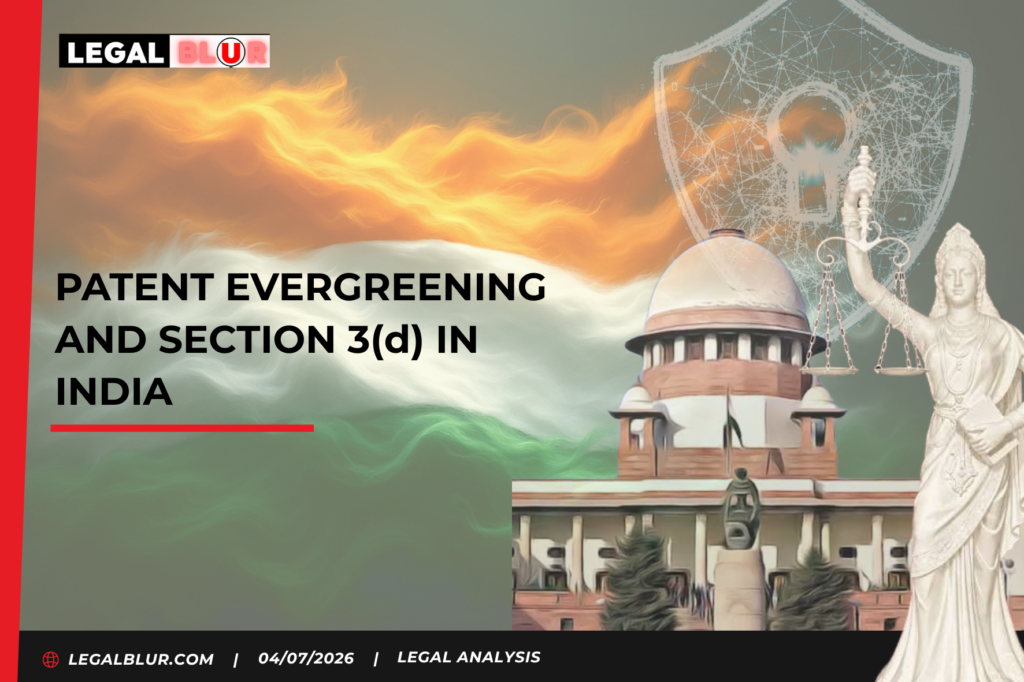
The relationship between intellectual property rights and public health is a highly contentious area, especially in the pharmaceutical sector where the price tag to make medicines that save lives can mean the difference between life and death. In this debate, one of the most controversial tactics which the multinational pharmaceutical companies have used to try to extend their monopoly over patented drugs beyond the statutory 20-year period has become known as “patent evergreening.
One of the most controversial tactics that the multinational pharmaceutical companies have used to try to extend their monopoly over patented drugs beyond the statutory 20-year period has become known as “patent evergreening” within this debate. Evergreening is the process of securing additional patents for minor changes to the original formulation of a drug, such as changes to the salt, polymorph, or isomers, to extend the market exclusivity for the drug, prevent generic competition, and maintain high drug prices.
India, realising their social and economic implications, has put in place a groundbreaking safeguard mechanism, under Section 3(d) of the Indian Patents Act, 1970 (as amended in 2005). The provision meets India’s TRIPS obligations and yet allows it to uphold its access to affordable medicines obligations by imposing an elevated standard for patentability – discovery of a new form of an existing substance is not patentable unless it demonstrates a significant improvement in therapeutic efficacy.
Section 3(d) provides that the mere discovery of a new form of a known substance is not patentable unless it results in the enhancement of the known efficacy of that substance. The Explanation clarifies that salts, esters, ethers, polymorphs, metabolites, pure forms, particle sizes, isomers, mixtures of isomers, complexes, combinations and other derivatives of a known substance shall be considered the same substance unless they differ significantly in properties with regard to efficacy.
Patent Evergreening and Section 3(d): Scope and Rationale
Pharmaceutical innovators typically seek to extend the patent term for a drug by filing for new salts, esters, ethers, polymorphs, metabolites and isomers of an existing drug; new formulations or dosage forms; new combinations of existing drugs; or new methods of administering a drug. There are many trivial changes that have little value other than to extend the period of time before generic competition is available, while others represent incremental innovations that carry actual therapeutic value. Section 3(d) was an substantive filter to exclude such frivolous patents.
The absence of an increase in the utility of a well-known substance, or the absence of any new property or new use for a well-known substance, or the mere use of a well-known process, machine or apparatus is not an invention under section 3(d) of the definition. According to the Explanation, salts, esters, polymorphs, isomers, complexes, and other derivatives of a known substance are considered to be the same if they have properties that are not significantly different from one another in terms of efficacy.
This is done for two reasons: first, it puts into practice the flexibilities allowed under the TRIPS Agreement, so that the conditions of patentability are tailored to the public interest, and second, it makes certain that patents are granted for real innovative products, that bring tangible therapeutic value, taking into account the interest of the patent holders and the larger interest of society in accessing affordable healthcare.
Case Laws
1. Novartis AG v. Union of India, (2013) 6 SCC 1
Section 3(d) was interpreted in the most definitive manner by the Supreme Court of India in Novartis AG v Union of India. Novartis filed a patent for the beta-crystalline form of Imatinib Mesylate (known as “Glivec” for the treatment of chronic myeloid leukaemia). The application was rejected because the substance was just a new formulation of a known substance (Imatinib) and not showing greater therapeutic efficacy. Novartis objected to the rejection and also raised a question of constitutional validity of Section 3(d). The Madras High Court upheld the provision and this case was brought to the Supreme Court.
In its landmark judgment of 1st April 2013, the Supreme Court dismissed Novartis’ appeal and upheld the rejection of the patent application. Any changes to the flow, thermodynamic stability or hygroscopicity would not be considered to be improvements unless they led to an improved therapeutic effect. The Court noted that Section 3(d) was drafted specifically to avoid evergreening, and reinforced the enhanced therapeutic efficacy idea, which has come to be treated as a standard for incremental pharmaceutical innovations.
The Court clarified that improvements in physicochemical properties such as better flow characteristics, thermodynamic stability or hygroscopicity would not satisfy Section 3(d) unless they translated into enhanced therapeutic efficacy.
2. F. Hoffmann-La Roche Ltd. v. Cipla Ltd., (2016) 65 PTC 1 (Del)
Roche had a patent for the drug Erlotinib Hydrochloride (Tarceva), which is used to treat cancer. Cipla introduced generic version and Roche sued for infringement. Although the dispute primarily concerned patent infringement and validity, the judgment reflected the rigorous scrutiny applied to pharmaceutical patents following Novartis, particularly where incremental pharmaceutical innovations are involved.
3. AstraZeneca AB v. Intas Pharmaceuticals Ltd., (2020) SCC OnLine Del 1446
The Delhi High Court refused an interim injunction against generic manufacturers of the diabetes drug Dapagliflozin, observing that the patent raised credible challenges under Section 3(d). The Delhi High Court found that the defendants had raised credible challenges to patent validity, including issues under Section 3(d), while considering interim relief. The decision illustrated that Section 3(d) continues to play a decisive role not only at the stage of patent grant but also during infringement and validity proceedings.
Impact and Criticism
Section 3(d) has given a tremendous impact to Indian Pharmaceuticals. Section 3(d) has prevented the grant or enforcement of several secondary pharmaceutical patents that failed to demonstrate enhanced therapeutic efficacy, thereby facilitating earlier generic competition in appropriate cases. India’s good manufacturing practice industry, commonly known as the “pharmacy of the developing world,” is responsible for providing low-cost medicines to Asia, Africa and Latin America, much of which is due to Section 3(d).
Section 3(d) is criticized, especially by multinational drug companies and the USA, as being at odds with TRIPS and stifling innovation. This is one reason why India has been included in the U.S. Trade Representative’s “Priority Watch List” every time. However, the Indian courts have consistently sustained the provision as reasonable and commensurate with the TRIPS flexibilities and as a necessary protection for public health.
Critics argue that an overly restrictive interpretation of Section 3(d) may discourage incremental pharmaceutical innovation, particularly where improvements enhance patient compliance, stability, or safety without necessarily increasing therapeutic efficacy. Supporters, however, contend that such improvements should be rewarded only when they represent genuine therapeutic advances rather than strategies to prolong monopoly rights.
Conclusion
Section 3(d) of the Indian Patents Act stands as a globally unique mechanism striking a delicate balance between rewarding genuine pharmaceutical innovation and preventing the abuse of patent rights through evergreening. By mandating demonstrable enhancement of therapeutic efficacy for new forms of known substances, it ensures that the patent system serves its constitutional purpose of promoting genuine innovation rather than perpetuating monopolies on trivial modifications. The Supreme Court’s ruling in Novartis has firmly entrenched this principle, and subsequent decisions continue to reinforce its application. As pharmaceutical innovation evolves in the era of personalised medicine, biologics, and emerging diseases, Section 3(d) will remain vital in ensuring that the right to health is not subordinated to commercial interests, embodying the constitutional vision of an equitable society where access to affordable medicines is treated as a fundamental human right rather than a privilege.
Frequently Asked Questions
1. What is patent evergreening?
Patent evergreening refers to the practice of pharmaceutical companies obtaining successive patents on minor variations, derivatives, or new formulations of an already patented drug to extend their exclusive market rights and delay generic competition.
2. What does Section 3(d) of the Indian Patents Act provide?
It provides that the mere discovery of a new form of a known substance which does not enhance the known efficacy of that substance, or the mere discovery of any new property or new use for a known substance, shall not be considered a patentable invention.
3. What is meant by “efficacy” under Section 3(d)?
As interpreted by the Supreme Court in Novartis AG v. Union of India (2013), “efficacy” in the context of pharmaceutical products means “therapeutic efficacy.” Mere improvements in physical or chemical properties are insufficient.
4. Why is Section 3(d) significant for public health?
It prevents the grant of unwarranted patents on trivial modifications of existing drugs, enabling generic manufacturers to produce affordable versions and ensuring wider access to essential medicines, particularly in developing countries.
5. Is Section 3(d) compliant with the TRIPS Agreement?
Yes. Section 3(d) is a valid exercise of the flexibilities permitted under Article 27 of TRIPS, which allows member states to determine their own patentability standards. Indian courts have consistently upheld its TRIPS-compatibility.
6. What was the outcome of the Novartis case?
The Supreme Court rejected Novartis’s patent application for the beta-crystalline form of Imatinib Mesylate (Glivec), holding that it did not demonstrate enhanced therapeutic efficacy and therefore failed the test under Section 3(d).