This article is written by Mansi Mishra, GGSIPU Delhi.
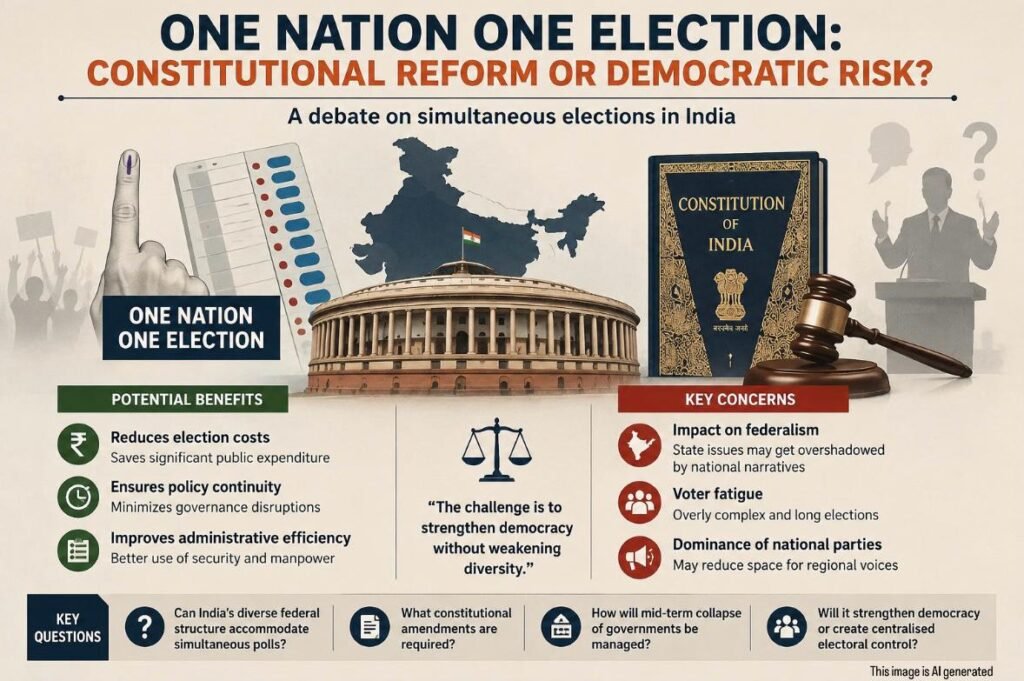
The “one nation one election” initiative is an ongoing topic of discussion among the population, but it is also one that has generated much debate over the potential effects on democracy. Supporters of this electoral approach seek to synchronise election cycles and improve administrative efficiency, while critics argue that it could undermine India’s federal structure and weaken regional political representation.
Historically, India held combined elections for the Lok Sabha and State Assemblies after independence during the years of 1952 through 1967, but since that point, elections have occurred on an ongoing cycle of periodic elections (general elections and state assembly elections) continuing throughout the calendar year at staggered times between the states.
The discussion surrounding the proposal for simultaneous elections is a constitutional one involving: the question of democracy; questions of federalism; issues of representation; the fairness of elections; and the feasibility of implementation of simultaneous elections. The proposed legislation provides an opportunity to create efficiencies within the various levels of government, which should lead to savings in administrative costs. However, policymakers must rigorously assess the proposal’s constitutional validity and ensure that it does not undermine democratic principles.
Definition of “One Nation One Election”:
The term “One Nation One Election” refers to the notion that there will be a scheduled election of the Lok Sabha and all state legislative assemblies at approximately the same date, as well as using that election date as the date for holding of elections for local bodies.
Implementing this proposal will require several constitutional amendments because the Constitution currently permits different legislatures to serve different terms and allows them to dissolve at different times.
The main purposes of this proposal are to:
- Lower the cost of holding elections;
- Increase stability of government;
- Decrease the number of times security forces must be deployed;
- Decrease policy paralysis created by the model code of conduct (by having elections all at once); and
- Increase voter turnout with one combined election to vote in;
This proposal has been supported in numerous policy discussion papers and reports by NITI Aayog and the Election Commission of India.
Problems of legality and constitutionality
Despite its purported advantages, introducing concurrent elections raises large constitutional issues. The Constitution of India creates a federal democracy, in which commensurately, both Houses of Parliament and State Legislature have the same constitutional recognition.
Articles 83 and 172 of the Constitution govern the normal tenure and dissolution of the Lok Sabha and State Legislative Assemblies, respectively, although authorities may dissolve both before the completion of their fixed terms under limited circumstances. Implementing simultaneous elections would therefore require amendments to the following Articles:
A major concern is that Federalism will no longer exist. The Constitution of India establishes the States as original political entities. Political pressures to conduct State Elections as a part of a centralised electoral cycle may dilute regional democratic representation, and limit the restoration of these local issues.
In Kesavananda Bharati v State of Kerala, the Supreme Court held the “Basic Structure Doctrine” which states that Parliament cannot change any of the fundamental characteristics of the Constitution as outlined in Article 368. Therefore, both Federalism and Democracy are part of the “Basic Structure”; therefore, no constitutional amendment can facilitate concurrent elections without violating these constitutionally required principles.
Additionally, in S. R. Bommai v Union of India, the Supreme Court reinforced that Federalism is one of the fundamental characteristics of the Constitution of India. Critics argue that concurrent elections could indirectly centralise power and reduce regional representation.
Benefits of Conducting Simultaneous Elections
1. Decreasing Overall Election Costs
India holds elections at such a large scale that it spends a lot of taxpayers’ money on security, polling staff, logistics, and administrative costs. By combining two electoral processes together, simultaneous elections should save the government significantly on repeated costs.
2. Improved Administrative Efficiencies
Frequent elections require repeated deployment of teachers, government officials, and security personnel in the system which causes disruptions to public administration and therefore governance. An election system that synchronizes elections across all levels of government may reduce the burdens of administering elections and allow more consistently governed public agencies.
3. Less Disruption From Model Code of Conduct
The enforcement of the Model Code of Conduct often delays project development and implementation because the government must restrict its operations during every election period. In states that conduct frequent elections, these repeated restrictions continuously disrupt governance and administrative functioning. Reducing interruptions by imposing simultaneous elections should alleviate many of these disruptions.
4. Increased Attention by Governments on Effective Governance
Supporters argue that frequent elections will keep the government in “election mode” for a full year, thereby producing a lack of focus on long-term planning and quality governance. So with multiple elections occurring at the same time, there will be less electioneering from the government, thus providing improved governance for the citizenry.
5. Increased Voter Turnout
Increased voter turnout can be achieved by conducting simultaneous elections, because doing so will simplify the process and reduce the occurrence of fatigue from participating in multiple electoral events.
Concerns and Criticisms Related to Simultaneous Elections
1. Threatens Federalism
Many critics of the idea of simultaneous elections have suggested that having one national election narrative could deaden or damage state election narratives of emphasis on local governance or concerns by overshadowing them with larger parliamentary elections held at the same time.
2. Complexity of Constitutional Issues
To implement simultaneous elections would require substantial amendments to the constitution, along with complicated co-ordination arrangements between the Union Government and State Governments. For example, if there were a situation where a government fell before its full term of office was completed, that would need to be addressed in the amendments.
3. Practical Issues with Simultaneous Voting
Given India’s size and diverse geography, there would be significant logistical problems in carrying out simultaneous elections to both the Parliament and State Assemblies. In addition, implementing those elections would require a very large number of electronic voting machines, security personnel, and polling staff to manage the day-to-day process of conducting the elections.
4. Impact of Simultaneous Elections on Regional Political Parties
Some critics have argued that conducting simultaneous elections would enable larger national parties to gain an advantage over regional parties; thereby reducing those regional parties’ political power and representation in a democratic manner.
5. Democratic Concerns
In democratic systems, frequent elections serve as an important mechanism of providing citizens with opportunity to assess both their state and national governments. Reducing how often we have elections will lead to a decrease in the number of people who can participate in the democratic process and, in turn, this will lead to a reduction in the accountability of elected officials.
Judicial Perspective
Although the Supreme Court hasn’t ruled directly regarding the constitutionality of holding local and national elections on the same day, they have made several rulings that have established support for Federalism, Democratic Accountability and free & fair elections in the country.
The Supreme Court held in the first ruling in case of Indira Nehru Gandhi v Raj Narain free & fair elections are fundamental elements of the Fundamental Framework of the Constitution for India. In Kihoto Hollohan v Zachillhu, the Supreme Court ruled that the continuity of the Legislature is the most important consideration in determining whether or not we have a Democratic System of Government. Any future constitutional challenge to simultaneous election systems will likely involve the judicial application of principles related to representative democracy, federalism, and basic structure.
Context for the comparison
There are a few countries that conduct concurrent national and provincial elections (South Africa, Sweden) that bear little resemblance to India in population, ethnic diversity, and the makeup of their constitutions.
The federalism demonstrated within India’s legal system is unique and complex, with numerous states having strong regional political identities, and exhibiting multiple political dynamics within and between those states. Consequently, foreign models of election systems cannot be translated directly into India without regard for the unique constitutional characteristics of India’s legal system.
Final Thoughts
The “One Nation One Election” initiative generates a significant dialogue regarding the creation of the Constitution and the operation of democracy in India today. The initiative has many benefits including lower electoral costs, fewer elections resulting in fewer personnel managing elections, and more consistent governance; however, there are also significant concerns such as federalism, representation, constitutional issues, and political balance between political parties.
The purpose of electoral reform is to develop a more democratic government; however, expressed constitutional principles relative to federalism, accountability and representative democracy need to take precedence over all else.
While simultaneous elections would provide some administrative convenience, simply having administrative convenience would not be sufficient to justify a constitutional amendment without proper protections. In summary, the success of any electoral reform is determined by both the degree to which the reform is practically efficient and the degree to which a reform continues to support the democratic principles as defined in the Constitution of India.
Frequently Asked Questions
What does One Nation, One Election mean?
One Nation, One Election means we should have both Lok Sabha and State Legislatures all electing at the same time for both levels of government.
Why is there a discussion in India about One Nation, One Election?
One Nation, One Election seeks to reduce the cost of elections, improve governance by providing for stable governments more often and reduce `GDP losses’ from having many elections happening at the same time.
Will One Nation, One Election require multiple amendments to the Constitution?
One Nation, One Election likely will require multiple amendments to the Constitution and potentially could require judicial review as to whether those amendments fall within the Constitution’s “basic structure” provision.
What are some of the main criticisms of One Nation, One Election?
The main criticisms against One Nation, One Election are that it will weaken federalism and lessen the importance of regional issues whereby they will be over-shadowed by national issues.
Which Articles of the Constitution would need to be changed in order to allow for the implementation of One Nation, One Election?
Articles 83, 85, 172, 174 and 356 of the Constitution will possibly have to be changed in order to allow for the implementation of One Nation, One Election.
References
- High-Level Committee on Simultaneous Elections, Report of the High-Level Committee on One Nation One Election (Government of India, March 2024).
- One Nation One Election Official Portal
- Press Information Bureau (PIB)
- NITI Aayog, Analysis of Simultaneous Elections: The “What, Why and How” (2017).
- NITI Aayog
- Law Commission of India, Draft Working Paper on Simultaneous Elections (2018).
- Law Commission of India
- Election Commission of India, Frequently Asked Questions – Simultaneous Elections.
- Election Commission of India