This article is written by Shiwani Shankar.
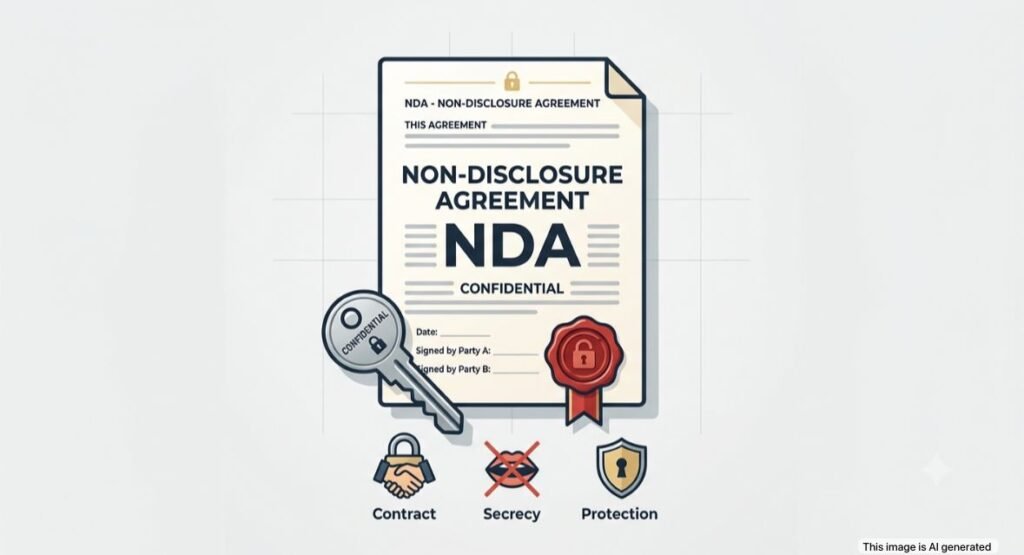
A Non-Disclosure Agreement (NDA) is a type of contract legally binding contract designed to safeguard confidential information from being shared with those whose knowledge of this information is not intended. NDAs act as a protestant for proprietary business plans, trade secrets or sensitive personal information.
Historical background
NDAs became popular in the mid to late 20th century, particularly in the technology and defense fields. Though you may find some of the principles of confidentiality that have been around before, it is not until around the 1940s that NDA’s started being used. You won’t find a single first case being talked about in court, but initial law principles that include duty of good faith or duty to protect trade secrets were established. As time went on, NDAs began to be commonly used to keep confidential information safe in business affairs.
What is an NDA and why is it used?
NDA stands for non – disclosure agreement is a type of contract agreed between several parties for not sharing specific confidential information among them. It is used to safeguard sensitive information, including business information and trade information and also personal information, from being made public.
Scope of NDA agreements
Normally, if the company has confidential information, such as the software developer who has access to company-provided code or secrets, then the NDA is utilized. Generally, the conditions of an NDA involve specifying what constitutes a confidential disclosure, the length of time the NDA will be in effect, obligations that they do not disclose, and penalties for failing to keep confidential. The heart behind a sound NDA is to state which individuals are covered, what information will be protected, how long it will be held and what consequence will be if the confidentiality is violated.
List of sectors where NDA agreements are widely used-:
- Technology and Software Development
- Mergers and Acquisitions
- Startups and Venture Capital Deals
- Employment (especially with access to sensitive data)
- Healthcare and Biotech Research
- Creative Industries (films, scripts, designs)
- Client and Vendor Contracts in Business Services
Comparison of different nations
| Country | Key Highlights | Drafting & Enforcement Notes |
|---|---|---|
| USA | Widespread, tech & corporate sectors, strong enforcement | Well-established but evolving restrictions |
| India | Common in employment and business, contract law basis | Clear terms essential for enforceability |
| UAE | Enforceable, used in business, strong free zone enforcement | DIFC/ADGM free zones offer robust enforcement |
| Dubai | Widely used, fully enforceable, criminal liability possible | Ensure clarity, free zones preferred for disputes |
| Pakistan | Recognized under general contract law, used in business/employment | Clear definitions, reasonable terms for enforcement |
The key message from the table is that although all of these countries implement an NDA as a method of safeguarding privacy data, the rules vary. They’re not very effective unless you are careful in writing them and conform to the local legal method
Different types NDA in contract law
1) Unilateral NDA: This one is used when – for example – a worker with sensitive company information is given an NDA.
2) Mutual NDA: A mutual agreement not to disclose information by the two parties, which may be used between partnership or joint ventures.
3) A Multilateral NDA: Involves more than two parties and at least one will need to hand over information that the other parties will need to secure—useful in more complex collaborations. The level of protection of sensitive data remains constant but purview varies, depending on the type.
Illustration
Here, a software developer hires an organization and they agree that the secret information of the company will be protected. First they sign a written confidentiality agreement – sort of like signing a no-tell contract for the data. A failure by the engineer to do so (such as passing the code to another person) may give the company grounds for legal action. When the promise, the NDA is fair, the court will support it in India. It is in short: They promise something and give them an actual answer in case they break that promise.
Case law regarding Non-Disclosure Agreements
A notable case in India touching on NDAs is the Homag India Pvt. Ltd. v. Mr. Ulfath Ali Khan (2015). In this case, an ex-employee was alleged to have breached the NDA by sharing confidential information. The Karnataka High Court restrained the ex-employee from disclosing or using the company’s sensitive information. This case highlights that NDAs are enforceable, and courts can grant injunctions to protect confidential information from being misused.
Others important case laws
Niranjan Shankar Golikari v. Century Spinning & Manufacturing Co. Ltd. — validity of restrictive covenants during employment.
American Express Bank Ltd. v. Priya Puri — distinction between confidential information and general employee knowledge.
Diljeet Titus v. Alfred A. Adebare — protection of client databases and confidential information.
V.F.S. Global Services Pvt. Ltd. v. Mr. Suprit Roy — protection of trade secrets and confidential business data.
The Future of NDAs in Safeguarding Global Business Confidentiality
In India, NDAs are becoming a vital tool as companies rely more on intellectual property and sensitive business information. They don’t just protect trade secrets; they build trust, allowing businesses to share valuable knowledge without fear. By clearly defining what must be kept private, NDAs give companies a solid framework to protect their most important assets. And as India’s privacy laws grow, NDAs help keep that local protection strong even when business crosses borders. They ensure that privacy remains safe, creating a more secure digital environment for businesses, both in India and around the world.
Conclusion
The pace of change and information in the world today is such that confidential information has become one of the most valuable assets to individuals and businesses. Non-Disclosure Agreements (NDAs) are one of the most important weapons in the arsenal against disclosures of trade secrets, business plans, intellectual property rights, and other closely guarded information. As mentioned in the course of this article, NDAs are also used in a number of other industries and have received some consideration and respect in diverse countries, such as India.
The need for robust confidentiality measures has become even greater with the increasing reliance on digital business operations, technology developments and interdependent collaborations globally. India courts have repeatedly upheld the enforceability of well-drafted NDA and have granted remedy for misusing the confidentiality for this. But the strength of an NDA is much determined by how it is drafted, what it says and the laws it abides by.
In essence, an NDA can be regarded as a contract more than just a document, but rather a form of trust, security and accountability between the parties. In today’s age of information, where a business’s key to success or failure is information, NDAs can be one of the strongest ways to protect valuable information and ensure business professionalism during all business operations.