This article is written by Mansi Mishra, a first-year student of GGSIPU Delhi.
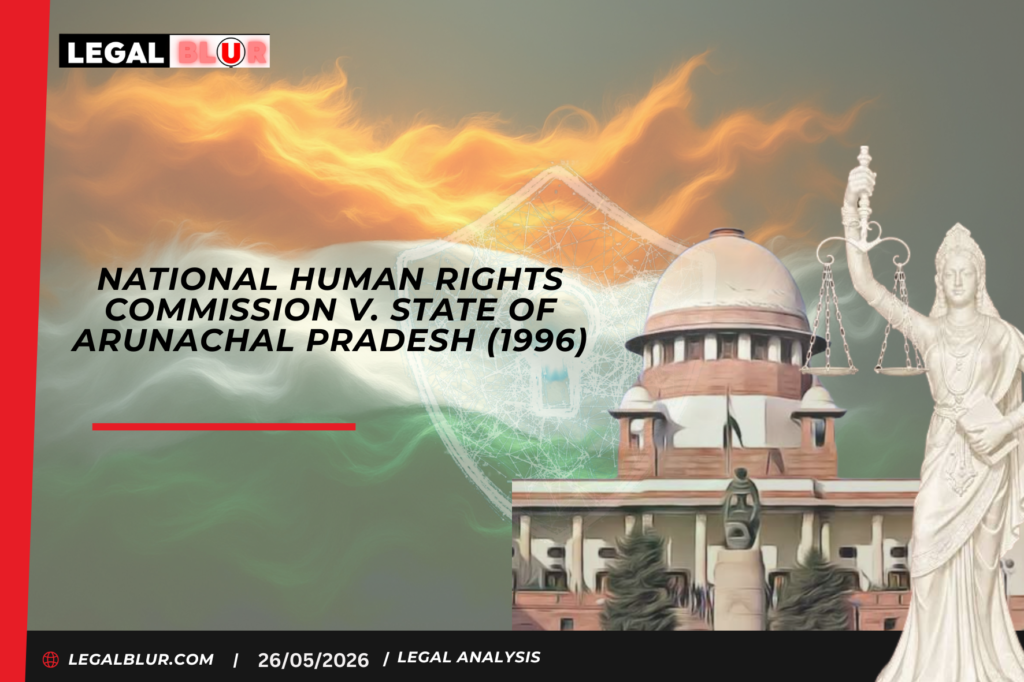
National Human Rights Commission v. State of Arunachal Pradesh (1996): A Critical Analysis of Citizenship, Constitutional Protection, and the Rights of Chakma Refugees
Displacement and migration have been an important part of Indian history due to various reasons such as political turmoil, environmental destruction, and religious persecution. Some of the most heated cases include that of the Chakma and Hajong tribes which have been displaced from their homes in East Pakistan (now known as Bangladesh) owing to the construction of the Kaptai Dam and the socio-political unrest in the area in the 1960s. Many of these people have been rehabilitated in the State of Arunachal Pradesh with the help of the Indian Government, and their long stay in the state has created certain political controversies regarding their constitutional rights and citizenship. The legal questions relating to the Chakma and Hajong tribes were brought to the notice of the Supreme Court in the landmark case of National Human Rights Commission vs. State of Arunachal Pradesh (1996). Although human rights activists like Suhas Chakma had continued to campaign for the rights of the Chakmas, the constitutional authority on the issue is the NHRC case that was decided by the Supreme Court. It was due to persistent claims of intimidation, discrimination, and expulsion faced by the Chakmas and Hajongs that the issue eventually found its way to the Supreme Court. It is noteworthy that the Supreme Court stressed that the constitutional rights cover even those persons who live in India but do not have citizenship. This decision is important in that, although India does not have any separate law regarding refugees, it once again confirmed the need for constitutional morality, humanitarianism, and legality. In light of these claims, the matter was finally brought to the notice of the Supreme Court through the filing of a writ petition under Article 32 of the Constitution. It is important to note in this context that the Supreme Court made it clear that the constitution provides rights to all individuals living within India, even those who are not citizens of the country. This judgment is noteworthy inasmuch as the fact that there is no refugee law in India has been overlooked by the Supreme Court.
Case Background
Chakmas and Hajongs had been forced to leave their homeland in East Pakistan in the 1960s, and the Indian government has facilitated them by settling down in India. Having stayed for several years in Arunachal Pradesh, many of the Chakmas and Hajongs had sought citizenship in India through the Citizenship Act of 1955.
As per sources, the local authorities of Arunachal Pradesh have done nothing regarding the applications, nor have they known that Chakmas and Hajongs have applications seeking Indian citizenship pending and never documented at which time their applications can be settled. Many organizations active in Arunachal Pradesh have been opposing the acquisition of Indian citizenship by Chakmas and Hajongs and threatening to use violence against them.
Chakmas and Hajongs fear forced evictions from their homes, losing access to government services, and experiencing social discrimination. The matter ultimately reached the Supreme Court through proceedings initiated by the National Human Rights Commission under Article 32 of the Constitution seeking protection of the life and liberty of the Chakma community and directions regarding citizenship applications.
As per the nature and type of situation arising out of this case, the following very basic and critical questions arise with regards to the legality of actions done by the Government of India via the Chakma Community.
Judicial Questions:
The Supreme Court of India is also reviewing judicial questions regarding the Chakma community:
- Do Chakmas have a right to receive a guarantee of protection under the Constitution of India?
- Is there a process of law to allow the Government of India to remove a Chakma person’s residence and to justify the action?
- Will the Indian Government be required to establish fair and adequate procedures for the citizenship applications of members of the Chakma Community?
- Are the acts of the State officials failing to process the citizenship applications of Chakma community unconstitutional?
- Is there any intimidation or threat by the Indian Government against the Chakmas and, subsequently, do the rights of the Chakmas as citizens violate?
- Whether non-citizens are entitled to protection under Articles 14 and 21 of the Constitution of India?”
The focus of this case will also be the broader questions of the rights of community and India’s internationally acknowledged humanitarian obligations.
Petitioners’ Arguments
According to the petitioners, the Chakmas have lived in India without difficulty for a significant period of time, with many being qualified by law to seek citizenship. The petitioners assert that their continued refusal to process their citizenship applications is arbitrary and unconstitutional.
Petitioners further state that the threats of deportation and/or violence to the Chakma community endanger their lives and liberty and therefore violate Article 21 of the Constitution. Petitioners state that fundamental rights such as the right to equality and protection of life apply to everyone “without distinction to citizenship.” Petitioners further relied upon India’s humanitarian traditions and constitutional values protecting vulnerable communities. Groups contesting Chakma citizenship argued that granting citizenship to them could upset the population and cultural balance in Arunachal Pradesh. Another concern raised about the interests of indigenous tribal communities.
The respondents further argued that problems relating to citizenship and migration were policies that involved an Executive and Legislative policy.
The Supreme Court observed that there is on the part of the Indian State an obligation to protect the Chakmas and that it constitutes a breach of the Indian Constitution if the Chakmas are repatriated. The Court further found that Article 21 guarantees Fundamental Rights to all human beings who are in Indian Territory (the term “person” includes citizens and non-citizens).
The Supreme Court ordered the Government of Arunachal Pradesh to ensure that:
- The Chakma community is not removed by force from their present location
- The Chakma community is physically safe and secure
- Applications for citizenship were processed in accordance with the law
- Law and order agencies of the state of Arunachal Pradesh provided sufficient protection from fear of violence or intimidation against the Chakma community.
The Supreme Court ruled that nations are governed according to the rule of law, and no individual, group or organization has a right to revert to self-help when they do so against a minority or displaced person or in violation of Indian law.
Principles in the Constitutional Order as Established in The Judgment
- Article 21
The Supreme Court has reiterated its broad reading of Article 21. The Supreme Court interpreted Article 21 broadly to include protection of life, dignity, and security for all persons, including non-citizens residing within Indian territory, as well as an entitlement for protection against arbitrary action, whether by the state or otherwise, for all people, including community.
- Article 14
The Supreme Court reaffirmed that Article 14 guarantees equality before the law and equal protection of the laws to all persons, including non-citizens residing in India. It has indirectly established an equal protection of laws for all persons within Indian territory in accordance with the equality provision in the Constitution.
- Rule of Law
The Supreme Court re-iterated that there can be no substitute for constitutional governance, free of mob violence and political pressure, and that all government actions must be undertaken in accordance with the law, thereby protecting the interests of vulnerable groups within the community. In addition to the foregoing, the Supreme Court reinforced the importance of judicial activism in matters involving humanitarian concerns and/or matters involving the safeguarding of the rights of minorities.
The Impact of The Judgment
The judgment in NHRC v. State of Arunachal Pradesh has substantial significance for constitutional law in India. First, the decision supports the universal nature of human rights; First, the decision reaffirmed the universal nature of human rights and constitutional protections. Rather, all individuals, regardless of their nationality, are entitled to constitutional protections within India, as such protections apply to all people living in India without regard to whether or not they were born there.
Furthermore, the judgment highlighted the absence of a distinct legal framework governing displaced and non-citizen communities in India. Despite this gap, the Supreme Court relied upon constitutional principles to ensure humanitarian protection and due process. The Court has functioned as a buffer to the Executive’s failure to act and any bias against society.
Finally, the effects of this case will still be felt today as new discussions on issues related to citizenship, migration, and refugee rights continue to emerge within the context of the Indian Government.
Case Laws
This case also addressed the protection of the Chakma people; the Supreme Court of India determined that the State has responsibility to defend their rights and they have an obligation to ensure proper processing of their applications for citizenship
This decision expanded Article 21’s scope and established that any process in which a person’s life or liberty would affect them must be done fairly.
This case concerned workplace harassment, but is significant because the Court considered international treaties as well as the Constitution as part of their humanitarian consideration of community.
CONCLUSION
This ruling illustrates an unusual circumstance where political bias has been overshadowed by constitutional principles in order to protect the dignity and fundamental rights of the affected persons (the dislocated). This will be consistent with the history of the Indian Constitution and evidence of the commitment of Indian courts to assure that every individual has access to his/her legal and constitutional rights for the duration of his/her life, regardless of the individual’s immigration status.
The Courts affirmed that every person, including marginalized and vulnerable communities, is entitled to constitutional protection and due process under law. This decision will be vitally important in view of the increasing social divisions and growing concerns regarding citizenship and migration.
Frequently Asked Questions
1. What was the main issue in NHRC v. State of Arunachal Pradesh?
The case concerned threats and discrimination faced by Chakma refugees in Arunachal Pradesh.
2. What did the Supreme Court hold?
The Court directed the State to protect the life and liberty of Chakmas under Article 21.
3. Why is this case significant?
It reinforced constitutional protection for every person, not only citizens.
4. What role did the NHRC play in this case?
The NHRC approached the Supreme Court seeking protection for Chakma communities.
5. How did the judgment impact human rights jurisprudence?
It strengthened constitutional accountability and refugee protection principles in India.