This article is written by Muskan Kaur, a student of St. Wilfred Law College, Jaipur.
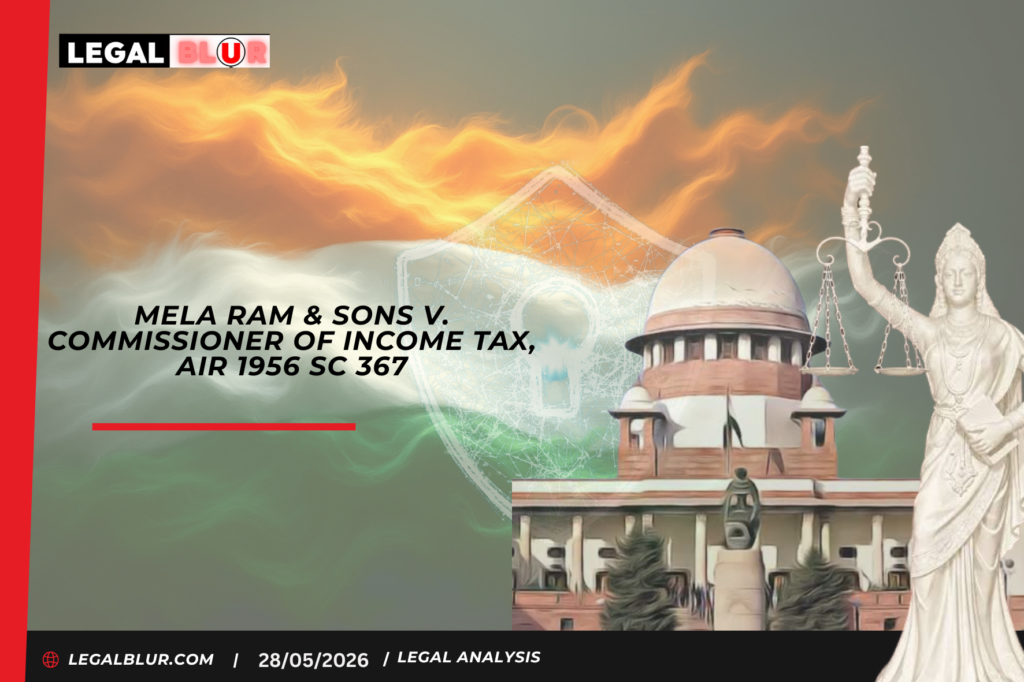
This case primarily concerns the interpretation of Sections 30, 31, and 33 of the Income Tax Act, 1922. The principal question before the Supreme Court was whether an appeal dismissed on the ground of limitation could still be regarded as an “appeal” in the eyes of law, thereby giving rise to a further statutory right of appeal.
The appellant was a partnership firm carrying on business in Patiala, Punjab. The tax assessment of the appellant firm for the year 1945-46 was done by the Income tax officer subordinate to the Commissioner of Income Tax, Punjab for Rs. 71,186 of the total income. After it, a demand notice for income tax and super tax of Rs. 29,857 was served to the appellant firm by the income tax officer on dated 17th September, 1947.
An appeal was filed by the appellant against the aforesaid order before the Assistant Commissioner (Appeal) which was filed later by 19 days. During the intervening period, the tax assessment of the appellant firm for the year 1946-47 was done by the income tax officer for Rs. 1,09,883.00 a notice for disposing Rs. 51,313.00 of the income tax was served to the appellant firm. The appellant also instituted an appeal against this order. This appeal was delayed by seven days beyond the prescribed limitation period.
The respondent raised an objection that these appeals being presented late, are time barred and liable to be rejected. It has been pleaded by the appellant that at the time of presenting the appeal there was division of the country nearby and the circumstances were not favorable, transportation and postal services were severely disrupted due to the partition-related conditions prevailing at the time, and this is an appropriate reason for the delay.
The Assistant Commissioner (Appeal) held both appeals to be barred by limitation and dismissed them accordingly.
An appeal was filed by the appellant against the aforesaid order before Appellate Tribunal. The Appellate Tribunal has also dismissed the appeal stating that the aforesaid order was passed by the Assistant Commissioner (Appeal) under Section 30(2) and not under Section 31 therefore no further appeal under Section 33 was maintainable.
On the request of the appellant, this case was referred to Punjab High court and the High Court also dismissed it. Thus an appeal was instituted by special leave to the Supreme Court under Article 136 of the Constitution by the appellant.
ISSUES BEFORE THE SUPREME COURT
- Whether an appeal filed beyond the prescribed limitation period continues to remain an “appeal” in the eyes of law.
- Whether an order dismissing an appeal as time-barred is an order passed under Section 31 of the Income Tax Act, 1922, thereby making it appealable under Section 33.
HELD
Under Section 30(2) of the Income Tax Act, a limitation period of thirty days for filing an appeal, subject to condonation of delay upon sufficient cause being shown. An appeal filed later can only be admitted on giving appropriate reasons for delay. According to Section 30(3), an appeal must be presented within the stipulated time, verified, and in the prescribed form.
If such an order is considered under Section 30(2) then there will be no appeal against it, but if that is considered under Section 31 then an appeal can be filed under section 33 of the Income Tax Act.
CASE LAWS
The Commissioner Of Income-Tax vs Mysore Iron And Steel Works, 1949 & K.K. Porbunderwalla v. Commissioner of Income Tax A.I.R. 1952
It has been held that if an appeal is filed beyond the period of Limitation is, in the eye of law, no appeal, unless and until there is a condonation of delay, and that in consequence, an order passed thereon cannot be held to be passed in appeal so as to fall within Section 31 and there will lay no appeal against it.
Champalal Asharam v. Commissioner of Income Tax A.I.R. 1954
It has been stated that if an appeal is admitted by ordering condonation of delay and later on it is rejected on the grounds of delay then such an order will be appealable under Section 33 so such other decisions were also presented.
After giving an adequate opportunity of hearing to both the parties and perusal of the presented judicial decision it has been held by the Supreme Court that an appeal filed under Section 30(1) of the Income Tax Act will be an appeal in view of law.
It has been stated by the court that if an appeal filed out of time is rejected on the same grounds then such an order will be appealable.
Being passed an order under Section 31, such an order will be appealable under Section 33. It has also been stated by the Supreme Court that the law of Limitation bars the remedy and not the right of a person. Resultantly, the Supreme Court while allowing the appeal of the appellant set aside the order of the court below.
PRINCIPLES LAID DOWN BY THE SUPREME COURT
The Supreme Court laid down the following important principles:
- An appeal filed beyond the prescribed limitation period does not cease to be an appeal in the eyes of law.
- An order dismissing an appeal as time-barred amounts to an appellate order under Section 31 of the Income Tax Act, 1922.
- Since such an order falls under Section 31, a further appeal under Section 33 is maintainable.
- The law of limitation bars the remedy and not the substantive right itself.
- Statutory provisions relating to appeals should receive a liberal interpretation where the right of appeal is involved.
SIGNIFICANCE OF THE JUDGMENT
The judgment in Mela Ram & Sons v. Commissioner of Income Tax became a landmark authority on the interpretation of appellate remedies and limitation law in India. The Supreme Court adopted a liberal approach toward statutory appeals and clarified that procedural defects such as delay do not destroy the legal character of an appeal itself.
The decision has been repeatedly relied upon in later cases involving limitation, maintainability of appeals, and interpretation of procedural statutes. It reinforced the principle that access to appellate remedies should not be defeated merely on technical grounds unless the statute expressly provides otherwise.
CONCLUSION
It is an important precedent of procedural and tax jurisprudence in India as the court made clear that an appeal filed after the prescribed period of limitation does not become any less of a legal appeal simply because it is a late one. Even if such an appeal gets rejected on grounds of being time-barred, then this rejection will amount to an appeal which is subject to further appeals according to the law.
Through this interpretation of the provision relating to appeals, the court has taken a flexible view of appeals by stating that procedural formalities must not be allowed to defeat the substantive rights of citizens unnecessarily.
As per the law, it was made clear that while the limitation law prevents the remedy, it certainly doesn’t put an end to the right.
FREQUENTLY ASKED QUESTIONS
1. What was the core issue of this case?
The core issue of the case is whether an order passed Appellate Assistant Commissioner (AAC) dismissing an appeal at the threshold as barred by limitation is an order passed under Section 31 or Section 30(2) of the Income Tax Act
2. How did the Supreme Court resolve the conflicting judicial interpretations regarding Sections 30 and 31?
The Supreme court resolved the conflict by discuss how the Supreme Court settled the divergence of opinion between the Punjab High Court which lead such order were under Section 30(2) and 31
3. What are the key takeaways from this case?
The key takeaways from this case are:
- An appeal out of the time is still an appeal
- Rejection equals confirmation a summary dismissal on a preliminary issue effectively upholds the lower order.
- Remedy cannot be choked; remedial statutory provision like the right to a second appeal should be interpreted liberally to grant access to justice rather than technical lockouts.
4. Does an appeal presented beyond the prescribed period of limitation cease to be an appeal in the eyes of the law?
No. an appeal presented out of time is still an appeal. The law distinguishes between a substantive right to file an appeal and the procedural rule of limitation that might bar it.
5. What did the Supreme Court decide?
The supreme court decided in favor of the taxpayer. The court held that an appeal submitted late is still an appeal and if the authority rejects an appeal because it is late then that rejection completely ends the case and leaves the lower officers order standing. Therefore, it counts as a final decision and the taxpayer has the right to appeal against it to a higher tribunal.