
This article is written by Vedant Raj Chopra, Vivekananda Institute of Professional Studies.
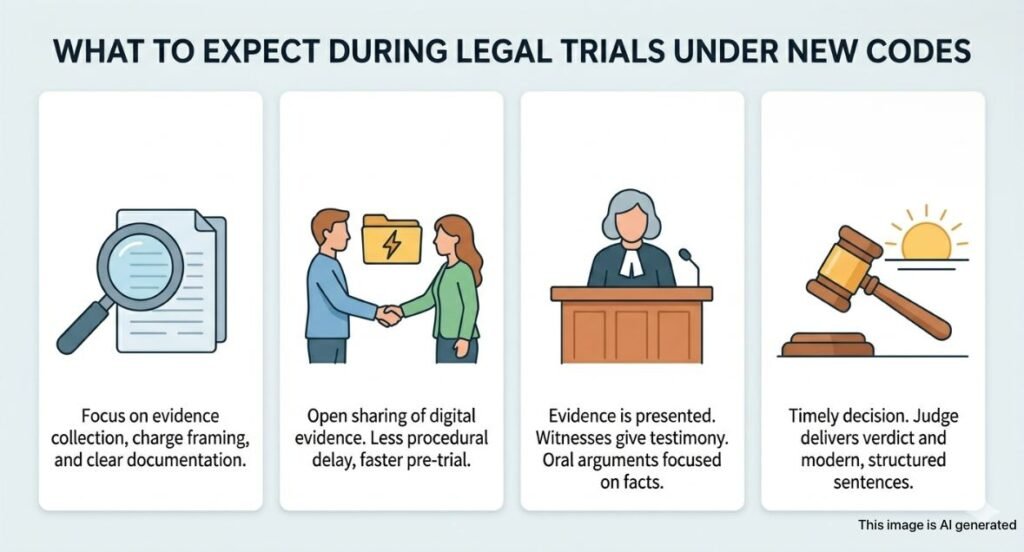
India’s criminal trial process has entered a new phase with the enforcement of the Bharatiya Nyaya Sanhita, 2023, the Bharatiya Nagarik Suraksha Sanhita, 2023, and the Bharatiya Sakshya Adhiniyam, 2023 from 1 July 2024. For an ordinary litigant, accused person, victim, or witness, this change is not merely about new names replacing the IPC, CrPC, and Evidence Act. It changes how a case moves from complaint to investigation, from charges to trial, and from evidence to judgment. The stated goal of the new framework is to make the process faster, more technology-driven, and more citizen-centric.
The first visible change begins even before the trial starts. A complaint can now be reported electronically, a Zero FIR can be lodged at any police station, and victims are entitled to a free copy of the FIR. The laws also strengthen communication rights around arrest by requiring that a person of the arrested individual’s choice be informed, while arrest details must be displayed at police stations and district headquarters. In practical terms, this means that the opening stage of a criminal case is expected to be less opaque than before.
Investigation and Procedural Timelines under the New Codes
Once the matter enters the investigation and trial pipeline, the new codes place clear emphasis on speed and structure. The BNSS introduces timelines for several procedural stages, including victim updates, supply of certain documents, investigation-related processes, and pronouncement of judgment in specific circumstances, with the objective of reducing delays and improving procedural efficiency. The intent is to reduce the culture of endless adjournments and procedural drift that often made criminal trials painfully slow. Courts are also expected to grant only limited adjournments, which means parties will need to be more prepared and less dependent on routine postponements.
Digitalisation of Criminal Trials
Another major expectation under the new codes is the increased use of technology. Summons may be served electronically, proceedings may be conducted in electronic mode, and statements in sensitive cases can be recorded through audio-video means. The Bharatiya Sakshya Adhiniyam also gives explicit recognition to electronic and digital records as documentary evidence, while preserving conditions for admissibility. In today’s courtroom, this means WhatsApp chats, emails, CCTV footage, call records, metadata, and device-based records are no longer peripheral material; they are often central to how facts will be proved or challenged.
Forensic Investigation and Scientific Evidence
The BNSS mandates forensic investigation for offences punishable with imprisonment of seven years or more, wherever forensic facilities are available, thereby institutionalising scientific investigation in serious criminal cases. For offences punishable with seven years or more, forensic investigation has been made mandatory, and crime-scene evidence collection is to be videographed. That is a significant shift in trial culture. Instead of relying excessively on oral testimony and post-facto reconstruction, courts are likely to see more scientific material placed on record at an earlier stage. For both prosecution and defence, this means preparation must begin sooner, because technical evidence can shape the trial long before witnesses step into the box.
Victim and Witness Rights under the New Framework
Victim participation is also more visible under the new scheme. Victims are entitled to case-progress updates within 90 days, copies of the police report and related papers within 14 days, and statutory hearing before withdrawal from prosecution. Witness protection has likewise been given formal importance, with States required to implement witness protection measures. So, what should one expect during trial under the new codes? A more structured process, more paperwork in digital form, greater pressure on timelines, and a courtroom that is increasingly shaped by forensic and electronic evidence. At the same time, because these laws are still new, much depends on how judges interpret the transition and enforce procedural discipline in real cases.
Transitional Challenges and Applicability of the New Codes
One should also expect some early confusion during the transition period. The new codes did not erase all old cases overnight. Courts have had to decide whether old substantive law, new procedural law, or a mix of both applies where offences occurred before 1 July 2024 but procedural steps happened later. This has made transitional case law especially important, because it tells litigants what to file, where to file it, and under which statutory provision they should proceed.
Judicial Interpretation of the Transition to the New Codes
The Allahabad High Court’s decision in Deepu and 4 Others v. State of U.P. is one of the clearest early rulings on transition. The Court held that if an offence was committed before 1 July 2024. However, the FIR was registered after that date; the substantive offence would still be governed by the IPC because of constitutional protection against retrospective penal liability. Still, the investigation would proceed under the BNSS. The Court further clarified that cognisance taken on or after 1 July 2024 in pending investigations would be under BNSS, and the later stages, such as enquiry, trial, and appeal, would also follow the BNSS procedure. For anyone entering a criminal trial today, this case shows that the date of the offence and the date of the procedural step are both crucial.
In Jawahar Lal Patel v. State of U.P., the Allahabad High Court reinforced the practical consequence of the Deepu ruling. The applicants filed a challenge under Section 482 of the old CrPC after the new laws had already come into force. The Court held that such a filing was no longer maintainable and that the correct route after 1 July 2024 was Section 528 of the BNSS. The matter was dismissed with liberty to file afresh under the new provision. The lesson for trial participants is simple but critical: under the new regime, even a technically strong case can be delayed if it is brought under the wrong procedural provision.
A similar transition issue arose before the Meghalaya High Court in Mr S.M. Suna v. Mr N.D. Chullai. The Court considered whether fresh applications, including bail applications filed after 1 July 2024, should continue under the old CrPC if the underlying investigation had begun earlier. The Court held that where no such application was already pending on the cut-off date, fresh procedural applications after 1 July 2024 had to be filed under BNSS. Importantly, the Court also adopted a practical approach by permitting conversion of wrongly titled applications instead of punishing parties for initial confusion. This suggests that courts may balance procedural discipline with fairness during the transition.
The Karnataka High Court in Arunkumar v. State of Karnataka went a step further by treating the FIR itself as procedurally defective when it was registered on 1 July 2024 under Section 154 of the repealed CrPC instead of the corresponding BNSS provision. The Court held that once BNSS had come into force, a fresh FIR on or after that date had to comply with the new procedure, even if the underlying allegations related to acts committed earlier. The Court treated compliance with the new procedural framework as significant and held that FIRs registered after the commencement of BNSS should ordinarily conform to the new statutory procedure. For litigants, this case is a reminder that under the new codes, procedural compliance is not a formality; it can affect the validity of the entire prosecution.
The Delhi High Court’s ruling in Adarsh Kumar Handa v. Government of NCT of Delhi further indicates how quickly courts have begun applying the new framework. The petition invoked BNSS and BNS provisions in relation to alleged false statements in court filings, but the Court held that offences affecting the administration of justice could not be pursued through a private complaint in that manner and had to follow the statutory court-initiated route preserved in the new framework. The broader takeaway is that while the codes are new, many foundational principles survive: procedure may be renamed, but courts will still insist that prosecutions follow the legally designated channel.
In Satender Kumar Antil v. CBI (2022) 10 SCC 51, the Supreme Court emphasised speedy trials, procedural efficiency, and reduction of unnecessary incarceration. Although decided before the new criminal codes came into force, the judgment reflects many of the same objectives pursued by the BNSS, particularly the emphasis on reducing delays and improving procedural discipline.
Conclusion
Legal trials under the new codes are likely to be more disciplined, more digital, and more evidence-heavy than before. Parties should expect faster movement on paper, stricter procedural scrutiny, greater use of electronic records, and a stronger forensic foundation in serious offences. Victims and witnesses are meant to have a more visible place in the process, while accused persons must be alert to new procedural routes and timelines. Yet the real test of the new system will not lie in legislative promise alone. It will lie in whether police, prosecutors, defence lawyers, and courts actually implement these timelines and protections in everyday practice. For now, the safest expectation is this: trials under the new codes will demand more preparedness, more technical awareness, and less tolerance for procedural casualness than the old regime often allowed.
Frequently Asked Questions
1. Do the new codes apply to all criminal cases immediately?
Not always. If the offence was committed before 1 July 2024, the old substantive penal law may still apply, while later procedural stages may shift to BNSS depending on the case stage. Courts have treated the transition as a mixed question of offence date and procedural timing.
2. Will trials become faster under the new laws?
That is the intention. The new framework introduces timelines for charge framing, victim updates, document supply, and judgment, while also restricting adjournments. Whether trials actually become faster will depend on implementation by trial courts and investigating agencies.
3. Is electronic evidence more important now?
Yes. The Bharatiya Sakshya Adhiniyam expressly recognizes electronic and digital records as documentary evidence and gives them legal validity subject to admissibility requirements. This makes digital proof central to many modern trials.
4. Can hearings and summons happen digitally?
Yes. The new framework allows electronic summons and permits proceedings in electronic mode, reflecting a deliberate move toward technology-enabled criminal justice.
5. What is the biggest practical takeaway for lawyers and litigants?
Use the correct procedural provision, prepare early, and treat timelines seriously. Early High Court rulings show that mistakes in choosing between old and new procedural routes can affect maintainability and even the validity of proceedings.