This article is written by Muskan Kaur, a student of St. Wilfred Law College, Jaipur.
This article provides an introductory overview of the evolution of labour laws in India, the constitutional protections available to workers, and some of the major legislations enacted to safeguard labour rights. It focuses primarily on the historical development of labour welfare measures and the legal framework governing employer-employee relations in India.
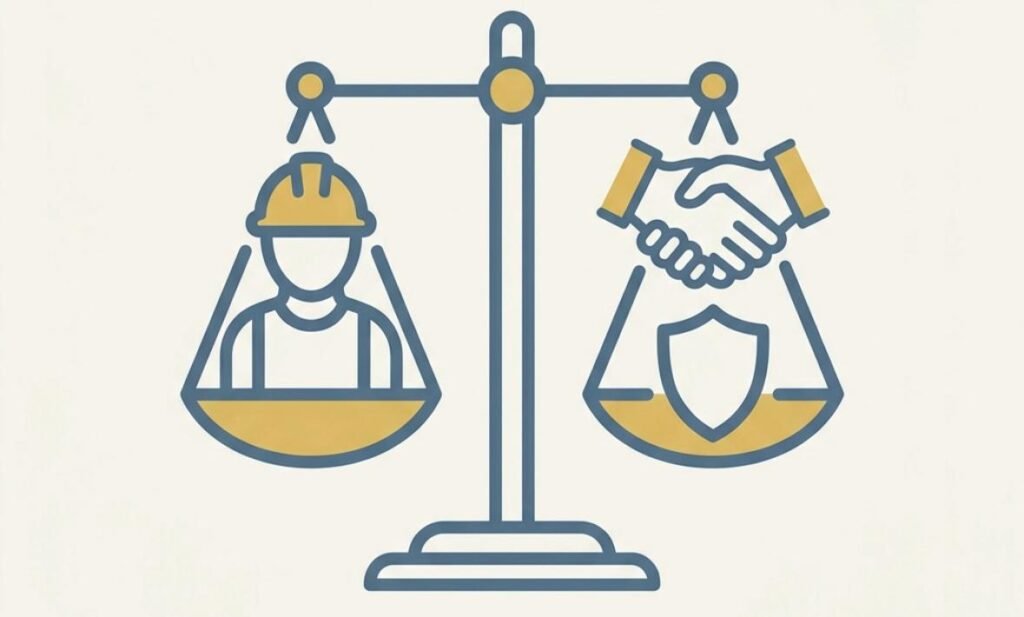
Labour rights is something that we all have heard about but do they really exist and if they exist how do they work?
Labour rights are governed by the labour law which helps to regulate the relation between an employer and employees. This law addresses issues like health and safety at the works place, unfair labour practice, annual leave, working hours, unfair terminations, minimum wages, layoff procedure, labour management relations and so on.
In recent years, India has consolidated several labour laws into four Labour Codes namely the Code on Wages, 2019, Industrial Relations Code, 2020, Occupational Safety, Health and Working Conditions Code, 2020, and Code on Social Security, 2020. These Codes aim to simplify and modernize labour regulation, though their full implementation is still underway.
Origin of Labour Law
The industrial revolution brought major changes in society and left some gaps in society which lead to the foundation of labour laws. Labour law is formed to address problems between the employer and employee.
What was the Need of Labour Law?
After the industrial revolution labours were being exploited at a large scale by
- Widespread child labour
- Making them work for long hours
- lack of proper wages
- lack proper place to live
- lack proper place of work
- lack of social insurance
- lack of medical facilities
- lack of pension
Constitutional Provisions Related to the Rights of Labours
Article 23 of the constitution prohibits traffic in human beings, begar, and other similar forms of forced labour, Any contravention of this provision shall be an offense punishable in accordance with law.
Article 24 of the constitution provides that no child below the age of 14 years shall be employed to work in any factory or mine or be engaged in any type of hazardous employment.
Article 41 of the constitution provides that the state shall within the limits of its economic capacity and development, making effective provision for securing the right to work, to education and to public assistance in cases of unemployment, old age, sickness and disablement, and in other cases of undeserved want.
Article 42 of the constitution provides that the state shall make provision for securing:
- Just and humane conditions of work
- Maternity relief
Y.A. Mamarde V. Authority Under the Minimum Wages Act, AIR 1972 S.C. 1721
To maintain the dignity and personality of the labour participating in the economic development of the nation, it is necessary to give them subsistence wages and provide them social security.
Labour Laws in India
1. Laws related to Industrial relations
Trade union means any combination whether temporary or permanent which shall be formed for the purpose of regulating the relation between workmen and employers or workmen and workmen or employers and employers or imposing restrictive conditions on the conduct of any trade or business.
The act contains rules concerning the formation and regulation of trade unions, as well as conditions under which registration can be granted, along with benefits arising from such registration. In short, the act covers both employer associations and labour unions.
Western India Cine Employees Federation v. Filmalaya Pvt. Ltd. 1981 L.L.J. 393
It was held that every trade union is free to perform its action peacefully. Mere demonstrations or agitation are not invaded on their own. An injunction cannot be issued against them.
In this case the union made various demands on behalf of the 19 workers alleging that these workers were shown as temporary employment of other sister concerns. The federation issued a letter to the various bodies and associations of cine artists, technicians and workers demanding that they issue directions to their members not to report for shooting work at the studio of the plaintiff. As a result the plaintiff filed a suit requesting the civil court to grant injunction restraining the trade union from carrying on such activities. The High court while rejecting the injunction said that the activities of the federation are neither under the pressure nor violent. These activities are related to their lawful demands.
B. Industrial Disputes Act, 1947
Industrial disputes occur when there is a disagreement between employees and employers, between employers and workmen, between workmen and workmen, which is connected with the employment or non-employment or the term of employment or with the condition of labour of any person.
This act also provides the grounds on which a worker may be laid off or dismissed or discharged or when the industry must be shut down.
2. Laws Related to Wages
A. The Payment of Wages Act, 1936
The objective of this act is to regulate the payment of wages to certain classes of workers employed in any industry or establishment who receive an average wage. This regulation has been made regarding the date of payment of wages, fines and otherwise deductions from wages.
The provisions relating to minimum wages have now largely been consolidated under the Code on Wages, 2019.
The objective of this act is to safeguard the interest of workers in the unorganised sector. This act sets and reviews the minimum wage for workers in scheduled employment and this act requires that the central and state government set and review the minimum wages.
3. Laws Related to Women
A. The Maternity Benefit Act, 1961
This act is made with the aim of regulating the employment of women during certain periods before and after delivery. The Act provides paid maternity leave and other benefits to women employees.
Following the 2017 amendment, eligible women are entitled to up to 26 weeks of maternity leave subject to statutory conditions.
This Act prohibits their discharge from service during the pre and post delivery periods.
B. Shah v. Labor Court, Coimbatore AIR 1978 S.C. 12
It has been propounded by the Supreme court that the Maternity Benefit Act, 1961 is an important legislation based on social justice. In certain circumstances, considering women different from men and providing them facilities seems discriminatory in itself but it is justified keeping in view the natural condition of women. It seems inappropriate to employ women workers at the time of delivery, before and after delivery because at such time women need health benefits.
B. Sexual Harassment of Women at Workplace Act, 2013
Over the period harassment at the workplace has increased rapidly. This act is made with the aim of protecting women and making them feel safe at the workplace.
It is worth mentioning that in this act internal complaint committees were established for the task of redressal of complaints related to sexual harassment of women at the workplace and Local Committees was entrusted with the task of receiving complaints related to sexual harassment of women at the workplace and taking action on them.
Conclusion
Labour law was developed as a result of the industrial revolution and in today’s circumstances these immunities are justifiable because the labour have the rights to raise their demands. They can act if there is any violation of their rights. In some ways the labour law resembles those of advanced industrial societies as many laws govern social security, workplace health and safety and other issues such as minimum employment standards. However only a small portion of the workforce is formally covered by the nation’s labour laws and even among that group that actual application of the law is very limited.
Frequently Asked Question
1. How can we make people aware about their rights at the workplace?
- By Educating
- Advertising
- Guidelines
- General awareness
2. What is the penalty of illegal strike?
According to the Section 26 of the Industrial Dispute Act, 1947 provides for the penalty for illegal strike which is imprisonment for a term of up to 1 month or with a fine of up to Rs. 50 or both.
The penalty provision originated under the Industrial Disputes Act, 1947. Current labour law reforms under the Industrial Relations Code, 2020 have introduced revised regulatory provisions.
3. What is fair wages?
Fair wages mean such wages which includes wages from other occupations and which emphasizes on increasing efficiency and on the necessity of providing education.
4. What are the specific provisions regarding employment of women having been employed in various sectors?
- Separate washrooms
- Women workers shall not be employed in the main part of the moving machinery
- No women shall be employed in any factory to lift
- Employment of women during night shifts is permitted in many sectors subject to safety, security, consent, and welfare measures prescribed by law.
5. What are the weekly hours of work?
No adult worker will be allowed to or asked to work for more than 48 hours in a week.