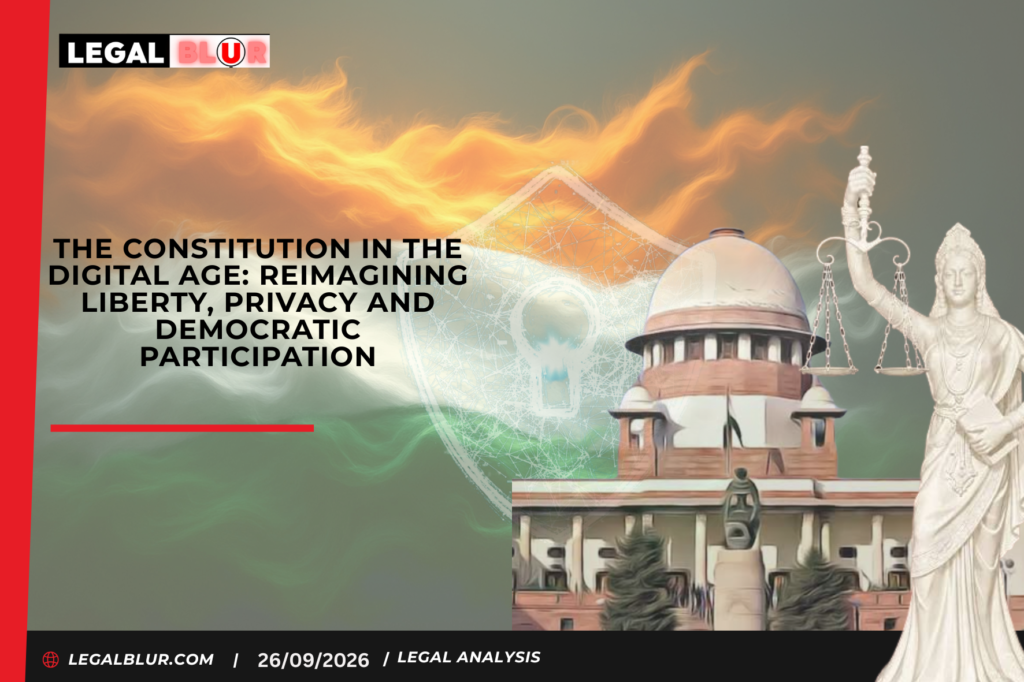
Mansi Mishra writes this Article. This article discusses how the interpretation of the Constitution should guarantee that these rights will continue to work in new situations.
Introduction
The Constitution of India was formulated in the age of paper records, physical borders and inadequate means of mass communication. But the perspective of this Constitution goes beyond the disadvantages of the technology of 1950. In essence, it seeks to protect human dignity, freedom, equality and democratic participation, which are equally applicable regardless of the technology employed in exercising these freedoms.
In modern times, a large part of the life of people has moved into the digital domain. People communicate using social media, learn using the Internet, transact business using computers and interact with the State using digital technology. Information which used to exist in physical forms could now be collected, analyzed and communicated more efficiently than ever before. A fundamental constitutional question arises from this development. Is it possible for constitutional freedoms to be truly exercised when their exercise is becoming more and more dependent upon digital technology? It is possible, certainly. It is not the Constitution which becomes out-of-date due to changes in technology. On the contrary, the way the Constitution is interpreted should guarantee that these rights will continue to work in new situations.
I. From Constitutional Text to Digital Reality
The Constitution guarantees the right to freedom of speech and expression through Article 19(1)(a), whereas Article 21 is a safeguard for the right to personal liberty. Despite the fact that neither of the two Articles has been drafted with the internet in mind, the constitutional significance cannot be restricted to the technology available in 1950 only. The constitutional jurisprudence in the Supreme Court has been progressive in its interpretation of fundamental rights. This is especially relevant in the era of digitisation where the internet has emerged as an important medium for exercising existing freedoms.
In this context, the landmark judgment of the Supreme Court in case of Anuradha Bhasin v. Union of India, where the legality of restrictions on use of the internet in state of Jammu & Kashmir was questioned, would be an example. The right to freely express oneself as guaranteed by Article 19(1)(a) of the Constitution and the right to carry out any occupation as guaranteed by Article 19(1)(g) of the Constitution includes the right to access the internet. This is a constitutional principle: the medium may be different, but the basic right cannot evaporate on account of its exercise via technology.
Therefore, a citizen will not stop enjoying freedom of expression because his opinion is articulated through social media posting instead of newspaper article. Likewise, constitutional oversight cannot vanish simply because the government action is done via an electronic mechanism.
II. Privacy in the Age of Perpetual Data
If free speech is one of the key constitutional issues in the digital age, privacy is perhaps the other. Modern individuals generate data digitally continuously. Search history, location data, photos, financial data, biometric data, and online communications could together tell much about a person’s life. The constitutional implications of such a truth were changed with the unanimous decision of the Supreme Court nine-judge Bench in Justice K.S. Puttaswamy (Retd.) v. Union of India. The Supreme Court has recognised the right to privacy as a constitutional right of the nation, particularly in Part III. But the significance of Puttaswamy case is not simply about the right to privacy. Privacy was linked with dignity, autonomy, and freedom of choice in the decision. This becomes especially critical in the digital age when personal information could be taken out of control of the individual without
his even knowing how extensive the collection and processing of such information was.
It is, therefore, not just a matter of information being revealed. It also depends on who will have the control over such information, why it was collected,
how long it is stored and how it will be used after that.
The Indian legislation on this issue has developed along with the constitutional progress. The Digital Personal Data Protection Act, 2023 regulates the processing of digital personal data taking into account,
first, an individual’s desire to keep his personal data protected and, second, lawful processing of such data. The Digital Personal Data Protection Rules, 2025 were published later providing another regulatory mechanism. Nonetheless, legislation by itself is inadequate for resolving constitutional problems.
The data protection should meet some principles which include dignity, autonomy, equality, and accountability.
III. Digital Surveillance and Constitutional Proportionality
Moreover, the use of new technologies makes the state able to conduct the digital surveillance and analysis of data. Digital surveillance may have many proper purposes,
such as the prevention of crime, the provision for national security, and managing of emergencies. However, the concept of constitution implies the need for restriction of government powers regardless of their legitimacy. The issue of proportionality of the digital surveillance comes where it is too much, insufficient, or disproportional. Therefore, the mere legitimacy of the aim does not mean the justification of all the means used to achieve it. Any encroachment on fundamental constitutional rights has to be justified by constitutional standards.
The main danger is the creation of a chilling effect. People will attempt to control their behavior
because they will think that everything they do on the Internet, in letters,
and even politically is under close scrutiny with no restrictions at all. Therefore, even though the freedom of speech will exist, it will be highly limited. Constitutional democracy therefore calls for not only freedom from censorship but also for environment in
which citizens can meaningfully exercise their freedoms without unreasonable fear of surveillance.
IV. The Digital Public Sphere and Democracy
The information revolution has both reinforced and challenged democratic engagement. Social media has made the process of public speech much less difficult. No longer does a person need to have access to a newspaper, TV station or a political organization
to speak to a large number of people about his or her ideas. The information revolution can enable the voice of the unheard. This democratization of communication is entirely in line with the constitutional principle of participation and freedom of expression. The information revolution has also made possible the spread of disinformation, manipulation, hate speech and campaigns to pervert public debate. Thus, the challenge raised by the constitution becomes complex:
how is it possible to maintain fairness in public discussion without resorting to censorship? A multi-dimensional answer becomes necessary. Rights under the constitution have always been more concerned with preventing state interference. However, constitutional principles can still be used to guide regulation of strong digital intermediaries.
What needs to be achieved is
to ensure that individual freedom as well as the public domain is maintained,
without ceding undue power to the government or corporations. Nor can it be achieved through unlimited control by the government of speech. This is because Article 19(2) has already provided a constitutionally
permissible basis for imposing reasonable limitations on freedom of speech and expression.
The Supreme Court has stressed again and again that such limitations
must fulfill the constitutional requirements and not just be convenient for administration.
On the other hand, the private digital intermediaries have significant control over the discourse of the public sphere. Decisions about content moderation, account suspensions, and algorithms can make or break one’s ability to express oneself. It leads to an interesting constitutional question as
these digital intermediaries become indispensable for democracy, should constitutional values govern the exercise of private power?
The answer to it needs to be a subtle one. Constitutional rights are essentially meant to restrain government action
but constitutional values may be able to guide the regulation of these powerful digital intermediaries.
V. Constitutionalism Beyond the courtroom
The era of technology serves as a confirmation of the notion that constitutionalism has not been restrained by judicial review. It is apparent that courts are very important in making sure that people enjoy their rights. Examples like Puttaswamy and Anuradha Bhasin illustrate the use of constitutional principles in the advancement
of technologies which the framers of the Constitution could never have imagined. But constitutional governance demands law-making, effective administration, institutions and an enlightened citizenry. The Constitution does not belong just to the courts, lawyers and the government -it belongs to the citizens. That is particularly true in the digital age because
the violations of the Constitution may not always come in recognizable shapes and forms. Internet shutdowns may violate freedom of speech. Privacy can be violated by unrestricted surveillance. Discrimination can be incorporated into algorithms. Marginalization can arise if essential services become available through the internet alone. Such scenarios need constitutional literacy in addition to technological literacy. The more literate a citizen is about the Constitution,
the better he/she will be at challenging arbitrary actions of the government and demanding transparency.
VI. Towards a Constitutionally Responsible Digital Future
India’s digital future must not pose a conflict between technological advancement and constitutional liberties. The two can live together. First, privacy by design needs to be an important aspect of digital governance. The system should not collect information unnecessarily and ensure
that there are necessary precautions right from the start and not make privacy an afterthought. At the same time, the imposition of restrictions by the government should not violate the principles of necessity and proportionality. Exceptions must remain exceptions while restrictions should be subject to regular review. Thirdly, transparency and accountability must accompany automated and data-based governance. People need to know the rationale behind the decisions that affect their rights and also should have appropriate redress mechanism.
Fourth, the regulation of digital space must uphold freedom of speech and address
genuine issues of harms caused by digital technology.
Last but not least, constitutional education needs to be relevant in the digital world. The young citizens of India should know not only their constitutional rights,
but also how those rights work in the context of technology and digital platforms.
Conclusion
That the constitution has lived for seventy-five years is not on account of its principles being fossilized,
but rather on the account of the values of which it consists being able to adjust according to change.
The digital revolution poses perhaps the greatest test of such ability to adjust. But it is also the chance to reaffirm the continuing importance of constitutionalism.
The constitution needs to go with the citizen into the digital world. Constitutional guarantees do not have any meaning if they are not applied to the real life of citizens and society.
There is no point in the right to privacy, given a constitutional guarantee,
if the power is aware of the true situation of people’s lives and communication.
And democracy means nothing if progress in technology undermines rather than
enhances the capacity of citizens to exercise their freedoms freely and equally.
Thus, it can be stated that the spirit of the Constitution is more than its textual content;
it exists in all situations when power is used against the individual,
and in the 21st century this happens through the medium of technology.
The challenge for India lies not in the choice between technology and the principles of constitutionalism. Its mission is to make sure that technology advances within the discipline of constitutional values.
This is the way the Constitution continues to remain not just a document of the past but a promise of the future.