This article is prepared by Ahona Das, Sister Nivedita University. This article examines the legal background of the case, the issues considered by the Supreme Court, its reasoning and decision, and the continuing impact of the judgment on child rights, criminal law and the present legal framework in India. It also discusses the challenges that still remain.
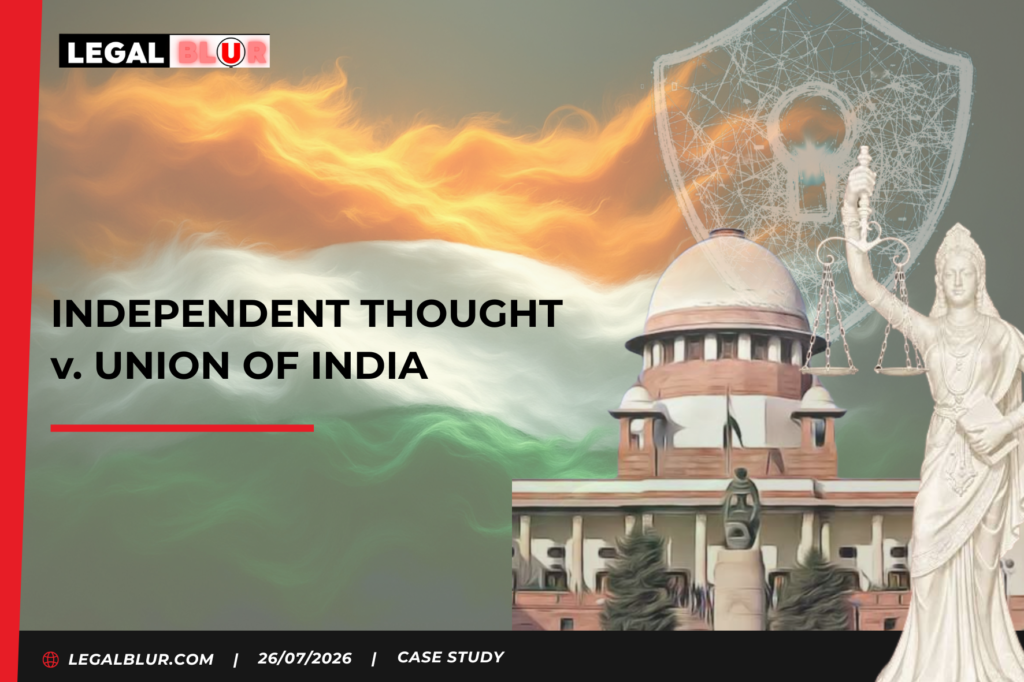
Child marriage is one of the most serious social and legal challenges in India for many years. Earlier, a conflict existed between the criminal law and child protection laws on the rights of minor married girls. This conflict created confusion that married girls under the age of 18 had the same legal protection against sexual offences as any other child. The judgment in Independent Thought v. Union of India (2017) 10 SCC 800 became a turning point in resolving this conflict. This decision is important to strengthen the protection of minor girls. It highlighted the need to interpret different laws which promote constitutional values and the welfare of all children. Even today, child marriage continues in many parts of India.
Keywords: Child Marriage, Sexual Offences, Child Rights, POCSO Act, IPC, BNS, Constitution of India.
Legal Background
Indian law had a serious legal confusion regarding the protection of minor girls Before the decision in Independent Thought v. Union of India (2017) 10 SCC 800. Many laws recognised every person below eighteen years as a child and aimed to protect children from abuse. The criminal laws followed different rules for married minor girls. This difference created confusion in cases related to child marriage and sexual offences. At that time, Exception 2 to Section 375 of the Indian Penal Code, 1860 (IPC) stated that sexual intercourse by a husband with his wife was not rape if the wife’s age was at least fifteen years. A married girl between fifteen to eighteen years of age did not receive the legal protection under this provision as other children. This exception went against the purpose of child protection laws. It also failed to protect the dignity of minor girls. Under the Indian Majority Act, 1875, a person generally attains the age of majority on completing eighteen years. The POCSO Act, 2012 also defines a child as any person below eighteen years of age. Similarly, the Prohibition of Child Marriage Act,2006 defines a child as a male below twenty-one years and a female below eighteen years and also discourages child marriage and provides legal remedies to protect children from forced marriages. Before the landmark judgment, the exception of IPC treated a married girl above fifteen years differently from other children. This difference created a conflict between the IPC and child protection laws and became one of the main issues before the Supreme Court.
The issue also involved important constitutional principles. The Constitution guarantees equal treatment before the law under Article 14, protects individuals against discrimination on grounds including sex under Article 15, and safeguards the right to life, dignity and personal liberty through Article 21. In this case, the central constitutional question was whether a girl below eighteen years of age could receive a lower level of legal protection only because she was married. The Supreme Court was therefore required to determine whether such a distinction was consistent with the values of equality, dignity and child protection guaranteed by the Constitution.
The judgment was delivered under the IPC, its principles are still important today. The Bharatiya Nyaya Sanhita, 2023 (BNS) has replaced the IPC but the constitutional values of equality, dignity and child protection recognised by the Supreme Court continue to guide the interpretation of criminal law. Therefore, the decision in Independent Thought v Union of India (2017) remains an important precedent even after the introduction of the BNS.
Purpose of the Petition
The writ petition was filed by Independent Thought, a non-governmental organisation working for children’s rights. The NGO argued that Exception 2 to Section 375 of IPC violates the Fundamental Rights. It also argued that the exception was inconsistent with the POCSO Act and the Prohibition of Child Marriage Act. According to the petitioner, every girl below eighteen years should receive equal protection against sexual offences whether she was married or unmarried. The Supreme Court examined whether this exception could continue when other laws recognised every person below eighteen years as a child. The case finally became a constitutional question on equality, dignity and the best interests of the child.
Court’s Decision and its Impact
The Supreme Court examined the issue and applied the principle of harmonious interpretation. The Court tried to ensure that all child protection laws worked together. In Independent Thought v. Union of India (2017) 10 SCC 800, the Court held that exception of the IPC could not deny protection to a married girl below eighteen years of age. Instead of declaring the provision unconstitutional, the Court read down the exception. It held that sexual intercourse with a minor wife would amount to rape. This decision removed the confusion between the IPC and child protection laws and ensured equal protection for every minor girl.
Supreme Court based its decision on constitutional values. It held that the welfare of a child is more important than social practices. The Court also stated that marriage cannot take away the fundamental rights of a child. Every minor girl has the right to equality, dignity and persona liberty. The judgement also made it clear that all laws relating to children should protect their welfare.
Legal and Social Impact of the Judgment
The judgment has had a significant legal and social impact. It strengthened the protection available to minor girls under criminal law and removed a long-standing legal confusion between the IPC, the POCSO Act and the Prohibition of Child Marriage Act. It also guided investigating agencies to treat offences against married minor girls in the same way as offences against any other child. It also made it clear that child marriage cannot be used as a defence in cases of sexual offences against a minor. Marital status, the Court said, cannot reduce the protection a minor girl is entitled to under criminal law. By extending equal protection to all girls below eighteen years of age, the Supreme Court ensured that child marriage could no longer be used to justify sexual intercourse with a minor wife. This strengthened children’s rights and promoted a more consistent application of criminal law.
Issues That Still Remains
Even after this landmark judgment, some challenges still remain. Child marriage continues in many rural and economically weaker communities. Social acceptance of child marriage, lack of awareness and delay on reporting cases still affect the effective implementation of the law. Another important issue is that this judgement applied only to wives below 18 years of age. The issue of marital rape involving adult wives is still a separate question and continues to be discussed before the courts and policymakers.
The Present Legal Position
Despite this landmark judgment, the issue of marital rape involving adult wives remains legally unsettled in India and continues to be debated before constitutional courts and policymakers. The Independent Thought judgment was confined to minor wives below eighteen years of age and did not decide the broader question relating to adult married women. After the enforcement of the Bharatiya Nyaya Sanhita, 2023, the principles laid down in Independent Thought continue to remain relevant. Although the IPC has been replaced by the BNS, the constitutional values of equality, dignity and protection of children remain unchanged. Courts are expected to interpret criminal laws in a manner that safeguards children’s rights and fulfils the objectives of child protection legislation. Therefore, the judgment continues to guide the interpretation of criminal law even under the present legal framework.
Conclusion
The judgment in Independent Thought v. Union of India (2017) 10 SCC 800 marked an important step towards strengthening the legal protection of minor girls in India. By applying the principle of harmonious interpretation, the Supreme Court removed the conflict between the IPC and child protection laws and ensured that every girl below eighteen years receives equal protection under criminal law. The decision reaffirmed that constitutional values such as equality, dignity and the best interests of the child must always prevail over outdated legal exceptions.
However, the judgment should be seen as the beginning of legal reform rather than its final achievement. Child marriage continues to exist in many parts of the country because of poverty, social customs and lack of awareness. Legal protection alone cannot completely eliminate this social problem. Effective implementation of the law, public awareness, education and coordinated efforts by the Government and society are equally necessary. This landmark judgment remains an important reminder that protecting children requires not only strong judicial decisions but also continuous social and legal reforms.
Frequently Asked Questions
1. What was the main issue before the Supreme Court in Independent Thought v. Union of India (2017) 10 SCC 800?
The Court examined whether Exception 2 to Section 375 of the IPC could deny rape protection to a married girl below eighteen years of age.
2. Why is this judgement considered a landmark judgment?
Ans: It removed the conflict between the IPC and child protection laws by extending equal legal protection to all girls below eighteen years.
3. What is the principle of harmonious interpretation?
Ans: It means interpreting related laws together so that they work consistently and achieve the same legal objective.
4. What change did the Supreme Court make to Exception 2 of Section 375 of the IPC?
Ans: The Court read down the exception and held that sexual intercourse with a wife below eighteen years amounts to rape.
5. How did this judgment protect minor girls?
It ensured that marriage cannot reduce the legal protection available to a child under criminal law.