This article is written by Kashish Yadav, Chhatrapati Shahu Ji Maharaj University.
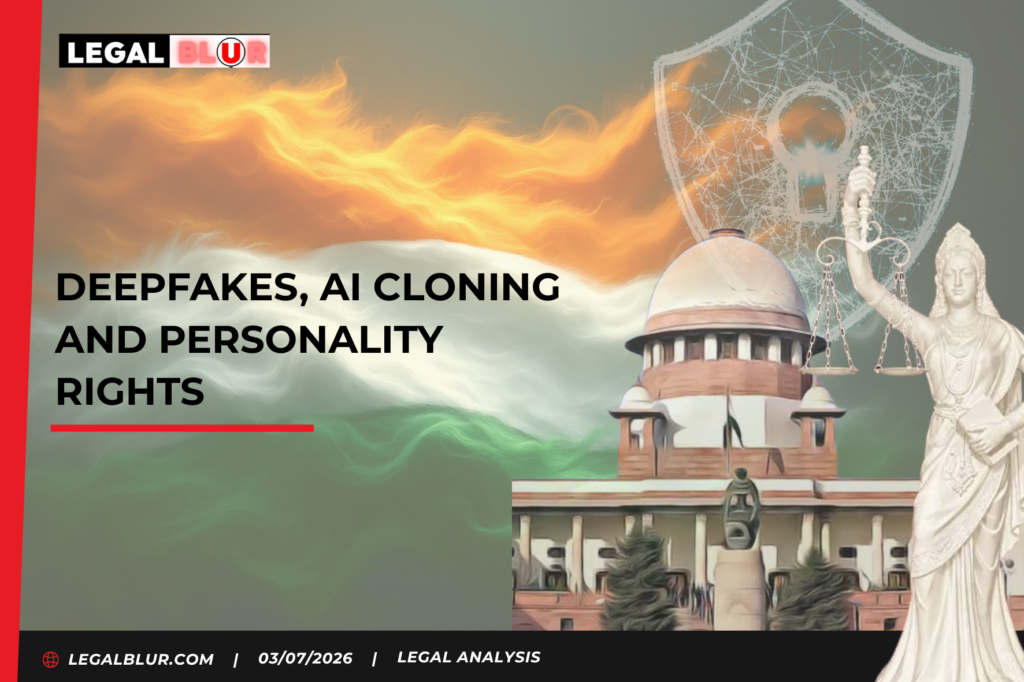
Technology has always tested the limits of existing law, but artificial intelligence is doing something different. It is not just creating new tools; it is recreating people. Deepfakes and AI voice or image cloning can now reproduce a person’s face, voice, gestures and expressions with a level of accuracy that makes it genuinely difficult to distinguish the real from the fabricated. This is no longer a distant concern. Indian celebrities, politicians, journalists and ordinary individuals have already found their likenesses used without consent in fake videos, AI-generated speeches and digitally cloned advertisements.
What makes this legally complicated is that India does not yet have a dedicated statute on personality rights. The right of a person to control how their name, face, voice or identity is commercially used exists at the intersection of intellectual property law, tort law and constitutional rights. Courts have borrowed concepts from copyright, passing off and the right to privacy under Article 21 to offer protection, but the framework remains fragmented and reactive rather than comprehensive and anticipatory.
This article takes the position that the arrival of deepfake technology and AI cloning has exposed a genuine gap in Indian IPR law. The existing remedies are inadequate for the speed and scale at which personality misappropriation now happens online. Through an examination of Indian and international case laws, and a plain reading of what these technologies actually do to a person’s legal interests, this article argues for a clearer, standalone recognition of personality rights within the Indian legal system.
Understanding the Technology and Its Legal Impact
A deepfake is a piece of media, typically a video or audio clip, in which a person’s likeness has been digitally superimposed onto another person’s body, or in which fabricated speech is placed into their mouth, using machine learning algorithms. AI cloning goes a step further: it can replicate not just appearance but vocal patterns, speech cadence and even writing style. These tools are freely available online, require no technical expertise to operate and can produce convincing results in minutes.
The legal harm caused by these technologies falls into at least three categories. First, there is reputational harm, where a person is shown saying or doing something they never did. Second, there is commercial harm, where a person’s likeness is used to endorse a product or service without their knowledge or consent, thereby depriving them of the economic value of their own identity. Third, there is dignitary harm, where intimate or offensive content is generated using a real person’s face or voice. Indian law currently addresses each of these harms through different, and somewhat overlapping, legal routes, none of which was designed specifically for AI-generated misuse.
Case Laws
Shivaji Rao Gaikwad (Rajinikanth) v. Varsha Productions (2015), Madras High Court
This is one of the earliest and most influential Indian decisions on celebrity personality rights. The superstar Rajinikanth successfully obtained an injunction against a film producer who intended to use his name, voice, style and likeness in a film without consent. The Madras High Court held that a celebrity’s persona, including their distinctive style of dialogue delivery and mannerisms, constitutes a protectable legal interest. The court relied on the concept of passing off and the tort of appropriation and recognised that celebrity identity possesses independent commercial value, to grant relief, even in the absence of a statutory personality rights provision.
The significance of this judgment in the context of AI is considerable. If a person’s voice and mannerisms are protectable when used in a film, the same logic must apply when those attributes are cloned by an AI and used in a fake advertisement or video. The court’s reasoning effectively lays the groundwork for extending protection to AI-generated misuse of celebrity personas, even if it did not contemplate that specific scenario.
Anil Kapoor v. Simply Life India and Ors. (2023), Delhi High Court
This is perhaps the most directly relevant Indian judgment on AI misuse of celebrity identity. Actor Anil Kapoor filed a suit after his name, image, voice and even the catchphrase ‘Jhakaas’ were being used without consent in AI-generated merchandise, memes and digital content. The Delhi High Court granted a broad injunction, restraining the defendants from using any aspect of the plaintiff’s personality for commercial gain without authorization.
What makes this judgment particularly significant is that the court explicitly acknowledged that a person’s voice, image and persona together constitute a composite protectable right. The court drew from American jurisprudence on the right of publicity, from the constitutional right to privacy recognized in K.S. Puttaswamy v. Union of India (2017), and from the law of passing off. It recognized that in the digital age, the appropriation of personality can happen at scale and at speed, and that the law must respond accordingly. This judgment is currently the closest India has come to recognizing a standalone personality right in the context of AI technology.
Amitabh Bachchan v. Rajat Nagi and Ors. (2022), Delhi High Court
In this case, actor Amitabh Bachchan approached the Delhi High Court after discovering that his image, voice and name were being used in fraudulent lottery and KBC-related scams circulating on WhatsApp and other digital platforms. The court granted an ex parte injunction not just against named defendants but also against unknown defendants and platform intermediaries, directing them to take down all infringing content.
The case is important because it demonstrates the practical challenge of enforcing personality rights in a digital environment: infringers are often anonymous, content spreads rapidly and platforms are reluctant to act without a court order. The judgment set a precedent for issuing wide injunctions in cases of digital personality misappropriation and placed obligations on intermediaries, which becomes especially relevant when deepfake content is distributed through social media platforms.
Midler v. Ford Motor Co. (1988), Ninth Circuit, United States
Though an American decision, this case has been cited in Indian academic and judicial discussions on voice rights. Singer Bette Midler sued Ford Motor Company after it hired a sound-alike singer to reproduce her distinctive vocal style in an advertisement, having been refused permission to use Midler’s actual recordings. The Ninth Circuit held that a person’s voice is as distinctive and personal as their face, and that its deliberate imitation for commercial purposes without consent is actionable.
This judgment is prescient in the age of AI voice cloning. If hiring a human to imitate a voice was held to be unlawful, the use of AI to clone that same voice is an even clearer violation, because it reproduces the actual vocal identity with greater precision. Indian courts would be well-advised to adopt this reasoning as AI voice cloning disputes begin to arise domestically.
White v. Samsung Electronics America Inc. (1992), Ninth Circuit, United States
This decision significantly expanded the scope of the right of publicity. Samsung ran an advertisement depicting a robot dressed in a wig, gown and jewellery resembling television personality Vanna White, standing beside a game-show board. Although the advertisement never used White’s name or photograph, the Ninth Circuit held that it deliberately evoked her identity for commercial gain and therefore violated her right of publicity.
The case is especially relevant in the era of generative AI. Deepfakes frequently avoid copying an individual’s exact image while reproducing enough identifying characteristics for audiences to recognise the person immediately. White demonstrates that personality rights may extend beyond literal copying to the commercial appropriation of an individual’s distinctive identity. Indian courts, particularly while developing personality rights jurisprudence, may find this reasoning persuasive where AI systems imitate a person’s recognisable persona without reproducing an exact photograph or recording.
Carson v. Here’s Johnny Portable Toilets Inc. (1983), Sixth Circuit, United States
Television host Johnny Carson successfully challenged the commercial use of the phrase “Here’s Johnny”, despite the defendant never using his actual name. The Sixth Circuit held that the phrase had become so closely associated with Carson’s identity that its unauthorised commercial exploitation amounted to a violation of his publicity rights.
The decision is increasingly relevant in the context of AI-generated content, where systems may imitate a person’s catchphrases, speech patterns or distinctive verbal style without reproducing their exact voice or image. It reinforces the broader principle that personality rights protect the commercial value of an individual’s identity, not merely their physical appearance.
No Doubt v. Activision Publishing Inc. (2011), California Court of Appeal
Members of the musical group No Doubt licensed their likenesses for use in the video game Band Hero. However, the game allowed players to manipulate the band’s digital avatars to perform songs and actions never authorised by the artists. The California Court of Appeal held that this exceeded the licence granted and violated the performers’ rights of publicity.
Although the dispute arose before the emergence of generative AI, its reasoning is directly applicable today. AI-generated avatars similarly enable digital replicas of individuals to perform new acts, speak new words and endorse products without consent. The case illustrates that digital manipulation of a person’s identity may itself constitute actionable misappropriation.
Arijit Singh v. Codible Ventures LLP (2024), Bombay High Court
In one of India’s earliest decisions directly addressing generative AI and personality rights, the Bombay High Court granted interim protection to singer Arijit Singh against unauthorised AI-generated reproductions of his voice, image, signature style and personality attributes. The Court recognised that technological advances such as generative AI and voice cloning substantially increase the risk of commercial exploitation of an individual’s identity without consent. It restrained the defendants from creating, distributing or monetising AI-generated content that falsely suggested Singh’s endorsement or reproduced his personality for commercial gain. The judgment significantly strengthens the emerging recognition of personality rights in India by expressly addressing AI-enabled identity appropriation.
Gaps in the Current Legal Framework
Indian copyright law under the Copyright Act, 1957 protects original creative works, but a person’s face, voice or likeness is not itself a copyrightable work unless it has been fixed in a creative expression. Trademark law can protect a registered name or logo, but most individuals do not register their personal attributes as trademarks. The Information Technology Act, 2000 addresses cyber offences but does not specifically target deepfake creation or AI personality cloning. The Digital Personal Data Protection Act, 2023 protects personal data but is not designed to address commercial misappropriation of identity.
What is missing is a dedicated right of publicity statute, similar to those that exist in several American states, which would give every person, not just celebrities, the right to control the commercial use of their identity, including AI-generated reproductions of it. Without such a statute, ordinary individuals who are not famous enough to invoke passing off have very limited recourse when their faces or voices are cloned and misused online.
Conclusion
Deepfakes and AI cloning are not edge cases or future problems. They are present realities that Indian courts are already beginning to encounter. The judgments in Anil Kapoor, Amitabh Bachchan and Rajinikanth demonstrate that the judiciary is willing to stretch existing doctrines to provide relief, but judicial creativity can only go so far. At some point, Parliament must step in with clear legislation.
Such legislation should not only recognise personality rights but should also address the broader regulation of generative artificial intelligence. A comprehensive AI framework should define responsibilities for developers, deployers and digital platforms, establish obligations regarding consent and transparency in AI-generated media, and provide expedited remedies for victims of deepfakes and identity misappropriation. Without such reforms, Indian courts will continue to stretch existing legal doctrines to solve problems that were never contemplated when those doctrines were developed.
A dedicated personality rights law in India should recognize the right of every individual to control the use of their name, image, voice, likeness and digital identity for commercial purposes. It should apply to AI-generated reproductions with the same force as it applies to human imitations. It should provide for swift remedies, including takedown orders against platforms and statutory damages that reflect the scale of digital harm.
As a law student, what strikes me most about this area is how quickly the technology has outpaced the law. We read about the right to privacy as a constitutional guarantee, yet every day people’s faces and voices are being used in ways they never consented to and may never even find out about. The law has the tools; it now needs the will to use them decisively. Brand protection in the digital age ultimately comes down to whether the legal system treats a person’s identity as something worth protecting seriously, and not just on behalf of celebrities who can afford to go to the Delhi High Court.
Frequently Asked Questions
1. What are personality rights and are they recognised under Indian law?
Personality rights refer to the right of an individual to control the commercial use of their name, image, voice and likeness. India does not have a dedicated personality rights statute. Courts have recognised these rights through a combination of passing off law, copyright principles, the constitutional right to privacy under Article 21, and tort law. Recent High Court judgments, particularly from the Delhi High Court, have significantly expanded the scope of protection available.
2. Is creating a deepfake of someone a criminal offence in India?
Depending on the facts, deepfakes may attract liability under the Information Technology Act, 2000 (including Sections 66E and 67), the Bharatiya Nyaya Sanhita, 2023 (including provisions relating to defamation, forgery, impersonation, obscenity, or identity-related offences where applicable), and other relevant laws.
3. Can an AI-generated voice clone of a celebrity be used in an advertisement without consent?
No. Based on the reasoning in cases like Anil Kapoor v. Simply Life India and Midler v. Ford Motor Co., using an AI-generated clone of a recognisable person’s voice for commercial purposes without consent is actionable. It can constitute passing off, violation of personality rights and unfair trade practice. Courts have consistently held that commercial exploitation of a person’s distinctive attributes requires their prior authorisation.
4. What remedies are available to a person whose likeness has been used in a deepfake?
A person whose likeness has been misused in a deepfake can seek a civil injunction to stop further distribution, damages for reputational or commercial harm, a direction to platforms to take down the content, and in appropriate cases, criminal prosecution. The Delhi High Court has shown willingness to grant ex parte injunctions in urgent cases and to direct intermediaries such as social media platforms to remove infringing content.
5. Does the Digital Personal Data Protection Act, 2023 provide any protection against AI cloning?
The Digital Personal Data Protection Act, 2023 regulates the collection, processing and storage of personal data. While it gives individuals rights over their personal information, it does not specifically address the commercial misappropriation of identity through AI tools. A deepfake or AI clone may involve personal data, but the Act’s framework is not designed to provide the kind of personality rights protection that would be needed to address AI cloning comprehensively. A separate statutory intervention remains necessary.