This article is written by Mansi Mishra, a student of GGSIPU, Delhi. This article studies the notion of copyright infringement in the age of Artificial Intelligence. It considers various cases, evaluates the legal position in India and other countries, and considers the future of copyright in an age dominated by AI.
The development of Artificial Intelligence (AI) is changing every segment of life, ranging from education and healthcare to entertainment, journalism, and law. One of the most significant legal debates surrounding AI concerns copyright ownership and infringement relating to works generated through artificial intelligence systems. Contemporary AI applications like OpenAI ChatGPT, Google Gemini, and AI picture generators generate writings, songs, images, coding algorithms, and even movies in seconds. In addition to improving creativity, AI innovations pose some challenges for IPR laws.
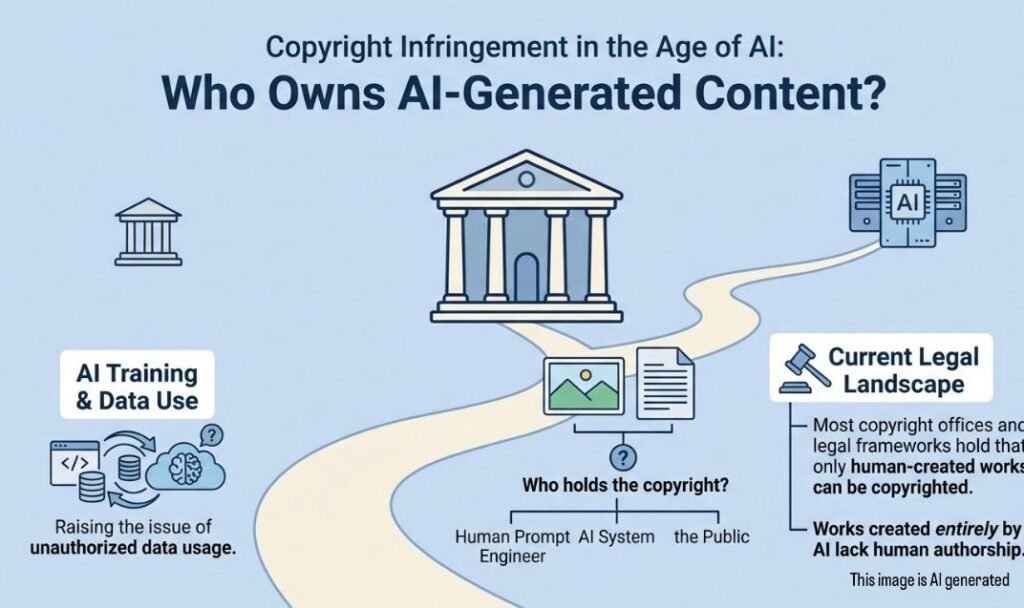
Under current copyright laws, authors of literary, artistic, dramatic, and musical creations receive protection if they have originated from human intellect and creativity. But it may become quite challenging to attribute content to some specific entity when that content was produced autonomously by a machine. Who should get the copyright? Is it a designer of an AI algorithm or its user who has prompted it? The problem becomes complicated because existing copyright laws throughout the globe were developed well before the emergence of generative AI technologies. Additionally, many people argue that their intellectual products are used illegally to train AI.
As a result, there have been attempts by courts and policymakers around the globe to define the relationship between creativity, ownership, and technology again.
Introduction to AI-Generated Content and Copyright
AI generated content means any text, picture, audio, video or any creative material which is created either wholly or partly by AI systems using machine learning technology. This system works by training on large datasets collected from books, paintings, websites, digital sources, and more.
According to conventional copyright law, ownership usually rests with the creator of the material who uses skill, labour and judgement to create his work. The copyright law fundamentally presumes that creativity is human in nature. On the other hand, AI systems lack legal capacity and human consciousness. Thus, the problem arises here.
Some of the key issues include:
- Can the content created by an AI system be protected by copyright?
- Does training an AI on copyrighted material amount to copyright infringement?
In many nations, copyright protection only covers the works produced by people. For example, the United States Copyright Office has repeatedly clarified that works generated entirely without human authorship are not eligible for copyright protection. Indian copyright law under the Copyright Act, 1957, also does not explicitly provide for any recognition of AI as an author.
Section 2(d)(vi) of the Copyright Act, 1957 provides that in the case of computer-generated works, the ‘author’ shall be the person who causes the work to be created. While this is somewhat flexible, it does not cater to the idea of AI that creates works with minimal interference from humans.
A major challenge faced by creators in AI-generated content is infringement. This happens when copyrighted texts, like books, songs, and art, are collected by the AI through scraping from the internet and used for training purposes.
Legal Issues in the Era of AI
1. Absence of Human Authorship
There are certain requirements that need to be fulfilled in order for a creation to be protected under copyright. One of them is originality and creativity which are inherent to the copyright itself. Many courts have established that human authorship is a key prerequisite for obtaining copyright. Since artificial intelligence is not a human being, it is deprived of a legal personality.
2. Ownership Issues
Despite copyright protection for AI-generated works, ownership becomes ambiguous as there could be more than one claimants such as:
- The person developing the AI software
- The user giving prompts to AI systems
- The entity owning the AI system
- Multiple owners
These issues arise because of the absence of legislative frameworks addressing the use of AI-based solutions.
3. Use of Copyrighted Materials for AI Training
The majority of generative AI models are trained through the use of large amounts of data, which includes copyrighted materials. As a result, many artists, writers, and media corporations filed lawsuits against the misuse of their works and copyright infringement.
Another major legal issue concerns whether the use of copyrighted works for AI training qualifies as “fair use” under United States law or “fair dealing” under Indian copyright law. Courts across jurisdictions are still determining whether large-scale data scraping for AI training constitutes transformative use or unlawful reproduction of copyrighted material.
4. Plagiarism
Another challenge associated with generative AI involves the possibility of mass-scale plagiarism due to similar works generated by the system. Such risks are amplified with deepfake videos and music created using artificial intelligence.
Case laws of significance
Although this dispute had nothing to do with artificial intelligence and its implications, it has become an important landmark case regarding copyright authorship and non-human beings. Photographer David Slater claimed copyright ownership over photographs captured by a monkey named Naruto using his camera. In accordance with the verdict, animals cannot hold copyrights as the copyright laws provide that only humans can own copyrights.
This decision became influential in later AI copyright debates because it reinforced that non-human entities cannot qualify as authors under copyright law.
Significance:
- Set precedence regarding the role of humans in copyright authorship.
- Shaped subsequent debates about AI-produced works.
Stephen Thaler applied for copyright registration of artwork produced autonomously by his AI software known as “Creativity Machine.” The rejection of the application was fully justified since, in accordance with copyright law, the creation has to originate from humans.
On the other hand, the ruling of the US district court proved this point by stating that any works created purely by means of AI will not be protected by copyrights.
Significance:
- Cemented the principle that copyright cannot be applied to purely AI-made products.
- Affirmed copyright principles in the age of AI technology.
Getty Images took legal actions against Stability AI on the grounds that millions of copyrighted pictures were illegally taken from its databases for training purposes.
According to Getty Images, the use of its database without authorization was copyright infringement and unfair competition. This is one of the major cases of AI copyright lawsuits worldwide.
Significance:
- Legal status of using AI training databases became a concern.
- The issues about the concerns of photographers and artists about the use of their work without authorization arose.
The New York Times sued OpenAI and Microsoft over alleged copyright violations of millions of news articles taken from their websites to train AI.
It was argued in the suit that AI responses would include substantial portions of the original journalistic content, hence impacting the revenues of the newspaper and copyright law.
Significance:
- The conflict between media outlets and companies that produce AI was shown.
- The decision of the court might affect global AI copyright laws.
This ruling predates the development of AI but still bears great relevance, since it highlights the intellectual contribution of people as the basis of copyright.
In the famous case heard by the Supreme Court of India, the court raised the issue of originality of creation for copyright to be provided. The Court accepted the principle of ‘modicum of creativity’ and ruled that copyrights will exist in cases where there is enough skill and judgement used.
Significance:
- Clearer standards for originality regarding Indian copyright law.
- Strengthens the case made about the necessity of human creativity for copyrights.
India’s Position on AI & Copyright
There are currently no specific laws governing AI-based creations in India. But some parts of the Copyright Act, 1957, could apply. Under Section 13 of the Act, original literary, dramatic, musical, or artistic works are provided protection.
Also, Section 2(d)(vi) identifies the author of any computer-generated work as a person who causes such work to be created. Some legal scholars have stated that users who give commands to AI could become the authors of such work.
But even today, Indian law fails to clarify some very critical questions:
- The level of human intervention required.
- If autonomous creations of AI can be protected under the Copyrights Act.
- The issue of whether AI training with copyrighted material falls under ‘fair use’.
Ethical and Economic Considerations
Aside from legal questions, there are other ethical and economic considerations with AI-generated content. The fears of artists and writers stem from their fear of losing their source of livelihood in light of imitation by AI done at a faster pace and at reduced costs. Musicians have concerns about voice cloning and composition plagiarism. Similarly, journalists have fears related to the automatic production of news articles by AI.
At the same time, supporters of technological advancement argue that technological innovation needs vast amounts of data. Limitations on AI technology might hinder development and prevent economic progress. Hence, legislators must seek a balance between:
- Incentivizing innovation
- Safeguarding rights of original creators
- Making sure there are adequate compensation mechanisms
- Preventing monopolization of human creativity by big technology firms
Reform Requirements
The growing role of AI technology underscores the critical need for modern copyright reform. Governments around the world should deliberate:
- The nature of ownership rights in AI-generated works.
- Licensing systems for AI training data.
- Limitations on what constitutes fair use or fair dealing.
- Transparency requirements for AI technology firms.
- Compensation systems for artists whose works become part of datasets.
Cooperation internationally will become vital since AI technology operates beyond geographical barriers. Agencies like WIPO have started discussions about international rules for AI and intellectual property regulation.
Conclusion
AI has significantly impacted the interpretation of creativity and authorship in the modern world. While AI-generated works present numerous possibilities for innovation, efficiency, and creative endeavors, they have posed a significant challenge to the principles of the existing copyright law, as it was designed for human creations and cannot be applied to AI-produced works in full capacity.
As shown above through several recent cases, courts still recognize human creation as the cornerstone of copyright law and protect authors accordingly. Nevertheless, with new advances in technology, countries including India need to develop legal instruments that would cope with the current challenges. A balanced approach should be adopted in order to prevent exploitation and stimulate innovation at the same time. Whether the future of copyright law depends largely upon redefining ownership and creativity.
Frequently Asked Questions
- What is AI-generated content?
It is the creation of texts, visuals, music, video clips, or any other type of art by means of the application of artificial intelligence technology in whole or in part.
- Can AI hold copyright?
No, since AI at present is not considered to be a person and thus cannot hold any copyrights.
- Who holds the copyright in AI-generated content?
It differs depending on the legal system, but there are instances when the user or developer may claim copyright if human creativity played a major role.
- Is the use of copyrighted work for training AI legal?
The legality of such acts has been contested through litigation. There are several court cases pending that address this question.
- Are there special provisions in Indian copyright law relating to AI-generated work?
Not at all; India does not presently have a law dealing solely with this matter.
References