This article is written by Priyanka Kumari, 4th Year B.A. LL.B. (Hons.) Student CMP Degree College, University of Allahabad. This article will explore the development of environmental constitutionalism in India. In particular, the focus will be on the interrelation between the constitutional law on fundamental rights and climate justice. In particular, it considers the interpretation of Articles 21, 48A, and 51A(g) of the Constitution of India with respect to environmental and climate rights and the role played by judicial activism when the legislature fails to address an issue adequately.
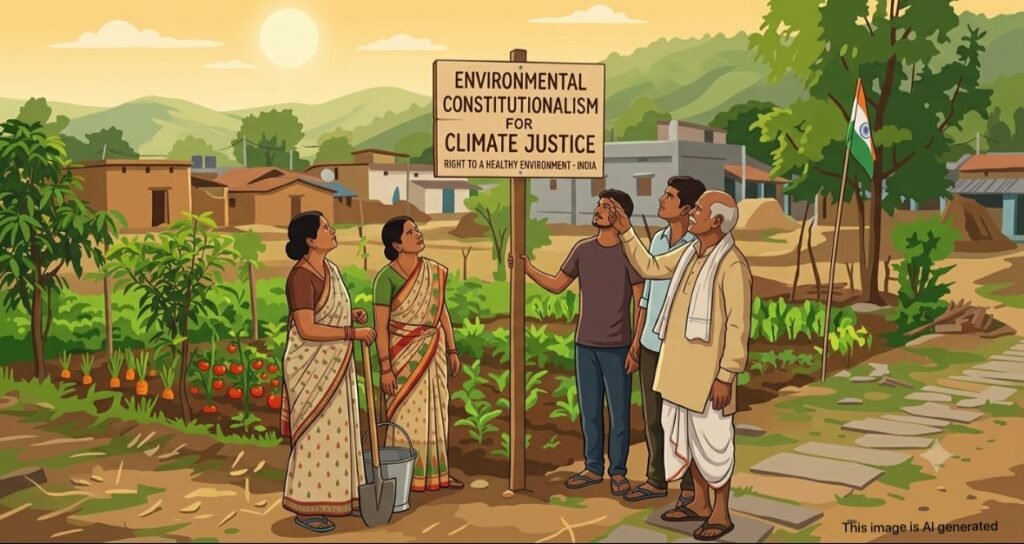
The fields of Climate Change and Constitutional Law are considered two of the most significant domains within the legal arena in relation to the twenty-first century. Indeed, India is one of the focal points of such challenges owing to its diverse environment, growing population, and status as one of the biggest contributors of greenhouse gases. Additionally, the article discusses the question of equity in climate policies, emphasizing that climate justice must focus on the needs of vulnerable populations and intergenerational equity.
Keywords
Climate Justice, Environmental Constitutionalism, Right to Healthy Environment, Sustainable Development, Climate Change Litigation.
I. Introduction
The impact of climate change is no longer an abstract issue of science; it is something that millions of Indians living on the bounty of the monsoons, the coasts, and the Himalayan glaciers experience as a reality. Law must now take notice of the challenge posed by climate change. Environmental constitutionalism is defined as the infusion of environmental values into the constitutional structure and its enforcement by the courts. This concept has always been an important element of the Indian legislative process. Climate justice poses unique dilemmas for the law and requires a new approach to constitutional law.
India stands out uniquely in global climate politics due to its peculiar situation in the matter of climate change. Being the third largest emitter of greenhouse gases in absolute terms while maintaining relatively low per capita emissions compared to many developed nations. In terms of internal legislation, although the Constitution of India was adopted in 1950, it has undergone judicial reinterpretation in order to cope with the emerging environmental issues. In particular, the Supreme Court of India has made a series of groundbreaking rulings in which the right to a healthy environment was considered part of the right to life provided in Article 21 of the Indian Constitution.
II. Constitutional Foundations of Environmental Protection
The structure of environmental protection under the Constitution of India is made up of three main aspects. First, Article 21 of the Indian Constitution, which provides for the right to life and personal liberty, was judicially interpreted to confer the right to a clean and wholesome environment. In Subhash Kumar v. State of Bihar, the Supreme Court decided that the right to live is a part of life and liberty guaranteed to the citizens by the Article 21 of the Constitution and it includes the right of enjoying pollution-free water and air for full enjoyment of life.
Second, Article 48A of the Indian Constitution, which became a directive principle of state policy through the 42nd Constitutional Amendment in 1976, provides that the State shall endeavor to protect and improve the environment and to safeguard the forests and wildlife of the country. Directive principles are, however, non-justiciable in nature; they cannot be enforced in a court of law but are to be taken into consideration while interpreting any provision of justiciable nature. Finally, Article 51A(g) places a duty on all citizens to protect and improve the natural environment, including forests, lakes, rivers and wildlife, and to have compassion for living creatures.
Collectively, these constitutional provisions helped to build a strong tradition of environmental constitutional law. National Green Tribunal Act 2010 was passed, which led to the establishment of a dedicated court to deal with environmental disputes. It is a dedicated court that deals with all civil matters concerning environmental protection and conservation, which include forests and other natural resources as well.
Historical Foundations of Environmental Constitutionalism
The evolution of environmental constitutionalism in India cannot be understood without reference to major international environmental milestones. The Stockholm Conference on the Human Environment, 1972, marked the first global recognition of environmental protection as a matter of international concern. The influence of the Stockholm Declaration is evident in India’s constitutional development, particularly through the 42nd Constitutional Amendment Act, 1976, which introduced Article 48A directing the State to protect and improve the environment and Article 51A(g), imposing a fundamental duty upon citizens to safeguard natural resources. Subsequently, the Rio Earth Summit, 1992, further strengthened global commitment towards sustainable development and introduced principles such as sustainable development, precautionary action, and public participation. These principles have significantly shaped Indian environmental jurisprudence and continue to guide judicial interpretation of environmental rights under the Constitution.
III. Judicial Activism and Evolution of Environmental Jurisprudence
The Supreme Court of India has made exceptional contributions to developing environmental jurisprudence through Public Interest Litigation (PIL). The liberalization of locus standi norms in the 1980s advocated by Justices P.N. Bhagwati and V.R. Krishna Iyer allowed the common man to use constitutional remedies and opened up new vistas for civil societies and citizens to file PIL before the judiciary in matters of national concern. The judgment of M.C. Mehta v. Union of India did not confine itself to merely dealing with the issue of pollution caused by the factories located on the banks of river Ganga; rather, it developed precautionary principle and polluter pays principle.
The principle of sustainable development was introduced to the Indian legal system through the landmark case of Vellore Citizens Welfare Forum v. Union of India where it was argued that the old concept where development and ecology were considered to be mutually exclusive cannot be allowed anymore and sustainable development should take its place. Since then, the sustainable development principle has been employed in many cases dealing with forests, wetlands, coastal areas, and air quality in cities. Climate change, which requires major changes to how we utilize energy resources and use lands, serves as a serious test for sustainable development principles.
Expansion of Environmental Principles through Judicial Decisions
Indian environmental jurisprudence has been considerably enriched through landmark judicial pronouncements. In M.C. Mehta v. Kamal Nath, the Supreme Court formally adopted the Public Trust Doctrine, holding that natural resources such as rivers, forests, and lakes are held by the State in trust for the public and cannot be transferred or exploited in a manner detrimental to public interest. Similarly, in Indian Council for Enviro-Legal Action v. Union of India, the Court reinforced the Polluter Pays Principle by holding that industries responsible for environmental degradation must bear the costs of remediation and restoration. These decisions established the foundation for modern environmental governance in India and strengthened the constitutional commitment to sustainable development and ecological protection.
Recently, The Court observed that protection from the adverse effects of climate change is closely connected with the guarantees under Articles 14 and 21. As the Supreme Court stated, the climate change problem is special in that it produces diffuse and extended harm that primarily affects people who contributed little, if at all, to it. It is a significant step forward in the direction of climate change accountability in Indian environmental law and constitutionalism.
IV. Climate Justice: Aspects and Constitutionality
Forest Conservation and Climate Governance
The contribution of the judiciary to environmental constitutionalism is also reflected in the continuing forest conservation litigation initiated in T.N. Godavarman Thirumulpad v. Union of India. Through a series of continuing mandamus orders, the Supreme Court expanded the interpretation of the term “forest,” strengthened regulatory oversight over forest diversion, and emphasized the ecological significance of forests in maintaining environmental balance. The case has played a critical role in preserving carbon sinks and biodiversity, both of which are essential components of climate change mitigation strategies. Consequently, the Godavarman jurisprudence represents an important link between forest governance, constitutional environmental protection, and contemporary climate justice concerns.
Climate justice is a multi-faceted term which includes aspects of distributive justice (equal sharing of the burdens and benefits associated with climate change), procedural justice (inclusion of the affected communities in the process of decision making), and recognition justice (recognition of the specific vulnerabilities of marginalized communities). In the Indian scenario, the demand for climate justice needs to be examined keeping in mind the highly stratified society. Communities such as the Adivasi who rely upon forest ecosystems for sustenance, fishing communities living along the coasts and vulnerable to rising sea levels, mountain dwellers at risk of flooding due to outburst of glacial lakes, and urban poor residing in flood and heat-stressed areas are examples of such marginalized communities.
The Constitution of India has a provision for equality (Article 14), non-discrimination (Article 15), and also provides rights for Scheduled Tribes (Articles 244, 342). The Forest Rights Act, 2006, which grants rights of the forest-dwelling tribal communities over their habitats in forest areas, becomes significant in light of climate-induced displacement and contribution of the forests in mitigation and adaptation of climate change. Constitutional rights, when enforced judicially against the state-sanctioned encroachments in the guise of development projects, including renewable energy projects, will form another important issue in climate change litigation.
Intergenerational equity represents one of the most convincing aspects of climate change justice. The Supreme Court of India, in many cases, has upheld the principle that the present generation holds the natural environment for future generations in trust. The public trust doctrine, as enunciated in M.C. Mehta vs Kamal Nath, imposes positive duties on the State to ensure no environmental degradation takes place, which would adversely impact the resources available to future generations of citizens. In this manner, the constitution also places duties on the State towards ensuring climate actions and decarbonisation within the 1.5° warming limit.
V. The Legal Framework and Its Limitations
In this regard, the laws that exist in India in dealing with the problem of climate change are very disjointed and are based on several pieces of legislation. For example, these laws include The Environment Protection Act, 1986, The Air (Prevention and Control of Pollution) Act, 1981, and The Energy Conservation Act, 2001, that was amended in 2022 to include provisions of carbon markets. However, the main policy framework used by India in response to climate problems includes the National Action Plan on Climate Change, introduced in 2008, along with its derivatives – The State Action Plans on Climate Change.
There are nevertheless major shortcomings with regard to this legal regime. There is no overarching piece of legislation providing legally enforceable reduction targets, accountability measures, or even climate-related community rights. Without such legislation, climate mandates can be pursued mostly by virtue of executive policies, which are inherently more politically flexible and difficult to challenge in court compared to statutory responsibilities. Environmental advocacy organizations and academics alike have insisted on the need to adopt a Climate Change Act along the lines of the UK Climate Change Act 2008.
VI. Role of India in International Climate Law
The participation of India in international climate law is guided by the concept of Common But Differentiated Responsibilities and Respective Capabilities (CBDR-RC), recognized by the UN Framework Convention on Climate Change (UNFCCC) and re-affirmed in the Paris Agreement. India has repeatedly held that the developed countries, owing to their historical responsibility for the lion’s share of emissions in the atmosphere, are more responsible and have a larger duty to take action and provide financial and technological assistance to developing countries. There is merit in this stance on both legal and ethical grounds, because CBDR-RC principles find relevance under international law.
The International Court of Justice Advisory Opinion on climate change that has been sought by the United Nations General Assembly for 2023 would offer valuable insight from a legal perspective on what states can be required to do under international law in relation to climate action and the rights of the populations affected. The Indian courts could make use of this advisory opinion in any climate change lawsuits in the future, since they have always been known to incorporate principles of international law into their constitution.
VII. Conclusion
Doctrinally, India’s environmental constitutionalism has become extremely sophisticated thanks to several decades of judicial innovation. The incorporation of the right to climate in India’s constitutional framework is a very important step forward, indeed. Still, the doctrinal changes alone are not enough to ensure that constitutional promises will become realities for India’s most vulnerable people affected by climate change.
To effectively deliver climate justice in India, one needs to achieve convergence between judicial enforcement of constitutional rights, climate-specific legislation, participatory governance frameworks, and climate financing from abroad. It is crucial to continue holding India’s executive accountable to both its constitutional responsibilities and its international commitments via judicial means. It is equally important to introduce climate legislation by means of parliamentary actions in order to protect India’s most vulnerable people from the impact of climate change.