This article is written by Sujal Tyagi, Vivekananda Institute of Professional Studies (VIPS), New Delhi.
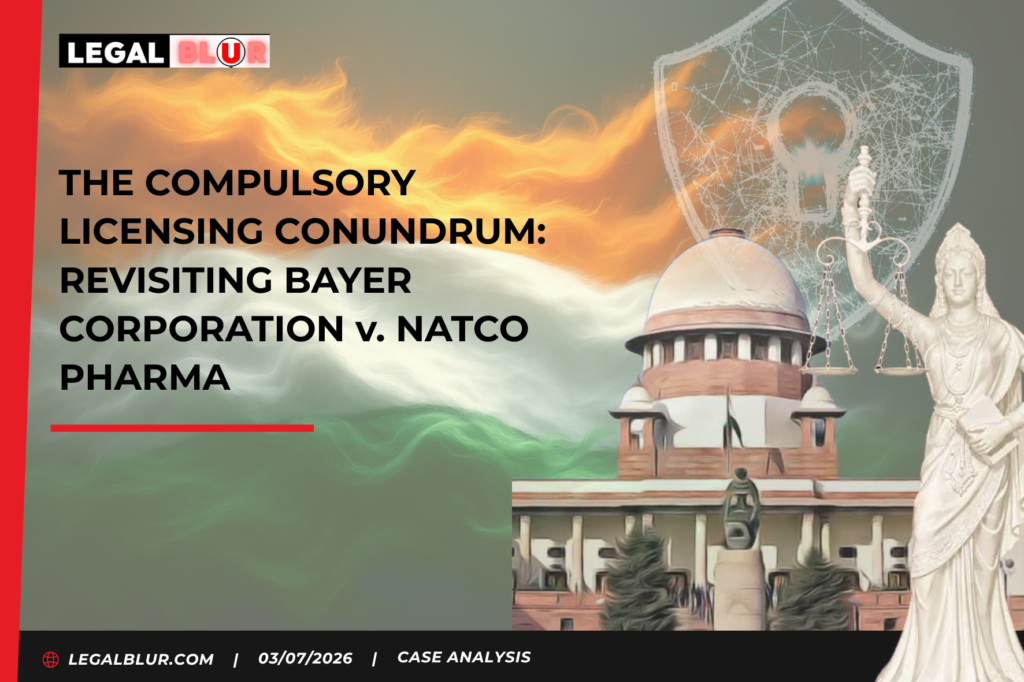
Compulsory licensing fits uneasily into the patent framework of India. It is a situation where the State intervenes and removes from the patent the exclusivity it normally provides, allowing others to manufacture and sell patented products without asking the patent holder, provided it allows certain conditions of law to be met and requires the payment of royalties. The rationale for such an extraordinary remedy lies in balancing patent rights with public interest, particularly access to essential medicines, consistent with India’s obligations under the TRIPS Agreement, the Doha Declaration on Public Health, and the constitutional commitment to protecting life and health under Article 21. Section 84 of Patents Act, 1970 provides for this balance by stating that the Controller of Patents could grant a compulsory licence three years after the grant of a patent if the applicant can prove that the reasonable requirements of the public have not been met, the patented invention is not available to the public at a reasonably affordable price, or the invention is not being worked in the territory of India.
This is the watershed case in this area of law as India has not invoked Section 84 to issue a compulsory licence in any other case since Bayer Corporation v Natco Pharma Ltd. It challenged, in a competitive setting for the first time, the application and interpretation of the three statutory conditions set out in Section 84, in relation to a drug used to treat advanced kidney and liver cancer, Nexavar (sorafenib tosylate). The order has continued to influence the public health and IP protection debate and will continue to play a role in the future of the compulsory licensing discussion in India.
Background of the Dispute
In 2008, Bayer Corporation’s sorafenib tosylate (Nexavar) patent was granted to Bayer in India. The price of the drug was around Rs. Beyond the capacity of most patients who need it, the price for a month’s course was 2,80,000. In 2010, the generic manufacturer Natco Pharma applied for a voluntary licence from Bayer to make a generic at a lower price. Bayer refused, and Natco requested a compulsory licence from the Controller of Patents under Section 84 on the basis that none of the three conditions of compulsory licensing was fulfilled.
Case Laws and Judicial Reasoning
In March 2012, the Controller of Patents approved a compulsory licence for the sale of the generic version of sorafenib tosylate by Indian company Natco, which could cost only Rs. A course costs 8,800, which is a small fraction against a “royalty” of six per cent of “net sales” for a month, at a price that Bayer charges. The Controller determined that all three of the conditions in Section 84(1) had been met. With the drug only reaching a small percentage of patients in need, Bayer’s own sales data has revealed this on reasonable requirements of the public. With respect to affordability, the price charged might not be deemed to be “reasonably affordable” when compared with the typical per capita income and the out-of-pocket expenditure on healthcare in India. When the Controller was considering local working, he was not satisfied that mere importation was sufficient, as manufacturing in the country to a reasonable extent was required, as later determined in some subsequent case law.
Bayer approached the Intellectual Property Appellate Board (IPAB) which in 2013 maintained the Controller’s order to a large extent with some changes, such as raising the royalty rate from 6 per cent to 7 per cent payable to Bayer. The IPAB concluded that Bayer had not made the drug available to the public at a reasonably affordable price, and that the reasonable requirements of the public had not been met, but was more cautious about the requirement for working, implying that importation under appropriate circumstances may meet the working requirement.
Bayer subsequently filed a writ petition in the Bombay High Court which in 2014 rejected the petition and upheld the compulsory licence. The HC held that patent rights are not absolute rights, but are limited by the public interest in the Patents Act; and Section 84 is a fair and reasonable way to achieve a balance between innovation incentives and access to medicine. The Supreme Court then did not allow Bayer’s special leave petition against the compulsory licence and thus, the lower fora’s decisions took final form.
Since Bayer v Natco, precedent has been applied in later proceedings such as BDR Pharmaceuticals’ application for a compulsory licence on Bristol-Myers Squibb’s dasatinib (Sprycel), in which the Controller found that there was no prima facie case made out, highlighting that the precedent does not automatically lead to liberal grants and that it is for each applicant to establish his or her own case.
Analysis: Balancing Innovation and Access
Bayer v. Natco series of rulings is an example of the structural conflict present in patent law in developing economies. However, on the other hand, strong patent protection is key to encourage the high costs of research and development needed in the discovery of a new drug; otherwise, the risk is dismissing concepts from innovator companies from the Indian market without considering the importance of the research. However, India’s duties under Article 21 of the Constitution, which has been interpreted as encompassing a right to health, and its obligations under the Doha Declaration on the TRIPS Agreement and Public Health make it clear that the role of intellectual property is to be subordinate to the public health demands, in certain clear-cut situations. The application of section 84 in Bayer v. Natco is an implementation of TRIPS flexibilities as opposed to a denial of India’s international obligations.
The critics state that compulsory licensing would stop multinational pharmaceutical companies from providing patented drugs in India, if they were to be misused.The critics say that if used liberally, compulsory licensing would discourage the provision of patented drugs by the multinational pharmaceutical companies in India, hence defeating the access objective of compulsory licensing. The statutory conditions in Section 84 are rigorous, and are designed to ensure that the demand and unaffordability are ongoing for at least three years after the grants are issued, which would make it extremely hard to be used routinely for non-innovator patents, opponents argue. The latter view is supported by the fact that India has only granted one compulsory licence since the amendment of 2005, in this case, in Bayer v. Natco, where the facts were compelling.
Conclusion
Bayer Corporation v. Natco Pharma remains the defining precedent on compulsory licensing in Indian patent law. It demonstrated that Section 84 is not a dead letter but an enforceable safeguard that can be invoked when a patentee’s pricing and supply practices leave a patented medicine beyond the reach of the public it is meant to serve. At the same time, the subsequent caution shown by the Controller in other applications indicates that Indian authorities are alive to the need to preserve the integrity of the patent system and to avoid converting compulsory licensing into a routine alternative to voluntary licensing or government procurement. The conundrum, ultimately, is not resolved by choosing decisively between innovation and access, but by maintaining a calibrated, fact-specific threshold, of the kind articulated in Bayer v. Natco, that allows compulsory licensing to function as a targeted corrective rather than a general override of patent rights.
Frequently Asked Questions
1. What is a compulsory licence under Indian patent law?
A compulsory licence is a statutory authorisation, granted under Section 84 of the Patents Act, 1970, permitting a person other than the patentee to manufacture, use, or sell a patented invention without the patentee’s consent, upon payment of royalty, once three years have elapsed from the grant of the patent and the prescribed statutory conditions are met.
2. What were the grounds on which the compulsory licence was granted in Bayer v. Natco?
The Controller of Patents found that Bayer had failed to satisfy the reasonable requirements of the public with respect to Nexavar, had not made the drug available at a reasonably affordable price, and had not sufficiently worked the patented invention within India, thereby fulfilling all three independent conditions under Section 84(1).
3. Has India granted any compulsory licence since Bayer v. Natco?
No. The Bayer v. Natco licence, granted in 2012, remains the only compulsory licence granted in India to date. Subsequent applications, such as the one concerning BDR Pharmaceuticals and dasatinib, have not succeeded, indicating that the threshold set in Bayer v. Natco has been applied with considerable caution.
4. Is the grant of a compulsory licence inconsistent with India’s obligations under TRIPS?
No. The TRIPS Agreement, as clarified by the Doha Declaration on TRIPS and Public Health, expressly permits member states to grant compulsory licences on grounds including public health necessity, and Section 84 of the Patents Act is framed to operate within these permitted flexibilities.
5. What is the broader significance of the Bayer v. Natco decision?
Beyond its immediate facts, the decision established the interpretive framework for Section 84, clarified that patent rights in India are subject to public interest limitations, and continues to serve as the principal reference point in any discussion of the balance between pharmaceutical innovation incentives and access to affordable medicine.