
This article is written by Shylet Nyamupinga, MVN University.
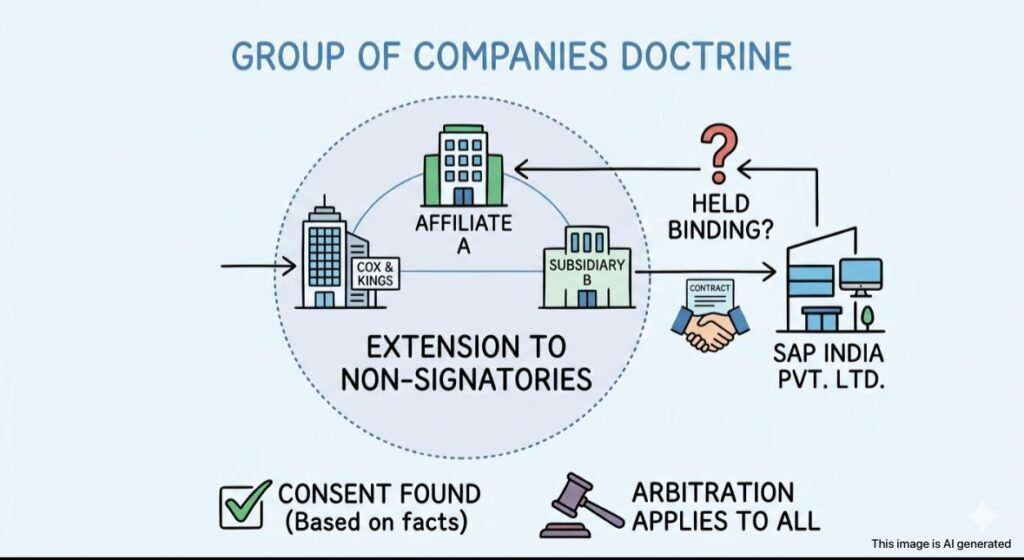
Arbitration has emerged as confidentiality of the most preferred mechanisms for resolving commercial disputes due to its efficiency , and party autonomy. One of the foundational principles governing arbitration is that only parties who have expressly consented to an arbitration agreement can be compelled to arbitrate. However, modern business transactions are rarely conducted through a single corporate entity. Multinational corporations often operate through complex groups of companies, subsidiaries, affiliates, and holding structures, making the traditional understanding of consent increasingly inadequate.
The Supreme Court of India addressed this challenge in Cox and Kings Ltd. v. SAP India Pvt. Ltd. (2023), a landmark judgment that revisited the controversial Group of Companies (GoC) Doctrine. The decision clarified whether non-signatory entities belonging to the same corporate group could be bound by an arbitration agreement despite not being formal signatories to the contract.
The judgment is significant because it attempts to strike a balance between respecting party consent and acknowledging the commercial realities of modern corporate transactions. By examining the scope and validity of the Group of Companies Doctrine, the Court reshaped the legal landscape of arbitration in India and strengthened its position as an arbitration-friendly jurisdiction.
Background of the Case
The dispute arose from a business arrangement involving Cox and Kings Ltd. and SAP India Pvt. Ltd. Certain agreements between the parties contained arbitration clauses. During the proceedings, questions emerged regarding whether entities that had not formally signed the arbitration agreement could nevertheless be compelled to participate in arbitration because of their involvement in the transaction.
The issue was not entirely new. Earlier decisions, particularly Chloro Controls India Pvt. Ltd. v. Severn Trent Water Purification Inc. (2013), had recognized the Group of Companies Doctrine. However, doubts persisted regarding its legal basis and compatibility with the principle of consent under Indian arbitration law.
Consequently, the matter was referred to a Constitution Bench of the Supreme Court to determine the validity and scope of the doctrine.
The Core Legal Issue
The primary question before the Court was:
Can a non-signatory company be bound by an arbitration agreement merely because it belongs to the same corporate group as a signatory company?
This issue required the Court to reconcile two competing principles:
- The doctrine of separate corporate personality.
- The practical reality that commercial transactions often involve multiple entities acting together as a single economic unit.
The Court had to determine whether consent to arbitration could be inferred from conduct and participation in a transaction rather than from a signature alone.
The Group of Companies Doctrine Explained
The Group of Companies Doctrine originated in international arbitration jurisprudence. The doctrine permits an arbitration agreement to bind a non-signatory company when the circumstances demonstrate a mutual intention of the parties to include that entity within the scope of the agreement.
The doctrine does not automatically bind every company within a corporate group. Instead, tribunals examine factors such as:
- Participation in negotiation of the contract.
- Involvement in performance of contractual obligations.
- Commonality of subject matter.
- Relationship between signatory and non-signatory entities.
- Conduct indicating an intention to be bound.
The doctrine seeks to prevent parties from avoiding arbitration through technical reliance on corporate structures.
The Supreme Court’s Analysis
The Constitution Bench undertook an extensive examination of arbitration law, contract principles, and international practices.
The Court rejected the argument that only a signatory can ever be bound by an arbitration agreement. It observed that Indian contract law recognizes various forms of consent that may be inferred from conduct and surrounding circumstances.
The Court emphasized that arbitration is fundamentally based on consent, but consent need not always be expressed through a signature. Commercial realities often require courts to examine the substance of a transaction rather than merely its form.
Importantly, the Court clarified that the Group of Companies Doctrine is not an independent legal principle capable of overriding consent. Rather, it serves as a tool for determining whether consent exists in a particular factual scenario.
The judgment therefore preserved the centrality of consent while allowing courts to look beyond formal contractual documentation.
Key Findings of the Court
1. Validity of the Group of Companies Doctrine
The Supreme Court upheld the validity of the doctrine within Indian arbitration law.
The Court held that the doctrine is not inconsistent with the Arbitration and Conciliation Act, 1996. It may be applied where evidence demonstrates that a non-signatory intended to be bound by the arbitration agreement.
2. Consent Remains Fundamental
The Court reaffirmed that consent remains the cornerstone of arbitration.
A non-signatory cannot be compelled to arbitrate solely because it belongs to the same corporate group. Courts must identify evidence indicating actual or implied consent.
3. Signatures Are Not the Sole Evidence of Consent
The judgment recognized that commercial relationships often extend beyond written contracts.Participation in negotiations, execution of obligations, and involvement in the underlying transaction may collectively establish consent.
4. Corporate Structure Is Insufficient Alone
The Court expressly stated that membership in a corporate group is not enough to invoke the doctrine.
There must be additional evidence linking the non-signatory to the arbitration agreement.
Case Laws Considered
1. Chloro Controls India Pvt. Ltd. v. Severn Trent Water Purification Inc. (2013)
This case first recognized the Group of Companies Doctrine in India. The Supreme Court allowed arbitration involving non-signatory parties where the agreements formed part of a composite transaction.
The Cox and Kings judgment revisited and clarified the principles established in Chloro Controls.
2. Cheran Properties Ltd. v. Kasturi and Sons Ltd. (2018)
The Court recognized that arbitration awards could, under certain circumstances, affect non-signatory entities connected to the transaction.
This decision demonstrated a gradual expansion of arbitration’s reach beyond formal signatories.
3. MTNL v. Canara Bank (2020)
The Supreme Court applied the Group of Companies Doctrine and emphasized the importance of examining the conduct of parties.
The Cox and Kings judgment built upon and refined this approach.
Critical Analysis
The judgment is widely regarded as a progressive step for Indian arbitration. It acknowledges that modern corporate transactions are rarely confined to a single legal entity. By allowing courts to examine commercial realities, the decision reduces opportunities for strategic avoidance of arbitration.
However, the ruling also raises concerns. The concept of implied consent may introduce uncertainty because different courts may interpret factual circumstances differently. Businesses may find it difficult to predict whether a non-signatory entity will ultimately be bound by an arbitration agreement.
Additionally, the doctrine creates a delicate tension with the principle of separate corporate personality. Excessive reliance on commercial realities could undermine the legal distinction between affiliated companies.
Nevertheless, the Court’s insistence that consent remains central acts as an important safeguard. By requiring clear evidence of participation and intention, the judgment seeks to prevent arbitrary extension of arbitration agreements.
From a policy perspective, the decision enhances India’s credibility as a pro-arbitration jurisdiction. It aligns Indian law with evolving international arbitration practices while retaining a strong contractual foundation.
Impact on Indian Arbitration
The decision has several important implications:
- Greater flexibility in dealing with multi-party commercial disputes.
- Reduced risk of parallel proceedings involving related entities.
- Increased emphasis on conduct and transactional involvement.
- Stronger alignment with international arbitration standards.
- Enhanced attractiveness of India as a destination for commercial dispute resolution.
Businesses must now carefully assess the role of affiliated entities in contractual negotiations and performance because such involvement may influence future arbitration proceedings.
Conclusion
The Supreme Court’s decision in Cox and Kings Ltd. v. SAP India Pvt. Ltd. (2023) represents a significant development in Indian arbitration law. By validating the Group of Companies Doctrine while reaffirming the centrality of consent, the Court successfully balanced legal theory with commercial reality.
The judgment recognizes that modern business structures cannot always be understood through rigid contractual formalities. At the same time, it prevents indiscriminate application of the doctrine by insisting upon evidence of actual or implied consent.
As arbitration continues to evolve, the decision will likely serve as a guiding precedent for courts, arbitral tribunals, and commercial entities navigating complex corporate relationships. It marks an important step toward a more pragmatic and commercially responsive arbitration framework in India.
Frequently Asked Questions
1. What is the Group of Companies Doctrine?
The Group of Companies Doctrine allows a non-signatory company within a corporate group to be bound by an arbitration agreement when evidence shows an intention to participate in the contractual relationship.
2. What was the main issue in Cox and Kings v. SAP India?
The principal issue was whether non-signatory entities could be compelled to arbitrate disputes under an arbitration agreement signed by another company within the same corporate group.
3. Did the Supreme Court approve the doctrine?
Yes. The Constitution Bench upheld the validity of the doctrine but clarified that it must be based on evidence of consent rather than mere group membership.
4. Why is judgment important?
The judgment addresses the realities of modern corporate transactions and provides guidance on how arbitration agreements may extend to non-signatory entities.
5. Does belonging to the same corporate group automatically bind a company to arbitration?
No. The Supreme Court clearly stated that group membership alone is insufficient. Courts must identify evidence demonstrating actual or implied consent.