This article is written by Sujal Tyagi, Vivekananda Institute of Professional Studies (VIPS), New Delhi.
Abstract
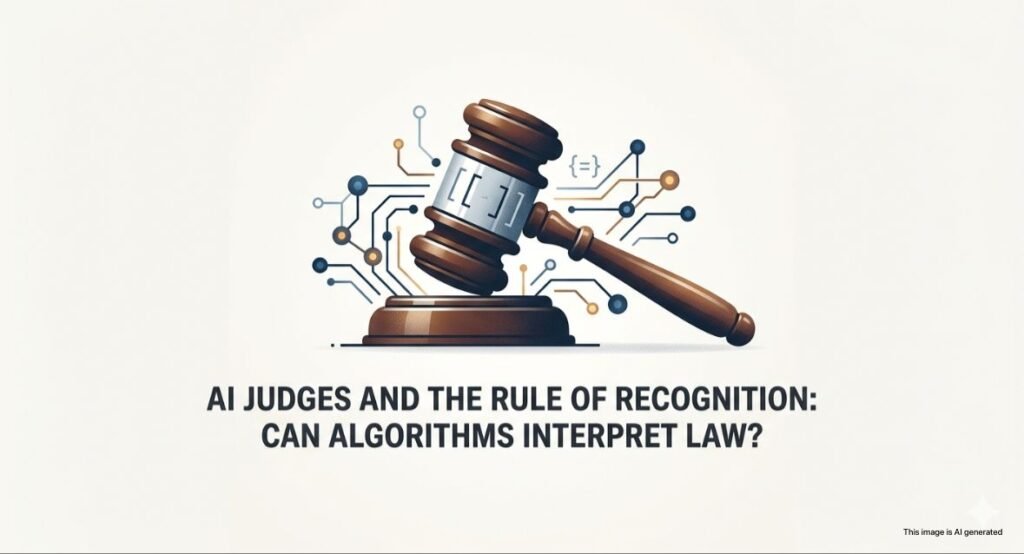
The growing deployment of Artificial Intelligence in judicial processes raises a fundamental jurisprudential question: can algorithms interpret law? This article examines that question through H.L.A. Hart’s Rule of Recognition, the social criterion by which valid legal rules are identified within a legal system. Drawing on domestic and international case laws and India’s constitutional framework, it argues that while AI can assist adjudication, it cannot replace the normative, institutionally embedded judgment that legal interpretation demands.
Keywords: Artificial Intelligence, Rule of Recognition, Judicial Interpretation, Algorithmic Adjudication, Legal Positivism.
Introduction
Artificial intelligence has moved from the margins of legal theory to the centre of judicial practice. Courts worldwide are deploying AI-driven tools for case management, sentencing guidance, bail assessments, and litigation analytics. In India, the SUPACE system, the Supreme Court Portal for Assistance in Courts’ Efficiency, represents the judiciary’s first major institutional embrace of AI. Globally, systems such as COMPAS in the United States and Prometea in Argentina have been used in consequential legal determinations.
Beneath this operational convenience lies a profound jurisprudential question. H.L.A. Hart, in The Concept of Law (1961), articulated the Rule of Recognition as the master criterion of legal validity, a social rule accepted by legal officials that demarcates valid law from mere social norms. Legal interpretation, Hart argued, is not mechanical rule-following; it involves an internal point of view, normative commitment, and discretionary judgment in hard cases. Can an AI system, which processes rules as data rather than accepting them as binding standards, ever genuinely interpret law? This article argues that it cannot, and that AI must remain a tool that augments rather than supplants human adjudication.
The Rule Of Recognition And Algorithmic Law
Hart’s Rule of Recognition is the backbone of legal positivism. It identifies what counts as law in a given system not by reference to moral content, but by reference to official acceptance and social practice. In India, it manifests as the supremacy of the Constitution, followed by parliamentary statutes, delegated legislation, and judicial precedent. An AI trained on these sources can identify this hierarchy mechanically, but Hart’s rule demands more than identification; it demands acceptance.
Officials who apply the Rule of Recognition do so from an internal point of view: they regard it as a standard of conduct, not merely a pattern to be followed. An AI system operates externally; it recognises rules as inputs, not as normative commitments. It has no stake in the legal system’s legitimacy. Moreover, Hart acknowledged the “open texture” of legal rules: zones of indeterminacy where no prior rule governs, and where a judge must exercise genuine discretion. Ronald Dworkin further argued that such hard cases demand reasoning from legal principles, not just rules. Both accounts require a capacity for moral reasoning that algorithms fundamentally lack.
Case Laws
A. State Of Maharashtra V. Praful Desai, (2003) 4 SCC 601
The Supreme Court held that evidence may be recorded via video conferencing, affirming that technology may be integrated into judicial proceedings provided natural justice is not compromised. This sets the baseline constitutional standard any AI adjudicatory tool must meet; it must not undermine the right to a fair hearing or the right to challenge evidence.
B. Loomis V. Wisconsin, 881 N.W.2D 749 (Wis. 2016)
The Wisconsin Supreme Court upheld the use of the COMPAS risk-assessment algorithm in sentencing but imposed a critical limitation: no sentence may be based solely on an algorithmic score, and the defendant must have a meaningful opportunity to challenge it. The case exposed the danger of proprietary algorithmic opacity. COMPAS’s methodology was a trade secret, raising serious due process concerns that remain unresolved in most jurisdictions.
C. Justice K.S. Puttaswamy V. Union Of India, (2017) 10 SCC 1
The nine-judge bench unanimously recognised the right to privacy as a fundamental right under Article 21. AI adjudication systems that aggregate criminal records, behavioural profiles, and socio-economic data to generate risk scores must comply with principles of data minimisation and purpose limitation that flow directly from this landmark ruling.
D. Vivek Narayan Sharma V. Union Of India, (2023) 4 SCC 1
In the demonetisation case, the Supreme Court engaged in a sophisticated proportionality analysis weighing competing constitutional values and the reasonableness of executive action. This exemplifies the kind of contextual, value-laden reasoning AI cannot perform. Adjudication of this character demands wisdom and institutional authority, not computation.
Constitutional Dimensions In India
The Constitution vests judicial power in the Supreme Court and High Courts under Articles 32, 226, and 136. Judicial review, the authority to invalidate unconstitutional legislation or executive action, is an inherently normative function that cannot be delegated to an algorithm. Articles 14 and 21 further impose substantive and procedural requirements on every state action affecting individual rights. An AI system that produces opaque outcomes, perpetuates bias embedded in training data, or cannot be meaningfully challenged would violate these guarantees. India’s Digital Personal Data Protection Act, 2023, and NITI Aayog’s Responsible AI framework both emphasise explainability and accountability values, constitutionally mandated in any judicial setting.
Conclusion
AI offers genuine benefits to the Indian judiciary: faster disposal, reduced backlogs, and greater consistency in routine matters. These are not trivial gains. However, the Rule of Recognition reminds us that law is a social institution sustained by normative commitment and public legitimacy qualities that no algorithm can authentically possess. AI may process law, but it cannot accept law in the sense Hart identified as essential to legal officialdom. The future lies not in algorithmic judges, but in AI as a tool that sharpens human judgment without supplanting it. Regulatory frameworks must mandate transparency, prohibit sole reliance on algorithmic outputs in consequential decisions, and preserve adjudicative authority exclusively in constitutionally appointed human judges.
Frequently Asked Questions
1. What is the Rule of Recognition?
H.L.A. Hart’s Rule of Recognition is the ultimate criterion of legal validity in a legal system, a social rule accepted by legal officials specifying which rules count as law. In India, it recognises the Constitution as supreme, followed by parliamentary statutes and judicial precedent.
2. Is AI currently used in Indian courts?
Yes. The Supreme Court’s SUPACE system uses AI to process case files and retrieve legal information to assist judges. It is designed as an assistive tool; final adjudicative authority remains with human judges.
3. What are the key legal risks of AI adjudication?
The primary risks include: violation of natural justice; perpetuation of historical bias in training data; lack of algorithmic transparency; privacy violations from mass data processing; and constitutional concerns about delegating judicial power to non-human entities.
4. What regulatory safeguards should govern AI in courts?
Any framework must mandate explainability, prohibit sole reliance on algorithmic outputs, require independent auditing for bias, ensure compliance with data protection law, and confirm that judicial authority vests exclusively in constitutionally appointed human judges.
References
Ronald Dworkin, Law’s Empire (HUP, 1986): https://www.hup.harvard.edu/catalog.php?isbn=9780674518360
Supreme Court of India, SUPACE: https://main.sci.gov.in/supace
Digital Personal Data Protection Act, 2023: https://www.meity.gov.in/data-protection-framework
NITI Aayog, Responsible AI for All (2021): https:ww.niti.gov.in/sites/default/files/2021-02/Responsible-AI-22022021.pdf
Brainware University v. State of West Bengal (2023): https://indiankanoon.org/search/?formInput=Brainware+University+2023