This article is written by Rafiah Mairaj, Lloyd Law College. This article undertakes a critical appraisal of the constitutional soundness of the Amendment Act. It surveys the trajectory of transgender rights jurisprudence in India, examines the pivotal judicial decisions in this area, and assesses whether the legislative changes introduced by the Amendment Act can survive scrutiny against the fundamental rights guarantees enshrined in the Constitution of India.
I. Introduction
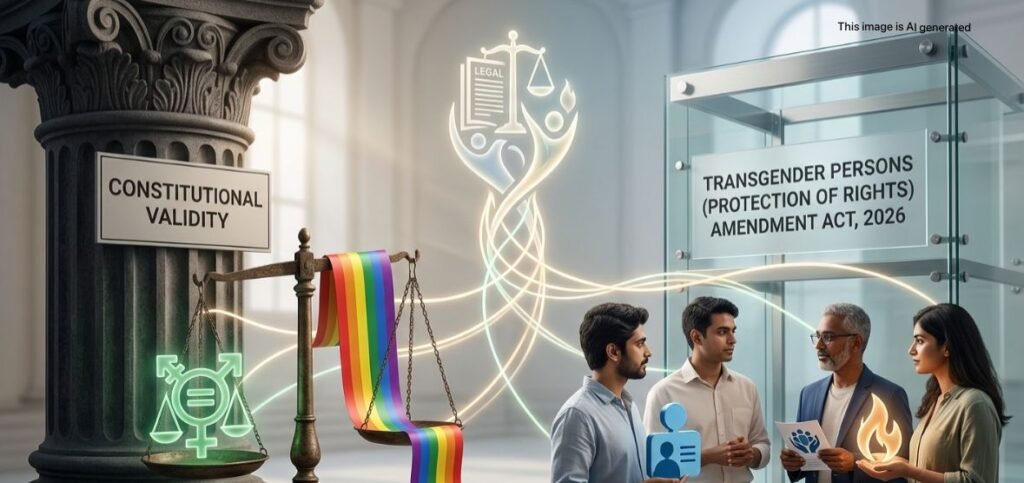
The Transgender Persons (Protection of Rights) Amendment Act, 2026 (henceforth, “the Amendment Act”) is one of the most controversial pieces of legislation recently passed by the Indian Parliament, which raises constitutional questions. The Bill was introduced in the Lok Sabha before the Assembly on 13th March, 2026, by Union Minister for Social Justice and Empowerment, Virendra Kumar Khatik. It was passed by the Lok Sabha on 24 March 2026 and the Rajya Sabha the next day and was assented to by the President on 30 March 2026. The Amendment Act reiterates the legal framework meticulously crafted by the Supreme Court of India through a series of incremental decisions over the past few years regarding the inclusion and rights of transgender individuals.
This is a significant statutory change. The Amendment Act changes the definition of ‘transgender person’ in the 2019 parent legislation and eliminates the right to self-perceived gender identity previously available in the legislation and replaces it with a system of medical certification and governmental verification. This change has been criticised by activists, academic legal commentators and the LGBTQIA+ community for being a step back from the rights that were solemnly declared in the Supreme Court’s ruling in National Legal Services Authority v. Union of India (2014), also known as the NALSA judgment.
The real legal fight against the Amendment Act has begun. On 24 April 2026, prominent transgender rights activist Laxmi Narayan Tripathi filed a petition before the Supreme Court asking for the invalidation of the Amendment Act because it violates Article 14 (Equality before law), Article 15 (Non-discrimination), Article 19 (Freedom of expression) and Article 21 (Right to life and Personal liberty) of the Constitution of India. On a significant occasion on 15 June 2026, the date of this article’s publication, the Supreme Court issued a stay on all parallel proceedings pending before the High Courts of Rajasthan, Karnataka, Kerala and Delhi that had taken up the question of the constitutionality of the Amendment Act. The Court also issued a notice on the Central Government’s transfer petition, which seeks consolidation of all such issues for hearing before it.
II. Legislative Background and Key Provisions
The Transgender Persons (Protection of Rights) Act, 2019, is also an enactment in response to the directions given in the NALSA judgment. It made formal recognition of transgender people, banned discrimination against them and established a procedure for issuing identity certificates. Yet the critics have continued to highlight that even the 2019 act failed to adequately uphold the NALSA mandate, primarily because the certification process was conducted in the name of self-identification but also involved a screening process through district magistrates and screening committees.
The 2026 Amendment Act intensifies these concerns considerably. Its most disputed provisions are as follows:
- Removal of self-perceived gender identity as a valid basis for recognition, replaced by mandatory certification from a designated medical authority.
- Revision of the definition of “transgender person” in terms that critics contend may exclude non-binary and genderqueer identities.
- Introduction of mandatory reporting requirements accompanied by penal consequences for non-compliance.
- Restrictions on gender-affirming medical interventions, including sex reassignment surgery, which petitioners argue are both medically essential and constitutionally protected.
Proponents of the Amendment Act contend that some form of medical verification is warranted to guard against the misappropriation of welfare benefits and reservations that are intended specifically for the genuinely marginalized transgender community. Supporters of the Amendment Act have argued that an entirely self-identification-based framework may create the possibility of misuse of welfare benefits and reservation entitlements. Petitioners respond that such concerns are speculative and cannot justify curtailing fundamental rights. Petitioners, however, argue that such fears are speculative, that no concrete evidence of systematic misuse has been placed on record, and that it is constitutionally impermissible to strip a community of its fundamental rights on the basis of a hypothetical risk.
III. Constitutional Grounds of Challenge
The constitutional challenge to the Amendment Act is primarily based on Articles 14, 15, 19, and 21 of the Constitution. Petitioners argue that mandatory medical certification violates the right to equality, undermines personal autonomy, restricts gender expression, and infringes dignity and privacy. The challenge therefore raises the broader question of whether Parliament can replace a judicially recognised right to self-identification with a system of State-controlled verification.
IV. Relevant Case Laws
A. National Legal Services Authority v. Union of India, (2014) 5 SCC 438
The most basic judicial power in this regard is the NALSA judgment. This judgment by the two-judge bench of Justice K.S. Radhakrishnan and Justice A.K. Sikri on 15 April 2014 is the foundation of constitutional safeguards for transgender people in India. It had the following major assets:
- Transgender individuals are considered a “Third Gender” under the Constitution and have the full spectrum of constitutional rights.
- The right to self-determination of gender identity and declaration of gender identity is a fundamental right protected by Article 21 (right to life and personal liberty) and Article 19(1) (freedom of expression).
- Gender identity is not linked to biological or chromosomal features, but rather to a psychological and personal identity and a person’s internal sense of gender.
- The right to privacy and dignity which is integral to Article 21 of the fundamental rights is violated if a transgender person is required to undergo any biological or medical test to be recognised.
The Court directed the Central and State Governments to treat transgender persons as socially and educationally backward classes for the purpose of extending reservations and other affirmative measures.
The Court reached these conclusions after consulting various international human rights instruments, such as the Yogyakarta Principles on the Application of International Human Rights Law in relation to Sexual Orientation and Gender Identity (2006), as well as comparative constitutional law from South Africa, the United States and the European Court of Human Rights. The NALSA judgment is a watershed in transformative constitutional adjudication and is still currently binding on all courts and authorities. The Amendment Act’s requirement for medical certification as a prerequisite to gender recognition is at odds with this precedent-setting decision.
B. Justice K.S. Puttaswamy (Retd.) v. Union of India, (2017) 10 SCC 1
In this basic constitutional bench judgment, the Supreme Court has upheld that the ‘right to privacy’ is an integral part of Article 21 and is a fundamental right. The judgment acknowledged that privacy always entails decisional autonomy, the right to make intimate decisions about oneself with impunity from the State, such as decisions about gender identity or sexual orientation. The Supreme Court of India, then presided over by Justice D.Y. Chandrachud, made it clear that the recognition of gender identity by the NALSA judgment was within the scope of this constitutionally protected right. The Amendment Act directly and problematically addresses this fundamental right by mandating that people be medically examined, in order for the State to issue a certificate to recognise their gender identity, as a condition of having their identity legally recognised. Petitioners argue that this compulsory medical surveillance violates the “zone of privacy.
C. Navtej Singh Johar v. Union of India, (2018) 10 SCC 1
The judgment of the five-judge constitutional bench in this case, which decriminalised consensual same-sex conduct under Section 377 of the Indian Penal Code, yielded four concurring opinions, which, in total, created the framework of transformative constitutionalism. The bench concluded that the State has the right to respect the constitutional morality as superior to the popular social morality, the State cannot discriminate based on sexual orientation or gender identity, and the dignity of every man is inalienable. Interestingly, Justice Indu Malhotra said that history is apologetic to the people of the LGBTQ+ community for the discrimination and sufferings they had faced. Navtej Singh Johar’s decision supports the constitutional argument that the system of medical gatekeepers in the 2026 Amendment Act stigmatises and marginalises the transgender community, thereby violating the constitutional principles of dignity.
D. Supriyo @ Supriya Chakraborty v. Union of India, (2023) — Constitution Bench
Although the Supreme Court in Supriyo @ Supriya Chakraborty v. Union of India (2023) declined to recognise a fundamental right to marry for same-sex couples, the Constitution Bench reaffirmed the dignity, autonomy, and equal citizenship of LGBTQIA+ persons. The judgment reiterated that gender identity and sexual orientation remain constitutionally protected attributes and that any State action affecting gender minorities must satisfy constitutional scrutiny.
V. Conclusion
The constitutional challenge brought against the Transgender Persons (Protection of Rights) Amendment Act, 2026 deals with the questions which deeply impact on the constitutional identity of India, as a republic which has been assured its highest court that no one will ever be denied the dignity, autonomy and full citizenship of the nation, based on their gender identity.
The Amendment Act seems to fly in the face of the constitutional law laid down by NALSA (2014), Puttaswamy (2017) and Navtej Singh Johar (2018). The requirement for a person to undergo a medical examination in order to receive legal recognition of the psychological and intrinsic nature of a person’s gender is a prima facie violation of the Constitution’s articles 14, 19 and 21. The Supreme Court’s order on 15 June 2026 to halt hearings in all High Courts and transfer all pending matters to its bench, is a reflection of the seriousness that the Supreme Court attaches to this constitutional matter.
However, a balance analysis must also take into account that the Government has an interest in ensuring that any affirmative measure or reservation that is made for a historically marginalised community is not diverted through fraudulent claims. But what the law does is the sweeping denial of the rights of the entire transgender community is constitutionally disproportionate. The Puttaswamy approach to the proportionality test under Article 21 is to ensure that any restriction on a fundamental right is proportionate to the legitimate objective that it is intended to address. The broad repeal of the right to self-identification will not meet this requirement.
The Supreme Court’s forthcoming ruling on the Amendment Act will be a watershed moment for transgender jurisprudence in India. It will resolve whether the constitutional promise of dignity and equality, so powerfully enunciated in the NALSA judgment, continues to operate as living law — or whether it may be overcome by an Act of Parliament. The legal profession, civil society, and the transgender community await the verdict with both hope and close attention.
V. Frequently Asked Questions
1. What changes has the Transgender Persons (Protection of Rights) Amendment Act, 2026 introduced?
The Amendment Act modifies the 2019 parent legislation by removing the right to self-identify as the basis for transgender recognition and making medical certification mandatory in its place. It further revises the statutory definition of “transgender person”, introduces penal provisions for non-compliance, and is said to restrict access to gender-affirming medical procedures.
2. What is the NALSA judgment and why is it significant in this context?
Decided in 2014, the NALSA judgment is the Supreme Court’s landmark ruling recognising transgender persons as a “Third Gender” and affirming that the right to self-determine one’s gender is a fundamental right protected under Articles 19 and 21 of the Constitution. The Court further held that no medical test may be imposed as a condition for such recognition. The 2026 Amendment Act is widely viewed as being in direct conflict with these holdings.
3. What is the current status of litigation?
As of 15 June 2026, the Supreme Court has granted a stay on proceedings before the High Courts of Rajasthan, Karnataka, Kerala, and Delhi that had been examining constitutional challenges to the Amendment Act. The Court has issued notice on the Central Government’s petition to consolidate all such cases before the Supreme Court. The matter is expected to be placed before a three-judge bench.
4. Does Parliament have the authority to legislate on transgender rights?
Parliament is competent to enact legislation on social welfare and personal law matters. However, such laws must conform with the fundamental rights guaranteed under Part III of the Constitution. Any legislation that violates Articles 14, 15, 19, or 21 is liable to be struck down by the Supreme Court, regardless of which legislative body enacted it.
5. What outcome is anticipated from the Supreme Court proceedings?
Senior advocates and legal commentators widely believe that the medical certification requirement faces formidable constitutional hurdles given the existing precedent. At the same time, the Court may explore alternative verification frameworks that can reconcile the rights of the transgender community with the Government’s stated objective of preventing misuse of welfare entitlements. A final ruling is awaited.