
This article is written by Khushi Chaturvedi from New Law College, BVDU, Pune. This article analyses the moral and ethical implications of AI in courtrooms, the importance of growing legal frameworks, and their causes and impact on the protection of human rights.
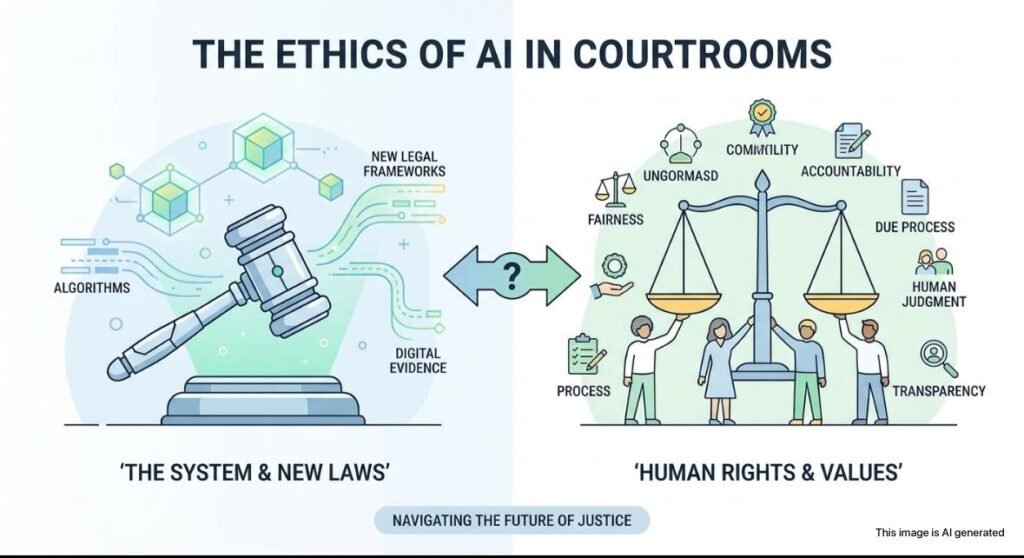
Artificial Intelligence (AI) has revolutionized several areas of society, including healthcare, education, and law. In recent years, courts have started to investigate the use of AI-powered technologies in judicial decision-making, legal research and analysis of evidence, case management and sentencing recommendations. Such innovations hold promise for increased efficiency and decreased judicial backlog, but raise ethical and human rights questions.
The swift adoption of AI has ignited discussions among legal scholars, government officials, human rights advocates and legal practitioners in the courtroom.This has led to debates amongst legal scholars, government officials, human rights advocates, and judges in the courtroom. Equality, accountability, privacy, transparency, and discrimination have come to play a large role in discussions that pose questions of the future of justice. Therefore, several countries and international institutions have amended earlier legislation and regulations and have enacted new laws and regulations concerning the use of AI in the judicial process, in order to draw attention to these issues and concerns.
Understanding AI in Judicial Systems
AI in courtrooms often refers to the use of computer systems that are capable of performing particular tasks that traditionally require human intelligence. These tasks include legal research and document review. It helps in predictive analysis of cases. It provides a clear view of assessment in bail procedures and sentencing decisions. Evidence examination is one of the essential tasks of AI. Case management and scheduling play an important role in it.
AI has been considered as a tool to improve efficiency, expedite legal proceedings, and reduce costs according to the authorities. However, the decisions taken under the roof of the judiciary clearly and rapidly affect fundamental rights, making moral and ethical suggestions considerate.
Ethical Concerns Surrounding AI in Courtrooms
1. Algorithmic Bias and Discrimination
Algorithmic bias is a key concern in today’s world. AI requires previous and historical data to learn from. If the AI is trained on such factors that contain racial discrimination and inequality. It will definitely show the misuse of new technology and the enhancement of AI.
Such bias can violate fundamental human rights principles, including equality before the law and non-discrimination.
2. Lack of Transparency
Several AI functions operate as “black boxes,” meaning their decision-making processes are difficult to analyse. If judges will depend on AI-generated suggestions without understanding how they will reach a conclusion, transparency in proceedings may be compromised.
The principle of open justice requires that legal decisions should be explained properly. It should make sense to citizens why these laws are made, especially when it comes to liberty, reputation and property.
3. Accountability Issues
In the field of law, accountability matters a lot. A person should know who is responsible for any act done by the other. If AI gives wrong decisions, then justice will be compromised. It will raise accountability questions and who will be liable for that, a judge, a software developer, a government or will the AI be blamed.
Traditional legal systems are based on human methods, and therefore, they are accountable. The introduction of AI will complicate responsibility when errors occur.
4. Privacy and Data Protection
AI needs large amounts of personal data to function. Records of the court often contain essential and sensitive information. Not handling such data with care may lead to privacy violations.
5. Threat to Judicial Independence
Exorbitant dependency on AI recommendations may subtly impact judges. Even if judges retain final authority, there will always be a risk that AI-generated outputs may not be accurate, leading to “automation bias” where human decisions will defer to machine suggestions.
New Laws and Regulatory Developments
Recognising these concerns, governments and international organisations have begun to develop legal frameworks to regulate AI within judicial systems.
The European Union has implemented one of the most comprehensive AI regulations through the AI Act.
The Act includes AI systems based on risk levels, which require transparency obligations, documenting requirements, etc.
2. UNESCO Recommendation on the Ethics of Artificial Intelligence
UNESCO adopted a global framework that emphasises human dignity, transparency, protection of privacy, etc.
These principles encourage authority to place human rights at the centre of AI governance.
Right to Privacy
AI-automated legal systems process personal information. Human rights protections should look after how such data is collected and used lawfully.
Human Dignity
Human dignity is a foundation of human rights. Critics argue that purely powered judicial decisions risk treating individuals rather than human beings with unique situations.
Important Case Laws:
State v. Loomis (2016) – United States
This landmark case involved the use of the COMPAS risk assessment algorithm during sentencing.
Eric Loomis argued that the proprietary nature of the software prevented him from understanding and challenging the basis of the risk assessment used against him.
The Wisconsin Supreme Court allowed the use of the tool but emphasised that it should not be the sole basis for sentencing decisions.
Houston Federation of Teachers v. Houston Independent School District (2017)
Teachers challenged an evaluation system that relied heavily on algorithmic assessments. The court recognised that individuals have a due process interest in understanding decisions affecting their rights and careers.
Conclusion
The impact of AI on courtrooms represents a crucial shift in how justice is being meted out. AI has great potential for efficiency, resource management, and consistency, but also comes with its own set of ethical and human rights issues. There are concerns, such as algorithmic bias, privacy violations, and transparency and accountability gaps, that have led to the establishment of new laws and legal structures by authorities and international organisations.
International ethical guidelines and the European Union AI Act are examples of rising regulations aimed at maintaining the human oversight of AI, and its use as a tool for humanity. Thus, justice cannot be limited to data analysis and predictive models but must be characterized by fair, accountable and respect for the dignity of human rights. Success will be driven by how well technology and the core values of justice coexist in courtrooms, as will the future of AI.
Frequently Asked Questions
1. What is AI in courtrooms?
AI in courtrooms refers to the use of artificial intelligence technologies to assist with legal research, case management, evidence analysis, risk assessment, and judicial decision-making.
2. Why is AI in courtrooms controversial?
AI is controversial because it may produce biased outcomes, lack transparency, threaten privacy, and undermine accountability in judicial processes.
3. What is algorithmic bias?
Algorithmic bias occurs when AI systems generate unfair or discriminatory results due to biased training data or flawed design.
4. Can AI replace judges?
No. Most legal experts and regulatory frameworks emphasize that AI should assist judges rather than replace human decision-making.
5. How do new AI laws protect human rights?
New laws require transparency, human oversight, accountability, bias testing, and data protection measures to ensure AI systems respect fundamental rights.
References:
- UNESCO Recommendation on the Ethics of Artificial Intelligence. (2021). Recommendation on the Ethics of Artificial Intelligence. United Nations Educational, Scientific and Cultural Organisation.
- UNESCO Ethics of Artificial Intelligence. (2024). Ethics of Artificial Intelligence. UNESCO.
- UNESCO Recommendation on the Ethics of Artificial Intelligence Overview. (2023). UNESCO.
- EU AI Act – Classification Rules for High-Risk AI Systems. (2024). European Union Artificial Intelligence Act.
- Administration of Justice and Democratic Processes under the EU AI Act. European Commission AI Act Service Desk. (2025–2026).