This article is written by Jeyashri R, a student at Government Law College, Madurai, Tamil Nadu. This article examines the new Labour Codes applicable to the Information Technology (IT) Sector.
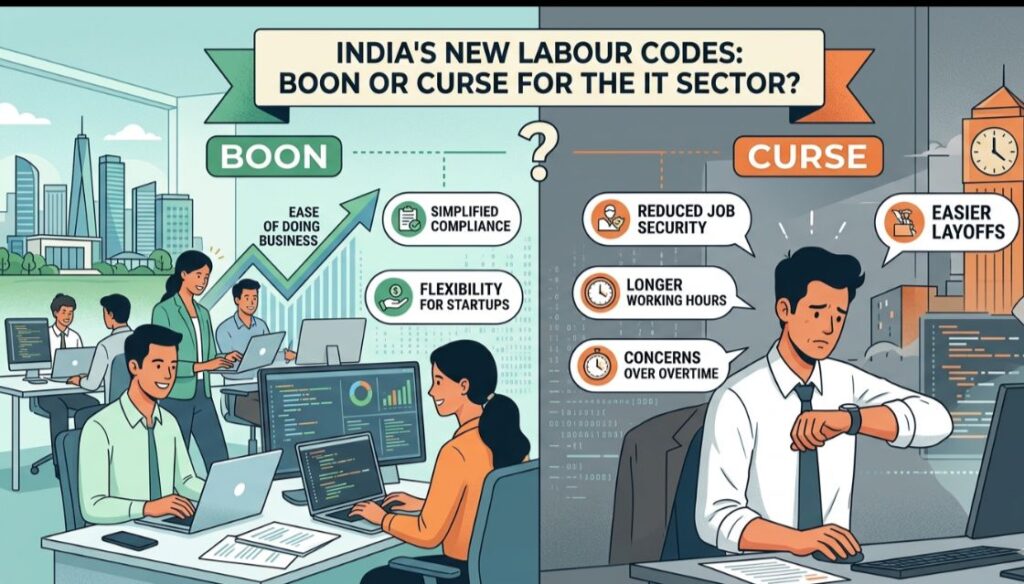
Globally, the digital revolution is reaching its peak. Countries were competing to monopolise technology development, especially in Information Technology.
However, the Indian Information Technology ecosystem is well-built and has a huge manpower. Therefore, protecting the rights of IT employees is crucial in India for technology development.
As a result, the Indian IT industry can achieve a target of $ 500 billion by 2030, as per the Electronics and Computer Software Export Promotion Council’s statistical yearbook 2024.
MANPOWER EMPLOYED IN THE INFORMATION TECHNOLOGY SECTOR
According to the Electronics and Computer Software Export Promotion Council’s statistical yearbook 2024, the manpower employed in information technology sectors is classified into 3 major categories:
1. Direct employment – Around 5.4 million people were directly employed.
2. Indirect employment – Approximately 15 million people were employed indirectly.
3. Gender diversity – Women constitute around 36% of the workforce.
The manpower in the IT sector includes software engineers and other non-technical teams.
PROTECTION FOR THE IT SECTOR WORKFORCE
In India, the workforce of the Information technology sector is primarily protected by the following Acts:
1. The Constituent of India, 1950.
2. The Code on Wages, Industrial Relations, Social Security, and Occupational Safety, Health and Working Conditions Code, 2020. These 4 new Labour law Codes subsumed 29 Acts.
Internationally, there were several conventions to protect labour rights. Some of them are:
- Universal Declaration of Human Rights.
- The International Covenant on Economic, Social and Cultural Rights.
- The International Convention on the Elimination of All Forms of Racial Discrimination.
- The Declaration on the Elimination of Discrimination against Women.
- The Convention on the Elimination of All Forms of Discrimination against Women.
- International Labour Organisation.
NEW LABOUR CODES AND THE IT EMPLOYEES
The new Labour codes protect IT employees employed either in on-site, hybrid or work-from-home. Notably, Section 2 (36) of the Code of Social Security, 2020, defines “home-based worker”.
It includes a person engaged in the production of goods or services for an employer in his home or other premises of his choice, other than the workplace of the employer, for remuneration.
In addition, it includes persons irrespective of whether the employer provides the equipment, materials or other inputs to the employee. Most Starts-ups do not provide equipment to employees. Therefore, the new codes will benefit the IT employees employed in Starts-ups.
FAIR WAGE PROTECTION
The Code on Wages, 2019 primarily enacted to ensure fair wages for the IT employees. Some of them are:
- Section 3 of this Code prohibits discrimination on the grounds of gender in providing just and favourable wage to employees.
- According to Section 4, every employee has the statutory right to receive wages, which shall not be less than the minimum rate of wages notified by the appropriate Government.
- Mostly, IT employees work based on project targets. So sometimes they tend to work more than the normal working hours. In such a case, the employer shall pay his or her for every hour or for part of an hour so worked in excess. The overtime rate shall not be less than twice the normal rate of wages.
- Generally, IT employees are employed on a monthly wage basis. Section 17 of this code protects them by imposing a statutory duty on employers to provide timely payment of wages. It states that monthly wages must be provided before the expiry of the seventh day of the succeeding month.
- This code provides the eligibility and disqualification for bonus entitlement. This provision is one of an example to secure accountability of employees to the employers and vice versa.
SOCIAL SECURITY PROTECTION
(i) Need for Social Security.
According to the International Labour Organisation, worldwide, out of five people, only one has adequate social security coverage. Therefore, it is needed for the hour to secure social security benefits to IT employees.
(ii) Basic understanding of social security.
The understanding of the social security benefits is necessary to achieve the Sustainable Development Goals in society. The term “Social security” is the protection that a society provides to individuals and households.
As a result, they can receive adequate access to health care. In addition, it guarantees income security, particularly in cases of old age, unemployment, sickness, invalidity, work injury, maternity or loss of a breadwinner.
(iii) Indian social security standards
In India, the Code of Social Security, 2020, provides social security to employees, including IT employees. Some of them are:
- Generally, the hiring model of employees in the IT sector is a Fixed Term Employee (FTE). This new code reduced the eligibility requirement for gratuity for Fixed Term Employee (FTE) from five years to one year under Section 53 of this code.
- India is a strong, culture-focused country. The definition in Section 2(33) of this Code was expanded. They included the father-in-law and mother-in-law of a female employee.
But the concern is that the definition of family to receive benefits did not include the father-in-law and mother-in-law of a male employee. Therefore, the parliament must include them to ensure a labour code as gender neutral legislation.
(iv) Social Security benefits of pregnant women
According to Section 60, a pregnant woman has the right to receive maternity benefits. In the case of women in work-from-home-based employment, maternity benefits are based on the mutual agreement between the employer and the employee.
As per Section 54, the total period for maternity leave shall not exceed twenty-six weeks. Notably, Section 69 protects pregnant women from unlawful deduction of wages. The establishment must ensure nursing breaks and crèches facility subject to this code.
THE OCCUPATIONAL SAFETY, HEALTH AND WORKING CONDITIONS CODE, 2020
(i) Protections under this Code
This Code protects various employees, including IT employees. They were:
1. To ensure just and favourable conditions of work.
2. Safe and healthy working conditions.
3. Rest, leisure and reasonable limitations of working hours.
4. Welfare of employees.
5. Working rights of women.
(ii) Protection for women
Night shifts were common in the IT Sector. Section 43 of the Code allows women to work in night shifts before 6 a.m. and beyond 7 p.m, with their consent.
However, the employer must ensure adequate arrangements for safety, transportation and other essentials required for their need.
(iii) Protection for transgenders
Sections 23 and 24 of the Code provide necessary arrangements for separate latrine, urinal, bathing and Locker room accommodations for transgender individuals. This is one of the milestones in Indian labour law reforms.
(iv) Duties of employers
Section 6 of this Code makes the employer accountable by prescribing duties. For example, an employer must issue a letter of appointment when appointing an employee.
(v) Duties of employees
According to Section 13 of the Code, employees must take reasonable care to protect their health and safety.
(vi) Ease of doing business
This Code provides ease of doing business through Electronic Single registration, Single return and Single all India licences. It will be valid for 5 years.
CASE LAWS
Air India v. Nargesh Meerza, AIR 1981 SC 1829 case
The Court struck down the termination of women employee due to her “first pregnancy”. It established that pregnancy is not a ground for terminating the employment of a woman.
Olga Tellis & Ors v. Bombay Municipal Corporation & Ors. Etc, 1986 AIR 180 case
It was observed that the Right to life and the right to work are integrated and independent.
CONCLUSION
This article examines the provisions of the new labour laws dealing with the workforce in the IT sector. The Indian labour Codes are gender neutral and ensures accountability between both employer and employee.
However, the new labour Codes raised several concerns. But through the effective implementation of these new Codes, the workforce of the IT Sector will benefit. As a result, the Indian IT revolution will reach a new high in the world economy.
FREQUENTLY ASKED QUESTIONS
Which Article in the Indian Constitution deals with Conditions of Work?
Article 42 of the Indian Constitution deals with securing just and humane conditions of work and maternity relief.
What are the statistics of engineering graduates in India?
According to the Electronics and Computer Software Export Promotion Council statistical yearbook 2024, approximately 1.5 million Engineering Graduates pass out every year in India.
What are the reforms made in the new labour laws regarding punishments?
Mostly, the nature of punishments is civil in nature rather than imposing criminal punishments.
Whether Gig and unorganised workers are covered under the new labour laws?
They are covered under the new Codes. For example, the Social Security Code, 2020, provides for creating a national digital platform (NDUW) for unorganised workers.
What is mean by FTE?
Section 2 (34) of the Social Security Code defines it. It means the engagement of an employee on the basis of a written contract of employment for a fixed period.
REFERENCES