Oladejo Afeezat Oluwatosin wrote this article. This Article Disscused about Digital authoritarianism is a term that describes how governments use tools to watch, control, and limit what people do online. This can include shutting down the internet, blocking websites, spying on people using spyware, filtering content, gathering large amounts of personal data, and tracking individuals who are seen as political threats or critics.
Introduction
Digital technologies have revolutionised the way people interact with each other, and how they get and consume information and organise and engage in politics. Digital technologies such as the Internet have created new pathways for both freedom of expression and access to information. But governments can also use digital technologies to control and monitor citizens, leading to what is called digital authoritarianism.
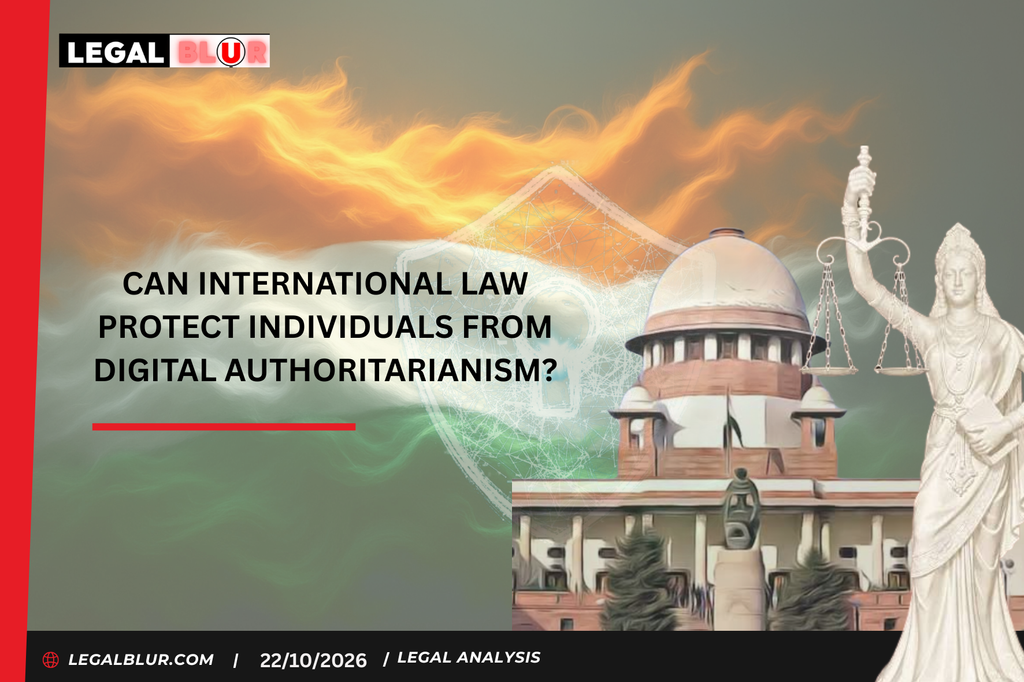
Digital authoritarianism is a term that describes how governments use tools to watch, control, and limit what people do online. This can include shutting down the internet, blocking websites, spying on people using spyware, filtering content, gathering large amounts of personal data, and tracking individuals who are seen as political threats or critics. These actions often happen under the guise of security or order. They can seriously harm freedom of expression and privacy.
The following discussion will explore whether international law offers protection against authoritarianism. It will look at existing rules and standards to see if they are strong enough to stop governments from using technology to control their citizens. It will also consider if these laws are enforced and whether they are applied across different countries.
Broadly speaking, international human rights law offers an international legal framework for protection from digital authoritarianism, yet there are considerable constraints on it.
DIGITAL INTERNATIONAL HUMAN RIGHTS FRAMEWORK
The main legal way to protect people from authoritarianism is international human rights law.
We are given the right to be protected from interference with our privacy, family, home, and private messages under Article 12 of the Universal Declaration of Human Rights (UDHR); our freedom of thought and speech is protected under Article 19. Protection for these rights is also in the ICCPR.
Article 17: No one shall face illegal interference with their privacy, family, home, or messages.
Article 19: Every person shall have the right to have thoughts, without being disturbed; every person shall have the right to speak freely.
Articles 21 and 22: The right to gather peacefully; freedom to join groups.
With regard to digital authoritarianism, the critical issue is whether the rights established under international human rights law still have the protective reach when exercised through digital platforms.
The Human Rights Committee (which monitors the ICCPR) has stressed the significance of the right to freedom of expression to transparency, accountability, and democratic governance, and has acknowledged the expansive nature of the right to freedom of opinion and expression enshrined in Article 19.
As a result, it is unlikely that States will be able to bypass their human rights duties by utilizing digital technology to conduct an interference. Internet censorship, digital monitoring, and blocking of online communication could therefore be evaluated under the standards of international human rights law.
THE RIGHT TO PRIVACY AND DIGITAL SURVEILLANCE
Among the most obvious rights that are threatened by digital authoritarianism is privacy. Advancements in tech allow governments to garner a significant amount of information about their citizens. Though not typical of conventional surveillance, information technology could enable governments to monitor communications, gather metadata, or access a person’s device through malware or spyware. In this way, a government could conduct surveillance by bulk collection or by individual targeting.
Art. 17 ICCPR may be summarized as follows: “No one shall be subjected to arbitrary or unlawful interference with his privacy, family, home or correspondence, nor to unlawful attacks upon his honor and reputation”. The above provision does not imply that any form of surveillance is per se unlawful. Invasive surveillance infringes upon individuals’ privacy and must be justified. The European Court of Human Rights has handed down several important rulings on State surveillance. In Roman Zakharov v Russia, the applicant complained about a secret system used to intercept all communications sent over mobile telephones. It considered whether the Russian system of secret surveillance and all the protective measures designed to safeguard it were compatible with the applicant’s right to respect for his private life and correspondence under the European Convention on Human Rights. It found that there were not sufficient safeguards in the system of surveillance in this case.
In the more recent past, the question of State surveillance has arisen once again to the detriment of the right to privacy and human rights. In Javadov and Others v Azerbaijan, the Court issued a communication of applications concerning alleged covert surveillance through Pegasus spyware. The applicants are journalists, lawyers, activists and human rights defenders. The case is an example of the modern challenges brought by advanced spyware and the impact on privacy and freedom of expression. But where persons are subject to internationally protected privacy rights, international law may not always offer an immediate or effective solution.
I think International and regional mechanisms face institutional limits and a person may have trouble getting redress for digital surveillance when local solutions are missing or do not work, especially in cases of digital surveillance. I think Freedom Of Expression And Censorship Of The Internet is an issue.
Another common manifestation of digital authoritarianism is censorship and internet shutdowns. Internet censorship impinges on a number of the same rights and freedoms as limitations on traditional media.
Article 19 of the International Covenant on Civil and Political Rights ensures the freedom of opinion and expression.
This includes the right to seek, receive, and share information and ideas in all forms.
The same right is also protected by the African Charter on Human and Peoples’ Rights. That document has a section called Article 9 that guarantees freedom of expression.
The African Commission on Human and Peoples’ Rights has stated that these protections also apply online. The Commission’s Declaration of Principles on Freedom of Expression and Access to Information in Africa holds that States should recognise the role that universal, non-discriminatory, accessible, affordable and meaningful access to the internet can play in facilitating the promotion of freedom of expression, access to information and other human rights. It also mentions that any limitations on access to the internet and digital technologies must be consistent with international human rights law and standards. The Declaration states that States should not knowingly allow or promote the disruption of access to the internet and other digital technologies targeting any section or all of a population.
Furthermore, the African Commission has made specific rulings concerning internet shutdowns on elections. In the 2024 Resolution on Internet Shutdowns and Elections in Africa, the Commission reiterated its position that “the right to freedom of expression and access to information” is enshrined in Article 9 of the African Charter, and was distressed about internet blackouts that violate such rights and may impact free and democratic elections. The effects of shutdowns, then, extend beyond freedom of expression. They also impact access to information, freedom of assembly and association, the press, education, business and political participation – critical considerations during elections in which the public uses digital networks to access information, communicate with others and engage in the political process.
Nevertheless, international law does not afford such absolute protection, and many governments continue to impose restrictions on internet speech. In some circumstances, restrictions are therefore tolerated provided they meet the standards set by international human rights law. The problem appears when governments take examples, like security or public order, and then stretch them to other restrictions that stop real criticism.
DIGITAL TECHNOLOGY, ASSEMBLY AND POLITICAL PARTICIPATION
It can be seen that people are increasingly using spaces to organise, talk and act in the political world. Such State surveillance and restrictions on digital communication could thus impact the rights to peaceful assembly and association.
Both the ICCPR and the African Charter also,
under their respective articles 21 and 22, 11 and 10,
Respectively, enshrine the rights to freedom of peaceful assembly and of association. African human rights framework also acknowledges the existence of these rights online.
The African Commission has recognised that the right to peaceful assembly also includes digital spaces
and the use of information and communications technology,
and urged States not to restrict internet access, websites or telecommunications networks, in the interest of preventing peaceful assemblies.
Thus, the consequences of digital authoritarianism extend beyond the right to free expression and the right to information. Fear of being monitored and the perception of restrictions on access to information and expression
can lead to a reduction of organisation and self-organisation, dialogue and legitimate political action. It can also lead to a decline in political speech or collective action. I see that digital authoritarianism threatens to roll back human rights.
I observe that one internet shutdown can affect freedom of expression,
access to information, assembly, association and political participation at once.
INTERNATIONAL LAW LIMITATIONS
Several mechanisms within international human rights law serve to protect individuals against digital authoritarianism. However, these protections have limitations. Implementation international human rights protection is usually largely dependent on domestic implementation and remedies. The rights set out above are primarily recognised under international law,
but the individual has to turn to domestic courts or regional human rights institutions for the effective enforcement of them.
Thus international protection in this area also relies heavily on the strength of domestic and regional institutions.
A second practical challenge for international human rights law is the challenge that is posed to it by technological development. Numerous primary international human rights treaties predate technologies like social media, wide-scale digital surveillance, and modern spyware.
While traditional rights can be placed in new technological contexts,
some new developments may create difficulties that were not specifically anticipated in the original instrument.
Third countries may say that they have a reason to look into spaces and
to set limits on what people do online when it comes to national security, keeping things orderly, or stopping crime. International human rights law says that some rights, like the right to speak freely, can have limits. These limits still need to follow rules like being legal, necessary, and not too extreme. Third, enforcement problems may diminish the practical impact of international law.
States continue to be central players in the international legal order,
and there are many instances where international human rights structures lack the authority to enforce their decisions without delay.
Indeed, the recognition of an international right does not always lead to
an effective remedy for the violation of that right.
THE ROAD AHEAD
International law can be more effective in dealing with authoritarianism if we use the right approaches. First countries need to make sure that surveillance programs are built on laws and have independent checks. These checks should include legal or other kinds of protections.
Second, any limits on communication and free speech must have a good reason and
follow the rules of being legal, necessary, and not too extreme. We should be very careful about shutting down the internet or watching everyone without any focus.
Third, regional human rights institutions such as
the African Commission on Human and Peoples’ Rights should continue to build on norms
that extend existing human rights protections to new digital devices and services in a way
that mitigates the risks of technology- created human rights gaps.
I think the tech sector plays a role.
Companies that record, store, or process personal data must put safeguards in place so
that the rights and privacy of users are protected. More transparency about government requests for data and limits on content can also make accountability stronger.
CONCLUSION
I believe the international human rights system, which includes
human rights treaties and regional human rights instruments, can give some protection against digital authoritarianism, but it is not complete.
The UDHR, ICCPR, African Charter, and the laws and principles set by international and regional human rights bodies protect some of the rights
Digital authoritarianism often hurts rights such as privacy, association, expression, assembly, and access to information. The use of digital technologies does not abandon human rights standards. It is simply possible to apply existing legal principles to new types of digital interference, although
the practical benefit of international law is lessened where individuals cannot access effective remedies,
States apply national security justifications for disproportionate restrictions,
and rapid technological change brings about new types of interference that the law cannot cope with.
At the end of the day, international law offers an important bedrock
for how people can be safeguarded from digital authoritarianism.
However, giving protection is not enough. Strong local organizations, checks, good solutions, and constant explanation of digital human rights rules are also important to protect against technology hurting rights.